
Board Game Academics, March 2026
Published in Vol 3. Issue I.
DOI: https://doi.org/10.70380/qz83n4r6k1b5y
Samantha Baugus, Ph.D.
Embry-Riddle Aeronautical University
Ozarks Technical Community College
INTRODUCTION
I would like to thank my good friend Adam for suggesting the title for this article and my party, going strong since 2019.
On October 23, 2011, the blog DMing with Charisma published “D&D Stats in Simple Language.” The goal of the post was to provide guidelines for interpreting ability scores from the fifth edition of the Player’s Handbook (PHB5e) in practical, common-sense terms. The introduction states, “[W]e try to draw conclusions about [ability scores] based on hard numbers…The problem is that this still leaves[s] a lot to interpretation.” The question is, what does a Charisma score of twelve mean in terms of playing a character rather than just the actions a player can take, and the chances of those actions’ success? The writer meticulously reviews all six abilities and translates an abstract number into actionable play. For example, a creature with a strength of fourteen would be “[v]isibly toned” and able to “throw small objects for short distances” (“D&D Stats in Simple Language”).
In a Reddit post commenting on the article, the user writes, “[T]his chart isn’t intended or all that logical when you use it for creature types that are not available player races” (theRapkin)1. The assumption is that the chart offers “an explanation of each modifiers [sic] meaning for a medium sized humanoid,” which is the most common kind of player character (theRapkin). The stat block for the common house cat serves as an easy example of this illogic.
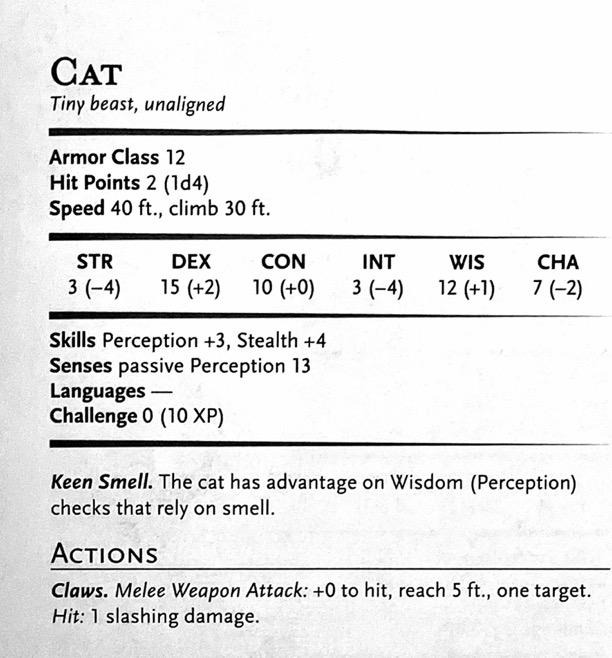
Readers may be surprised to learn that, according to PHB5e and the handy Reddit post, cats’ charisma (which is 7, meaning 2 is subtracted from ability checks) equates to “terribly reticent, uninteresting, or rude” (theRapkin). While we have most likely experienced an unfriendly cat out-of-game, this does not seem enough to categorize an entire species. As charisma controls the ability to persuade, I find it hard to believe that all cats in the D&D world cannot successfully beg for head scratches or treats. A cat’s strength would be denoted as “being able to be knocked over by a strong breeze” (theRapkin). A Strength of three, in this system, would only make sense for tiny (literally not technically) creatures, like butterflies or mice. Based on my personal—and physical—experience of trying to bathe an unwilling cat, most members of Felis catus, if determined enough, could take me, a size Medium Human, in a fight and probably win. My point here is that these abilities are based on something other than actual, observed abilities. To “properly” play the game, a player would have to sacrifice their lived experience of observing and interacting with cats to comply with the rules, or, as I hope to demonstrate in this article, an anthropocentric application of those rules.
DEFINING ANTHROPOCENTRISM
Before continuing, I want to address two definitions of anthropocentrism. The first is what Aigner, Piper, and Grimm call epistemic anthropocentrism: “the inevitability of the human perspective, without implying human superiority” (59). For humans, anthropocentrism is an inescapable reality, as we cannot just stop being human, stop having a human perspective, stop seeing, hearing, feeling, and being in the world with human bodies. This is the default assumption in creating D&D—everything must be oriented around the human players for the game to have coherence, goals, and engagement with said human players. Epistemic anthropocentrism is a neutral (and even self-evident) assertion, but one worth considering, particularly in the context of a game that asks players to role-play as other species, because epistemic anthropocentrism can quickly slide into moral anthropocentrism.
Moral anthropocentrism prioritizes humans above all other animals, and the presumptive nearness of nonhumans to a human standard determines their moral value relative to humans. Nik Taylor argues that “while the human element cannot be avoided in any human interpretation of others (and this includes interpretations of other humans), it need not necessarily lead to, or stem from, an assumption of human superiority” (265). Aigner, Pieper, and Grimm ask: “ [I]f the human perspective is inevitable for us, do we have an alternative, epistemologically non-anthropocentric way of problematizing the suffering of animals?” (59). I want to answer these questions through an exploration of the representation of beasts2 and animalizing within D&D.
These posts are only in response to, and in alignment with, the inherent anthropocentrism of D&D, which is my core concern here. theRapkin’s clarification that their interpretations could only be applied to size Medium humanoid player characters implicitly acknowledges the game’s anthropocentrism. I take as my object of study beast statistic blocks to illustrate this mandated anthropocentrism and how it supports and perpetuates hierarchical and supremacist notions. I argue that these choices limit gameplay in important ways and that in upholding this hierarchy, Wizards of the Coast is undercutting their diversity, equality, and inclusion initiatives and curtailing the potential for radical, collaborative performance.
ANIMALIZING RACISM IN D&D5E
Many scholars (see Ko; Peterson; Spiegel) and activists (see Adams; Jones; Ko and Ko) have commented extensively on the use of animalizing (ascribing animal qualities to humans, on the assumption humans are not also animals) as a means of denigration to allow for and justify the exploitation of other humans. Examples are probably immediately jumping to mind, but some are referring to women as bitches, Black humans as apes, or immigrants as an infestation. Highlighting negative animalization is a key rhetorical tactic for human rights activism as a means of inspiring sympathy and action. This is the cultural value of moral anthropocentrism; it provides the tools and language to deny humans moral value and consideration by assuming non-human beings are inherently less than.
In recent years, Wizards of the Coast and the Dungeons and Dragons franchise have faced severe criticism for their stereotypical and racialized representations of in-game races and groups. Orcs are of particular interest for this study, and the issues identified rely on racial animalization. The Monster Manual for the fifth edition of the game (MM5e) reads: “Orcs are savage raiders and pillagers with stooped postures, low foreheads, and piggish faces with prominent lower canines that resemble tusks” (244, emphasis added). The words used to describe orcs are copied from descriptors of any number of Others: “Savage” is a derogatory term commonly applied to indigenous or dispossessed peoples to disparage and belittle their distinctive cultures and civilizations in relation to colonizing humans. MM5e further emphasizes this when orcs are described as seldom settling permanently as they need to “dwell always within striking distance of new targets” due to their “ lust for slaughter” (244). The fear of violent incursions into “civilization” by nomadic (or assumed nomadic) peoples is reminiscent of “attacks” from victims of colonization and genocide (see Humphreys). Further, the physical description of orcs bears a striking resemblance to apes, a common derogatory comparison for people of African descent.
To add a final racist flourish, the description ends with a section entitled “Orc Crossbreeds:” “Luthic, the orc goddess of fertility…demands that orcs procreate often and indiscriminately… The orcs’ drive to reproduce runs stronger than any other humanoid race, and they readily crossbreed with other races” (Monster Manual 245). This clever bit of euphemistic dancing heavily implies that orcs satisfy more kinds of lust than that of slaughter during their “savage” raids. This summons long-standing, deeply offensive stereotypes that “less developed” humans—i.e., not of White European descent—are unable to control their appetites for sex. In D&D5e’s rules-as-written (RAW), orcs are not available as a playable species, but half-orcs are. In the description of half-orcs, the RAW contradicts itself, claiming half-orcs come from alliances between humans and orcs “sealed by marriage,” although the description quickly adds that half-orcs’ “human blood gives them an edge over their full-blooded orc rivals” (Player’s Handbook 40). On the opposing page, the RAW further clarify that “[e]ach half-orc finds a way to gain acceptance from those who hate orcs” through self-erasure, fawning, or violence and isolation (41). The RAW for D&D5e struggle to present a brutish race without resorting to racist stereotypes or reifying racist hegemonies3.
These racist representations have long been noted by players, and critiqued and analyzed thoroughly by scholars (Allen; Cote and Saidel; Ferguson; Holmes; Premont and Heine; Stang and Trammell; Hoffer; Yessler and Craig; Young). In 2020, during the Black Lives Matter protests in the United States, Wizards of the Coast released a (now deleted) statement promising “to address legacy D&D content that does not reflect who we are today.” The statement includes a list of proposed changes to reflect the stated ethos of 5e to “depict humanity in all its beautiful diversity,” specifying that “human” means “everyone.” They specifically mention orcs, drow, and Vistani as problematic, noting the use of “description painfully reminiscent of how real-world ethnic groups have been and continue to be denigrated.” The 2024 overhaul of the game did bring significant changes to orcs. The largest is that orcs are no longer classed as monsters but as a playable species. All animalizing descriptors are removed, and the half-age art presents a happy orc family traveling through a desert as opposed to the MM5e art of a grizzled war band traversing a snowy mountain.
While these changes are welcome and much needed, the underlying anthropocentrism is not addressed. The issue with orcs is the animalized racist representation; an issue that is made explicitly problematic when numerical values are attached to these animalized traits. This numerical value is directly translated into value as a person, meaning, in the RAW of D&D, a playable species. The animalization is removed from orcs but not from the game. In fact, the animalizing traits must exist within the game as “lesser” to ensure that the newly non-animalized orcs are seen as “better,” i.e., closer to human and thus deserving of moral value, in other words, maintaining moral anthropocentrism.
Excavating embedded “ values and influences” is key to “how players explore and construct meaning” (Garcia 233). Garcia writes, “ By understanding the embedded values of virtual worlds, this study explores how systems shape specific forms of play” (233). Garcia charts some of the sexist and racist implications of the game, embedding his analysis in the context of systems—“[C]ritical emphasis on how inequalities—particularly around race and gender—are embedded in cultural systems remains vital” (Garcia 234). This nuance shifts the object of study from how players interpret the gaming system in exclusionary or inclusionary ways to how the system itself permits and perpetuates inclusions and exclusions4.
THE FALLACY OF THE HUMANIST SUBJECT
Aigner, Grimm, and Pieper turn to Cary Wolfe’s deconstructive notions of posthumanism, which is “primarily based on Derrida’s critique of [the] logocentric notion of the subject,” which “identifies humans as being humans, in contrast to animals, and therefore, it effectively avoids seeing human beings as human animals” (Aigner et al. 60). The persistence of the humanistic definition of the human subject is the concern: “As long as the notion of the ‘human’ is accepted as a ‘fact,’ we reproduce—on an epistemic level—what we attempt to overcome: anthropocentrism” (Aigner et al. 60). The very premise of a roleplaying game asks players to imagine themselves otherwise and D&D heavily encourages players to imagine themselves as non-humans. Simultaneously, the notion of “human” is maintained as a core tenet of gameplay. Thus, even in creating a non-anthropocentric environment, anthropocentrism is maintained. The very notion of the uniquely human, which is not animal, is what undergirds epistemic anthropocentrism. This humanist notion also supports the exclusionary practices that Wizards of the Coast is trying to combat. The single and specific notion of the human is a tool through which so many are denied human status. Therefore, Wizards of the Coast is already implicated in this work and critique, even as they stubbornly foreclose anti-anthropocentric possibilities. Moral anthropocentrism will always be reproduced via clinging to epistemic anthropocentrism. There is no way to actually combat moral anthropocentrism and its attendants without confronting a priori epistemic anthropocentrism and an anthropocentric episteme. Moral anthropocentrism is a tool to give (or take) human moral status and consideration and therefore will always require the human as the ultimate standard, the true measure of all things. An anthropocentric episteme asserts that because we do not (some would argue cannot) conceptualize a standard that is not oriented around the human moral, anthropocentrism is a given. Remaining in an anthropocentric episteme means relying on moral anthropocentrism to argue for moral consideration, which means that the discourse of animalization will remain available. “The animal” is a position, not a biological identifier, and is the absolute other of the human, capable of being occupied by anyone of any species.
Wizards of the Coast is concerned with inclusivity but resists any question of the mechanisms of exclusion through an insistence on stark, anthropocentric divisions. This is not to disparage their work—for those among us who have been denied access to the privileged position of being the “I” of the Enlightenment human subject, efforts to be included in that category and to provide ways for humans to be included in that category are not to be dismissed. What I want to highlight is that this does nothing to move beyond humanism itself and does more to reify it than resist it. In maintaining the hierarchical formation between human(oid) and beast, D&D leaves the structure of humanism in place and therefore still available for abusing and denigrating cultures, people groups, and players.
In The Animal That Therefore I Am, Derrida’s emphasis is on deconstructing the humanist notion of the subject, a version of the human that transcends animality to achieve a higher state of self-knowledge and moral certainty. In D&D, this transcendence is assigned a numerical value with ability scores. Derrida asks, “[W]hether what calls itself human has the right rigorously to attribute to man, which means therefore to himself, what he refuses to animal, and whether he can ever possess the pure, rigorous, indivisible concept, as such, of that attribution” (Derrida 135). Derrida’s critique, therefore, is of the uniquely autonomous human liberal subject and the hierarchical distinctions that create and support that subject, rather than asserting moral principles or the moral value of nonhuman beings.
A POSTHUMAN GAME
Cary Wolfe used posthumanism to recognize “the existence of nonhuman subjectivity in the sphere of living things” (Wolfe 47). The posthuman subject is one without distinctive boundaries, one that cannot rely on any a priori hierarchies to define itself; the posthuman subject is less of a subject in the ways we define it than it is a system that “opposes the fantasies of disembodiment and autonomy, inherent from humanism” (Wolfe xv). Wolfe expands Derrida’s critique of the human subject to consider what would come after such a subject. Posthumanism looks to what could be beyond humanism, beyond an anthropocentric episteme, and proposes a wider order of moral considerations or something else entirely.
In more literal and virtual ways than the non-game world, D&D realizes the relational creation of a holistic world. The fantasy of an autonomous subject is revealed as just that. While players and designers can and do cling to this desire, the reality of the game is deeply dependent. Players and their characters can only exist and be understood in the context of their relations to each other, the game world, and the game itself. The globally and locally collaborative and cooperative nature of D&D demands recognition, thus, of a posthuman subject. A D&D character should be a posthuman subject, one that is not reliant on humanist beliefs and assumptions about human supremacy and exceptionalism, but instead, one that embraces the mixed-up, messy virtuality of the game world and the improvisational and collective nature of play. But that opportunity is forestalled through the mandated anthropocentrism realized in the presentation of game elements embedded in an anthropocentric episteme, like the beast stat blocks.
With this theoretical framework, I return to the player analysis of the logic of using the same interpretation of ability scores for all creatures, as introduced at the beginning of the article. According to the players cited above, the intelligence spectrum starts at “Animalistic, no longer capable of logic or reason. Behavior is reduced to simple reactions to immediate stimuli” and ends with “Famous as a sage and a genius. Able to make Holmsesian leaps of logic” (theRapkin). This scale explicitly recognizes anthropocentrism of the game—the further away from “animal” a player gets, the “smarter” they become. To briefly return to the orc example, in Volo’s Guide to Monsters, orcs are introduced as a playable race but are mandated to have their intelligence reduced by two (120). The application of an intelligence penalty to such an animalized species points to a specific and anthropocentric notion of who can have intelligence.
Ravens are given a very low intelligence of two, even though examples of their intelligence (and the intelligence of all members of the Corvidae family) can be amply provided (Sax; Van Dooren; Emery; A. H. Taylor). Corvids can remember with a high degree of accuracy where they have cached food and other valuables (Bednekoff et al.; Bednekoff et al.; de Kort et al.); to plan for the future based on cached food stores (Bednekoff et al.; Grodzinski and Clayton); use tools (Bird and Emery); and mourn their dead (Dooren; Anderson; Iglesias et al.).
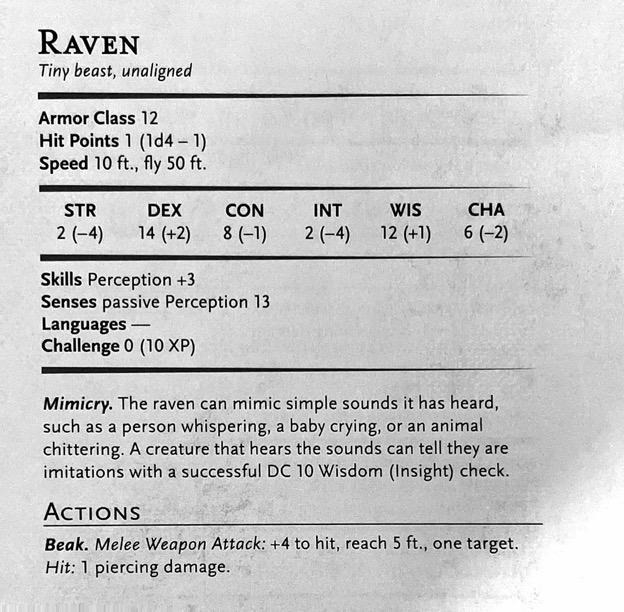
In giving ravens such a low intelligence, Wizards of the Coast is going against well-researched and observed behaviors of corvids to implement an anthropocentric notion of an animal being that can, in non-game settings, effectively hold its own against humans on humans’ own standards of intelligence. The point here is not that the creatures of D&D must be identical to their real-world counterparts, but that this disjunction reveals the insistence on anthropocentric structures. Intelligence, in D&D, is a one-dimensional attribute. There is only one kind and form of it, and it is not the kind and form that ravens have, so their intelligence score must be low, even though they show traits of intelligence that were thought to be exclusively human. The implicit argument of ability scores is that for a player character with an intelligence of 19 to be seen as highly intelligent, someone must have an intelligence of 2 to make the 19 mean something. This comparative and hierarchical logic is the underlying foundation for the game—as the PHB5esays, “[M]uch of what your character does depends on their ability scores,” revealing how the game is dependent on anthropocentric hierarchies (12).
There must be unambiguous definitions for these abilities, and those definitions are singular to the human. Because strength can only be understood in anthropocentric terms, there is no space for bird strength—or the myriads of “strengths” of birds that we humans are little aware of—to be different from human(oid) strength. Opening space for different and broader interpretations of ability scores within the logical contexts of a beast’s natural abilities would push gameplay not only to be more immersive but to be less anthropocentric and less exclusionary. In providing and allowing more specific definitions, interpretations, and applications of ability scores, the relational, multiple posthuman subject becomes clear. D&D characters and the D&D world should be seen as posthuman because of the overt ways in which the elements of the game and the people participating in the game are reliant and dependent on each other, showing more directly how our humanist notion of the subject is potentially disrupted. The D&D character cannot be an independent, autonomous, liberal subject because the character is so deeply and necessarily embedded in collaborative play. A strong D&D character is shaped and molded and realized in the context of the other players and the game world; all of which are shaped, molded, and realized in response to each other. But this posthuman reality is occluded by the irreducibly humanist trappings of the game’s rules, which always handicap the game’s progress towards its inclusive and progressive goals.
But also, as Garcia points out in his conclusion, a system can change. Garcia ends hopefully:
D&D is a system of possibilities. Although these possibilities have been constricted in initial iterations, the possibilities for revision, dialogue, and production have proven ripe in opening up and diversifying what gaming and roleplay mean and for whom. A critical understanding of how the foundational aspects of the system have shaped current forms of play only further enriches these contexts. (244)
I encourage my fellow players to consider how they explore non-anthropocentric possibilities within this game. My analysis does not touch on spells that summon beasts to help players, druids who can transform into beasts, and the many mundane uses a beast can serve a player, which would be strong entry points for players and scholars to explore alternative modes of play. I love this game because of the opportunities it provides for creation, creativity, and imagination, and I believe the longevity of the game is because of those very qualities. I hope the game continues to evolve toward more inclusionary and posthuman practices.
Appendix A: Diversity and Dungeons & Dragons
Statement posted on 06/17/2020 to the official D&D website
Dungeons & Dragons teaches that diversity is strength, for only a diverse group of adventurers can overcome the many challenges a D&D story presents. In that spirit, making D&D as welcoming and inclusive as possible has moved to the forefront of our priorities over the last six years. We’d like to share with you what we’ve been doing, and what we plan to do in the future to address legacy D&D content that does not reflect who we are today. We recognize that doing this isn’t about getting to a place where we can rest on our laurels but continuing to head in the right direction. We feel that being transparent about it is the best way to let our community help us to continue to calibrate our efforts.
One of the explicit design goals of 5th edition D&D is to depict humanity in all its beautiful diversity by depicting characters who represent an array of ethnicities, gender identities, sexual orientations, and beliefs. We want everyone to feel at home around the game table and to see positive reflections of themselves within our products. “Human” in D&D means everyone, not just fantasy versions of northern Europeans, and the D&D community is now more diverse than it’s ever been.
Throughout the 50-year history of D&D, some of the peoples in the game—orcs and drow being two of the prime examples—have been characterized as monstrous and evil, using descriptions that are painfully reminiscent of how real-world ethnic groups have been and continue to be denigrated. That’s just not right, and it’s not something we believe in. Despite our conscious efforts to the contrary, we have allowed some of those old descriptions to reappear in the game. We recognize that to live our values, we have to do an even better job in handling these issues. If we make mistakes, our priority is to make things right.
Here’s what we’re doing to improve:
- We present orcs and drow in a new light in two of our most recent books, Eberron: Rising from the Last War and Explorer’s Guide to Wildemount. In those books, orcs and drow are just as morally and culturally complex as other peoples. We will continue that approach in future books, portraying all the peoples of D&D in relatable ways and making it clear that they are as free as humans to decide who they are and what they do.
- When every D&D book is reprinted, we have an opportunity to correct errors that we or the broader D&D community discovered in that book. Each year, we use those opportunities to fix a variety of things, including errors in judgment. In recent reprintings of Tomb of Annihilation and Curse of Strahd, for example, we changed text that was racially insensitive. Those reprints have already been printed and will be available in the months ahead. We will continue this process, reviewing each book as it comes up for a reprint and fixing such errors where they are present.
- Later this year, we will release a product (not yet announced) that offers a way for a player to customize their character’s origin, including the option to change the ability score increases that come from being an elf, a dwarf, or one of D&D’s many other playable folk. This option emphasizes that each person in the game is an individual with capabilities all their own.
- Curse of Strahd included a people known as the Vistani and featured the Vistani heroine Ezmerelda. Regrettably, their depiction echoes some stereotypes associated with the Romani people in the real world. To rectify that, we’ve not only made changes to Curse of Strahd, but in two upcoming books, we will also show—working with a Romani consultant—the Vistani in a way that doesn’t rely on reductive tropes.
- We’ve received valuable insights from sensitivity readers on two of our recent books. We are incorporating sensitivity readers into our creative process, and we will continue to reach out to experts in various fields to help us identify our blind spots.
- We’re proactively seeking new, diverse talent to join our staff and our pool of freelance writers and artists. We’ve brought in contributors who reflect the beautiful diversity of the D&D community to work on books coming out in 2021. We’re going to invest even more in this approach and add a broad range of new voices to join the chorus of D&D storytelling.
And we will continue to listen to you all. We created 5th edition in conversation with the D&D community. It’s a conversation that continues to this day. That’s at the heart of our work—listening to the community, learning what brings you joy, and doing everything we can to provide it in every one of our books.
This part of our work will never end. We know that every day someone finds the courage to voice their truth, and we’re here to listen. We are eternally grateful for the ongoing dialog with the D&D community, and we look forward to continuing to improve D&D for generations to come.
- Player races are the types of beings a player can use to build their character, sometimes called playable races, The 2024 overhaul of the game changed “race” to “species.” As I prefer this term for reasons that will be made obvious later in this article, I’ve used it throughout. ↩︎
- All living things in D&D are divided into sub-categories of various kinds. Out-of-game animals are classed as “beasts,” which is a convenient way to achieve two things: First, differentiate the kinds of creatures under analysis here from other nonhuman being, and second, to allow the word “animal” to define a category, as will be discussed below. ↩︎
- At time of writing (January 2026), this statement has been preserved through the Internet Archive (https://web.archive.org/web/20200628191921/https://dnd.wizards.com/articles/features/diversity-and-dnd). The complete statement is in Appendix A for preservation. ↩︎
- A full, or even partial, explanation and explication of the human require far more space than I have. An operative definition is a single, cohesive subject who through self-defined and self-prescribed subjecthood determine itself superior to any and all who it deems lacking subjecthood. ↩︎
WORKS CITED
Adams, Carol J. The Sexual Politics of Meat – 35th Anniversary Edition: A Feminist-Vegan Critical Theory. 4th ed., Bloomsbury Academic, 2024. Bloomsbury Revelations.
Aigner, Andreas, et al. “‘Post-Anthropocentrism’ in Animal Philosophy and Ethics: The Disparity of the Prefix ‘Post.’” Humanimalia, vol. 7, no. 2, 2016, pp. 56–83.
Allen, Melissa L. “‘Reset the Counter, Guys!’: A Thematic Analysis of Fan Discourse about Female Players on Dungeons & Dragons Actual Play Web Series.” Journal of Fandom Studies, The, vol. 12, nos. 2–3, Sept. 2024, pp. 159–78. intellectdiscover.com, https://doi.org/10.1386/jfs_00097_1.
Anderson, James R. “Comparative Thanatology.” Current Biology, vol. 26, no. 13, July 2016, pp. R553–56. DOI.org (Crossref), https://doi.org/10.1016/j.cub.2015.11.010.
Bednekoff, Peter A., et al. “Long-Term Spatial Memory in Four Seed-Caching Corvid Species.” Animal Behaviour, vol. 53, no. 2, 1997, pp. 335–41. ScienceDirect, https://doi.org/10.1006/anbe.1996.0395.
Bird, Christopher D., and Nathan J. Emery. “Insightful Problem Solving and Creative Tool Modification by Captive Nontool-Using Rooks.” Proceedings of the National Academy of Sciences, vol. 106, no. 25, 2009, pp. 10370–75. Biological Sciences. www.pnas.org, https://doi.org/10.1073/pnas.0901008106.
Cote, Amanda, and Emily Saidel. “Race” And Race: Longitudinal Trends in Dungeons & Dragons Character Creation. May 2024. direct.mit.edu, https://doi.org/10.7551/mitpress/15175.003.0022.
“D&D Stats in Simple Language.” DMing with Charisma, 23 Oct. 2011, https://www.dmingwithcharisma.com/2011/10/dd-stats-in-simple-language/.
de Kort, Selvino R., et al. “Retrospective Cognition by Food-Caching Western Scrub-Jays.” Learning and Motivation, vol. 36, no. 2, 2005, pp. 159–76. ScienceDirect, https://doi.org/10.1016/j.lmot.2005.02.008.
Derrida, Jacques. The Animal That Therefore I Am. Translated by Marie-Louise Mallet, Fordham University Press, 2008.
Dooren, Thom van. Flight Ways: Life and Loss at the Edge of Extinction. Columbia University Press, 2014.
Emery, Nathan J. “Cognitive Ornithology: The Evolution of Avian Intelligence.” Philosophical Transactions of the Royal Society B: Biological Sciences, vol. 361, no. 1465, 2006, pp. 23–43. royalsocietypublishing.org (Atypon), https://doi.org/10.1098/rstb.2005.1736.
Ferguson, Christopher J. “Are Orcs Racist? Dungeons and Dragons, Ethnocentrism, Anxiety, and the Depiction of ‘Evil’ Monsters.” Current Psychology, vol. 42, no. 15, May 2023, pp. 12400–08. DOI.org (Crossref), https://doi.org/10.1007/s12144-021-02551-4.
Garcia, Antero. “Privilege, Power, and Dungeons & Dragons: How Systems Shape Racial and Gender Identities in Tabletop Role-Playing Games.” Mind, Culture, and Activity, vol. 24, no. 3, July 2017, pp. 232–46. DOI.org (Crossref), https://doi.org/10.1080/10749039.2017.1293691.
Grodzinski, Uri, and Nicola S. Clayton. “Problems Faced by Food-Caching Corvids and the Evolution of Cognitive Solutions.” Philosophical Transactions of the Royal Society B: Biological Sciences, vol. 365, no. 1542, Mar. 2010, pp. 977–87. royalsocietypublishing.org (Atypon), https://doi.org/10.1098/rstb.2009.0210.
Hoffer, Christian. “Why Orcs Are Problematic in Dungeons & Dragons.” ComicBook.Com, 27 Apr. 2020, https://comicbook.com/gaming/news/dungeons-and-dragons-orcs-racist/.
Holmes, Steven. “Negative Estrangement: Fantasy and Race in the Drow and Drizzt Do’Urden.” Mythlore, vol. 42, no. 1(143), 2023, pp. 121–46.
Humphreys, Sara. “The Mass Marketing of the Colonial Captive Hannah Duston.” Canadian Review of American Studies, vol. 41, no. 2, Aug. 2011, pp. 149–78. utppublishing.com (Atypon), https://doi.org/10.3138/cras.41.2.149.
Iglesias, T. L., et al. “Western Scrub-Jay Funerals: Cacophonous Aggregations in Response to Dead Conspecifics.” Animal Behaviour, vol. 84, no. 5, Nov. 2012, pp. 1103–11. ScienceDirect, https://doi.org/10.1016/j.anbehav.2012.08.007.
Jones, Pattrice. Sistah Vegan: Black Women Speak on Food, Identity, Health, and Society. Edited by A. Breeze Harper, Lantern Publishing & Media, 2010.
Ko, Aph. Racism as Zoological Witchcraft: A Guide for Getting Out. Lantern Books, 2019.
Ko, Aph, and Syl Ko. Aphro-Ism: Essays on Pop Culture, Feminism, and Black Veganism from Two Sisters. Red Wheel/Weiser, 2017.
Monster Manual. 2014.
Monster Manual. With Christopher Perkins et al., Wizards of the Coast, LLC, 2014.
Peterson, Christopher. Bestial Traces: Race, Sexuality, Animality. 1st ed, Fordham University Press, 2013.
Player’s Handbook. With Jeremy Crawford et al., Wizards of the Coast, LLC, 2014.
Premont, Antoine, and Samuel Heine. “The Human Fantasy: Exploring Race and Ethnicity through Dungeons & Dragons.” Proceedings of the 16th International Conference on the Foundations of Digital Games [New York, NY, USA], FDG ’21, 2021, pp. 1–11. ACM Digital Library, https://doi.org/10.1145/3472538.3472560.
Sax, Boria. Crow. Reaktion Books, 2003. Animal.
Spiegel, Marjorie. The Dreaded Comparison: Human and Animal Slavery. Rev. and Expanded ed, Mirror Books, 1996.
Stang, Sarah, and Aaron Trammell. “The Ludic Bestiary: Misogynistic Tropes of Female Monstrosity in Dungeons & Dragons.” Games and Culture, vol. 15, no. 6, Sept. 2020, pp. 730–47. SAGE Journals, https://doi.org/10.1177/1555412019850059.
Taylor, Alex H. “Corvid Cognition.” WIREs Cognitive Science, vol. 5, no. 3, 2014, pp. 361–72. Wiley Online Library, https://doi.org/10.1002/wcs.1286.
Taylor, Nik. “Anthropomorphism and the Animal Subject.” Anthropocentrism: Humans, Animals, Environments, edited by Rob Boddice, Brill, 2011, pp. 265–79, https://ebookcentral.proquest.com/lib/erau/detail.action?docID=737675.
theRapkin. “D&D ability score ranges described.” Reddit Post. R/Dndnext, 2 Mar. 2018, www.reddit.com/r/dndnext/comments/81cras/dd_ability_score_ranges_described/.
Van Dooren, Thom. The Wake of Crows: Living and Dying in Shared Worlds. Columbia University Press, 2019.
Volo’s Guide to Monsters. With Mike Mearls et al., Illustrated edition, Wizards of the Coast, 2016.
Wolfe, Cary. What Is Posthumanism? University of Minnesota Press, 2010.
Yessler, Reagan, and Bethany Craig. “Dungeons and Dragons: Gender, Race, and Power in the Fantasy and Storytelling Space.” GeoHumanities, vol. 10, no. 2, July 2024, pp. 463–71. Taylor and Francis+NEJM, https://doi.org/10.1080/2373566X.2024.2352528.
Young, Helen. Race and Popular Fantasy Literature: Habits of Whiteness. Routledge, Taylor & Francis Group, 2016. Routledge Interdisciplinary Perspectives on Literature. Open WorldCat, https://search.ebscohost.com/login.aspx?direct=true&scope=site&db=nlebk&db=nlabk&AN=1051192.

Samantha Baugus
Samantha Baugus, Ph.D. (Embry-Riddle Aeronautical University, Ozarks Technical Community College) is a critical animal studies scholar. Her work focuses on human–animal interactions (particularly with pets), focusing on language and communication. She lives in Missouri with her husband and three cats.