
Board Game Academics, March 2026
Published in Vol 3. Issue I.
DOI: https://doi.org/10.70380/j4m8v2c7p9s1d
Emma Reay, University of Southampton
Laura Davies, University of Cambridge
Jack Heath,
INTRODUCTION
This article shares insights generated through a series of knowledge-exchange workshops that brought together experts working in the fields of end-of-life care, bereavement support, and game design. Contextualised within existing literature on the therapeutic benefits of game design, our findings suggest that when it comes to navigating an ‘unspeakable’ topic like death, game-making and game-playing are powerful tools for facilitating honest, in-depth, and transformative conversations.
Conversations about death can be uncomfortable and intimidating. In many cultures within the contemporary Western world, there is a lack of space—both literal and metaphorical—designated for these conversations, as well as a lack of social scripts (MacKenzie and Lasota 2020, 476, 479). An unwillingness to discuss death and dying can have negative consequences, heightening feelings of fear and isolation for the dying and their bereaved families, whilst putting pressure on clinical practitioners, for whom death is often disciplinarily pathologized as a “fail state” to be overcome through technological innovation. In contrast, when people are equipped with the language, forums, and critical frameworks to articulate their ideas about death, they can navigate the end of life with an enhanced sense of agency and confidence (Sutherland 2019).
Providing members of the public, as well as professionals and volunteers working in end-of-life settings, with these tools is one of the aims of the ‘A Good Death?’ project, which was founded at the University of Cambridge, UK, in 2018. This research and public impact initiative collaborates with end-of-life experts, bereavement specialists, and people who are dying to encourage meaningful conversations about death and dying. We curate, create, and disseminate literary and artistic works that can be used as scaffolding for such conversations. Since 2022, ‘A Good Death?’ has been expanding its resources to include digital and analogue games. One first step has been to curate a list of videogames that have the potential to stimulate meaningful conversations about death. This list was shared via our website in 2022, and spotlights smaller, indie titles that are free or inexpensive to play. The list was accompanied by a series of blog posts examining Spiritfarer (2020), What Remains of Edith Finch (2017), Brothers: A Tale of Two Sons (2013), and Gris (2018) to demonstrate how thinking deeply about these texts could yield new insights about death and dying. Since 2022, there have been several new video games published that invite philosophical and emotional meditations on mortality, including Clair Obscur: Expedition 33 (2025) and Hideo Kojima’s Death Stranding series. The last decade has seen AAA developers, often with the support of Sony Interactive Entertainment, increasingly deploy motifs of grief, mortality, and dying to re-examine, reboot, or sequel their dormant IPs (God of War, 2018 and God of War: Ragnarök, 2022; The Last of Us Part II, 2020; Alan Wake II, 2023 Ghost of Yōtei, 2025). Gamers, furthermore, are creating increasing demand in indie circles for games that are intentionally difficult and often use the mechanics of repeated dying as both a punishment and reward mechanism (MacDonald, 2026; Hollow Knight: Silksong, 2025). 2021 notably saw the release of two video game shooters that interrogate at a metaleptic level the genre’s central, if now traditional, structures of death as a “fail-state” to inflict on others or endure (Returnal; Deathloop). By providing a narrative scaffold and game system that encouraged and justified repeated dying, these games trouble death’s negative associations with alterity, finality, and judgement through a form of acceptance and naturalisation. As games continue to explore the possibilities of re-integrating the experience of death into their design, they present unique opportunities for culturally- and socially-minded research intervention.
Following the curation of this corpus of digital games, A Good Death? sought out responses to the idea of using games to structure reflections on death from professionals working in end-of-life care and from those working in game design. When we ran a pilot session in 2022 to gauge interest in this topic, we focused on contemporary video games. After a short lecture that introduced a selection of videogames about death, we facilitated a seminar about how the medium-specific affordances of games could enhance conversations about dying. This generated some fascinating ideas; however, the facilitators felt that a lack of equal access to gaming technology and the different levels of digital ludic literacy amongst participants held the group back from being able to test and refine their ideas. As a result, we decided that going forward, we would place a greater emphasis on non-digital games, including board games, pen-and-paper games, card games, folk games, table-top role-playing games, and live-action role-playing games. Although there are comparably fewer examples of critically and commercially successful board games that explore dying1, there are a number of recent research studies that make a case for the effectiveness of TTRPGs in particular as a tool for creating beneficial dialogues in therapeutic settings (Connell 2023; Hand 2023). Similarly, LARP has shown promise as a therapeutic intervention for issues relating to social interaction and self-esteem (Bartenstein 2022; Diakolambrianou 2021). We, therefore, felt that this shift to the realm of non-digital games would prove a valid and valuable testing ground.
HYPOTHESES
The workshops that form the subject of this article’s analysis invited expert participants to engage with a sequence of structured table-top game-making activities. The workshops were organised around the following hypotheses:
- Conversations about death and dying are often considered to be serious, unpleasant, forced, and high stakes, whereas games are generally considered to be light-hearted, enjoyable, voluntary, and low stakes (Salen & Zimmerman 2004, 76-78).
- Games often have explicit rules and quantifiable outcomes (Juul 2005, 36), which can compensate for the lack of clear social scripts to talk about dying. Equally, an openness to unexpected outcomes is one of the defining features of play (Malaby 2007, 105-109), which may reframe anxiety about exploring an unfamiliar topic.
- Multiplayer games often encourage interpersonal interaction that goes beyond ‘everyday’ roles and relationships, which can open new ways for players to relate to one another and to themselves (Bowman 2010, 13; Connell 2023).
Through an analysis of the creative outputs of the workshop series (including two game prototypes) and of feedback collected at a subsequent playtesting session, this article argues that designing games about dying is as useful a tool for facilitating conversations about death as playing games about dying. Our findings suggest that designing games offers new ways to manage the ‘unspeakable’ nature of death by providing participants with the opportunity to craft, engage, and communicate with non-verbal metaphors that rely on the tactile, the gestural, and the procedural.
METHODS
Over the course of two weekends in 2024, the ‘A Good Death?’ team ran a set of game design workshops that brought together palliative care workers, medical students, doctors, bereavement counsellors, death studies academics, a death doula, games studies academics, a narrative board game designer, a video game designer, and a video game artist. These participants were recruited by email from a host of professional and academic networks based in Cambridge, including researchers of Games Studies and Death Studies, and Cambridge-based game designers. The facilitator led participants through a series of game design activities that covered ideation, iteration, prototyping, and playtesting2. These activities were designed not only to generate creative outputs and encourage interdisciplinary exchange, but also to train participants in basic game design skills and to introduce theoretical approaches from the academic field of Games Studies. The reciprocal exchange of knowledge, practice, and techniques across disciplines in our cohort was successful in establishing a ‘level playing field’ of expertise between death and games experts.
These experts were engaged as co-researchers from the outset and presented with the broad question: ‘Can games and play facilitate better conversations about death and dying?’ We invited critical engagement, encouraging participants to unpack its terminology, the assumptions underpinning it, and to clarify our definition of ‘better conversations’ with greater precision. We established that ‘conversations’ are not limited to conventional, in-person, verbal, turn-based dialogues, but are inclusive of any interpersonal exchange that communicates meaning, including ‘self-conversations’ where one explores a topic internally. Likewise, by specifying what we meant by ‘better’, we were able to delineate some of the common challenges that perturb conversations about death. We consequently established that ‘better conversations’ refers to both improved content and improved affective experience, which in practice means conversations that are timely, honest, and destigmatized3.
We created a written and photographic record of the workshops and collected and annotated all creative outputs generated through the structured activities4. We identified the recurrent themes that emerged in these outputs, which are presented in the ‘Findings and Discussion’ section below alongside visual examples of the creative outputs and excerpts from our written notes. Based on these explorations of the research question, we then developed a tabletop game designed to test our preliminary findings in a new context. This game was presented in an additional workshop where attendees included three of the original workshop participants and four newly recruited participants who shared a particular interest in tabletop roleplaying games. The experts participating in this workshop were again hailed as co-designers rather than simply playtesters. They were invited not only to provide oral and written feedback but also to hack, mod, and reskin the game. This resulted in participants making a range of creative edits to the prototype, including adapting the flavour text, removing mechanics, and expanding certain rules. Again, we took detailed written notes and photographic records and collected all creative outputs. This second dataset was used to test and review the findings from the first workshop series.
There are advantages but also limitations to the design of these workshops and to the findings that have emerged. We are aware that we worked with a self-selecting group of participants in the first set of workshops, and that the participants of the playtesting stage, although non-specialist, were experienced tabletop role-playing gamers, nevertheless aware of their participation in a research activity. The intimate and time-intensive nature of the workshops also meant that we could only collect data from a small sample size of eighteen unique participants. Our participants included a range of genders, ages (from early 20s to late 70s), and life stages (from student to retired). They also included people with various orientations towards death and dying, including those with professional interests in death, a parent of a child with a life-limiting condition, and several people who had experienced a recent bereavement. However, we were careful and deliberate in setting boundaries around the kinds of deaths that we as a group had the ability to discuss. Death happens to everyone, but it is far from an equalising experience: race, gender, class, sexuality, religion, amongst other factors all impact the kinds of death one might experience, Following a group discussion about the inequities surrounding dying, the group decided to explicitly limit our focus to deaths that happen in the comparatively privileged context of a developed country with ready access to medical care, rather than attempting to grapple with deaths that result from war, systemic violence, or natural disasters. Therefore, we see this study as serving the circumscribed purpose of refining existing hypotheses about the therapeutic value of game design and of generating new hypotheses about how this applies in the context of dying and bereavement. We would not, on the basis of this evidence, recommend game playing or game design as universal strategies that are appropriate for a wide range of demographics. As with any therapeutic intervention, there has to be a good match between the client, context, and therapeutic approach.
FINDINGS AND DISCUSSION
The most striking finding from the initial workshops was the extent to which the game design process itself was highly effective as a ‘framing device’ for supporting conversations about death. The written feedback collected at the end of the workshops highlighted the quality of the conversations that took place. Some representative examples include (emphasis added):
“All the knowledge from the death experts has allowed us designers to explore how to open up conversations about death using game mechanics in a really authentic way. This has been incredibly energising for me as a designer.”
“Really interesting, encouraging space for conversations […] looking forward to seeing what comes of it!”
“Brilliant ideas, collaboration between everyone. So much knowledge and great opening of conversations.”
Furthermore, the game design process provided novel perspectives on death, even for those whose professional lives involve discussing death on a daily basis. One death expert wrote,
“Really enjoyable experience – so, so different to anything I have done before. Taking away ways to step into very different viewpoints and strategies from the gamers which has expanded my views on not just death but looking at life.”
Ideas of ‘opening’ and ‘expanding’ recur throughout the written feedback, as do themes of collaboration and authenticity. This aligns with the findings of Doris Rusch (2009; 2018, 2-3), Sabine Harrer (2018, 258), and Sandra Danilovic (2018; 2024), who argue that the game design process can have therapeutic value in the context of social anxiety, baby loss, and addiction, respectively.
These studies have demonstrated that the act of reimagining a complex problem or a painful lived experience as a rules-based system can have three kinds of therapeutic effect. Firstly, the act of remediating a lived experience as a system can have a distancing effect. Autobiographical game-making encourages critical and emotional distance from firsthand experience by prompting designers to articulate the underlying rules and systems that produce certain outcomes (Danilovic et al. 2024, 330:3-4; Danilovic 2024; Rusch 2018, 6). This, in turn, allows designers to envisage the relationships between variables and to articulate how adjusting factors across a range of scales—from the intrapsychic to the interpersonal to the political—might have changed their experience.
Secondly, game design can be conducive to social healing because it values a range of diverse skill sets, perspectives, and contributions. Both digital and analogue games require an exchange of multidisciplinary expertise, meaning that participants with different backgrounds can offer complementary contributions to the creative process whilst also navigating the challenges associated with interdisciplinary exchange. The sharing of experiences, expertise, and energy by a community in the service of generating a creative output can initiate a network of interdependence (Harrer 2018, 186-87). Opportunities to embrace inter-reliance can mitigate the harmful effects of social fragmentation, loneliness, and the glorification of hyperindividualism (Segal 2023; The Care Collective 2020). This is particularly powerful in the context of bereavement, as grief has become increasingly ‘privatised’ (Jalland 2013) and conceptualised as something the individual is expected to manage through self-regulation and ‘self-help’. The Covid-19 pandemic instigated multiple investigations into the power of digital games to facilitate social-connectedness (e.g., Barr et al. 2022; Boldi et al. 2024). Many of the findings of these studies are relevant in the broader context of death and dying (such as players’ perception that games help them ‘cope’ with negative emotions).
Thirdly, as a form of art therapy, game design extends existing theorisations of the importance of metaphor-making between therapist and client (Rusch 2018; Rusch & Phelps 2020, 9-12). Over the last two decades, there has been a significant rise in the recognition of the importance of metaphors in psychotherapy (Lawley & Tompkins 2011; Southall 2013 304-5), including a growing awareness of how metaphors exchanged between therapists and clients might shape attitudes towards loss and grief (Nadeau 2006; Young 2008; Neimeyer et al. 2010; Goldberg & Stephenson 2016; Guité-Verret et al. 2021). Research has demonstrated the value of metaphors in the facilitation of ‘difficult conversations’ about death, including with individuals who are dying (Benkel et al, 2014, 1-2, 5). As multimodal media, games challenge those engaging with art therapy to express their emotions and ideas in ways that extend familiar verbal or visual metaphors into, for example, their spatial elements, and the kinds of (inter)actions a metaphor implies. Games “can make abstract, inner states concrete by letting us physically enact them through our virtual bodies or other means of projection into a game environment. This opens the door for a powerful form of metaphorical mapping and meaning generation that plays a huge role in the design of deep games: experiential metaphors” (Rusch 2017, p.74).
Our workshops built on these existing studies, generating additional insights into how an intentional tabletop game design practice might enhance the construction and articulation of ideas about death. Below, we present these findings as three core strands.
- Rules, Goals,and Obstacles in Design Practices
To demonstrate how game design principles offer new routes into conversations about death, it is useful to contrast our workshops with a comparable initiative created to tackle the ‘unspeakable’ nature of death: death cafés. Death cafés provide physical and temporal spaces that welcome discussions of dying. The first was held in London, UK, in 2011, and over time, it has grown into a not-for-profit social enterprise of considerable popularity. Cafes are pop-up events that can be organised by any individual, and beyond the requirement that discussions are respectful, these events tend to lack a formal structure5. With the exception of granting permission to broach the taboo topic of death, the ‘rules’ that govern death café interactions usually default to the implicit social norms that apply when engaging with strangers over tea and coffee (Seifu et al, 2024, 248-49) One could argue that this open-endedness allows for the freedom to explore multiple aspects of dying, from the metaphysical to the practical. However, from a game design perspective, the ‘sandbox’ nature of these discussions—the lack of explicit rules, goals, and obstacles—could result in several negative outcomes:
- Choice paralysis for participants. Choice paralysis inhibits confident engagement, devalues risk-taking, and can make an experience feel overwhelming, directionless, and incoherent.
- Unbalanced play. As a ‘multiplayer’ activity, the absence of explicit rules to guide a novel experience leads to an overreliance on an assumed set of unspoken social rules. For example, without clear rules stipulating player turn-order or turn-length, one person could (unintentionally) dominate an experience.
- Undermined honesty and vulnerability. The familiarity of the café setting, and even the cosiness it suggests, may, in fact, enforce the mandate to ‘be oneself’ and to offer up authentic opinions. This can create pressure to present a stable, comprehensible, and transparent version of oneself. In contrast, inviting people to step into a role—whether that is a fictional character in a role-playing game, or simply the role of ‘player’—creates opportunities for identity experimentation without the pressure to take full ownership of a particular set of opinions or behaviours. This is sometimes referred to as the ‘alibi effect’ (Deterding, 2018, 268-271), and it allows players to distance themselves from antisocial behaviours (such as deception, aggression, or selfishness) exhibited within the ‘magic circle’ of play.
During our workshops, participants were challenged to solve a complex puzzle (‘improve conversations about death’) using a specific set of tools (‘games and play’). There was a strong sense that the group had a shared goal (‘produce a playable prototype’) and fixed limits: the most pressing being the time constraints of a two-day workshop. Each design activity functioned as a ‘round’ of play with its own subset of rules, and built towards a final test where the two groups played each other’s prototype. It was repeatedly emphasised to participants that the activities had no ‘fail state’: in fact, the facilitator stressed that the research team had a particular interest in design deadends, unplayable games, and examples of how games might impede conversations about death. However, the framing of the design activities as forms of play (e.g., as imaginative play, intergroup competitive play, or time-based challenges) meant that playful dynamics emerged amongst the participants. In short, we found that the scaffolding of game design activities had a similar effect on the quality and content of conversations about death as one might expect from the scaffolding provided by a bespoke game.
- A Level Playing Field for Co-Creating Metaphors
Our opening ‘ice breaker’ activity hailed participants both as experts and as players. Adapting a game design brainstorming technique developed by Eric Zimmerman (2022, 168-173), we gave participants ten Post-it notes each and invited them to write down a range of ways to complete the sentences ‘Playing is…’ and ‘Dying is…’. The facilitator collected the Post-it notes and then challenged participants to sort them into the ‘correct’ categories. The table below (Table 1) captures the details of the group’s attempt to organise the Post-its.
| Playing is | Unresolved | Dying is |
| Creative | Sharing | Private |
| Magic | Letting Go | Dark |
| Radical | Relief x 2, a Release | Sad |
| Stimulating | Negotiation | Isolating |
| Unreal | Timeless | Lonely |
| Easy | Revealing x 2 | Serious Stuff, Serious |
| Not Always Good | Instinctive | Careful |
| Experimentation | Interesting | Uncomfortable |
| Connective | An Escape | Quiet |
| Imaginative | A Trial | A Process x 2 |
| Communal | Important | Tiring x 2 |
| Sociable, Social | Frustrating x 2 | Tragic |
| Regressive, Child-like, For Kids | Freeing x 3 | Lasting |
| A Safe Space, Safe | Unpredictable | Peaceful |
| Carefree | Universal | Final, an end, the end, ending |
| A Learning Experience / Learning x 2 | Meaningful | Unknown x 2 |
| Avoidable | Necessary | Anxiety-inducing |
| Competitive | Natural x 2 | Scary |
| A Human Right | A Relief | Disappearing |
| Energising | Vulnerability | Upsetting |
| Interactive | Intriguing | Loss x 2 |
| Consequence free | Messy | Challenging x 2, Difficult, Hard |
| Joyful | Equalising | |
| Fun x 2 | Beautiful | |
| Enjoyable | ||
| Practice | ||
| Light | ||
| Meaningless |
Table 1: Ice-breaker activity details of categorisation
Bringing ‘play’ and ‘death’ into proximity with one another revealed how multifaceted and sometimes contradictory both concepts are, but there were many satisfying moments of recognition and resonance as the participants discovered commonalities between their languages. For example, ideas about diminishing agency at the end of life were discussed in terms of game design decisions relating to the balance of chance and choice. Similarly, the problematic framing of death as a fail state was explored in terms of non-binary or non-zero-sum endgame states, which led to participants speculating about rule sets that might encourage players to engage non-antagonistically, and even cooperatively, with death. We also found that the game designers and the death experts spent a significant amount of time discussing two overlapping ideas that were vital in both their fields: ‘release or letting go’ and ‘naturalness’. Misapprehension, clichés, and oversimplification of these concepts as somehow universal, instinctive, or timeless caused complementary frustration and agreement from both groups: game designers emphasised that ‘play’ is cultural and socially specific, whereas death experts expressed scepticism that death is anything other than distinctly shaped by particular socio-cultural contexts.
However, while the activity explicitly invited participants to share their professional expertise, it also had a defamiliarizing effect. End-of-life experts had the opportunity to argue for the playfulness of death, and game designers could insist on the dark and serious potential of play. This activity elicited lively and lightly competitive debates between participants as they attempted to challenge clichés and misconceptions about their respective fields. For instance, some individual experts felt a sense of victory and achievement when they were able to successfully persuade the group to categorise a word in an unexpected way (for example, winning the word ‘beautiful’ for the ‘dying is…’ category). Thus, it was evident that the invocation of binary categories as a starting point did not result in a rigid desire to simplify the concepts being discussed, but rather encouraged lateral and creative thinking about how the notion of a single ‘correct’ column might be ripe for interrogation and subversion. The game-like nature of this exercise also provided scaffolding within which it was acceptable to question each other’s opinions despite the sensitive nature of the topic. Play and gentle provocation attenuated a (polite, pro-social) tendency towards self-censorship.
After a break, participants were invited to reconceptualise the polarised categories of ‘play’ and ‘death’ as an interconnected and overlapping network (Figure 1).
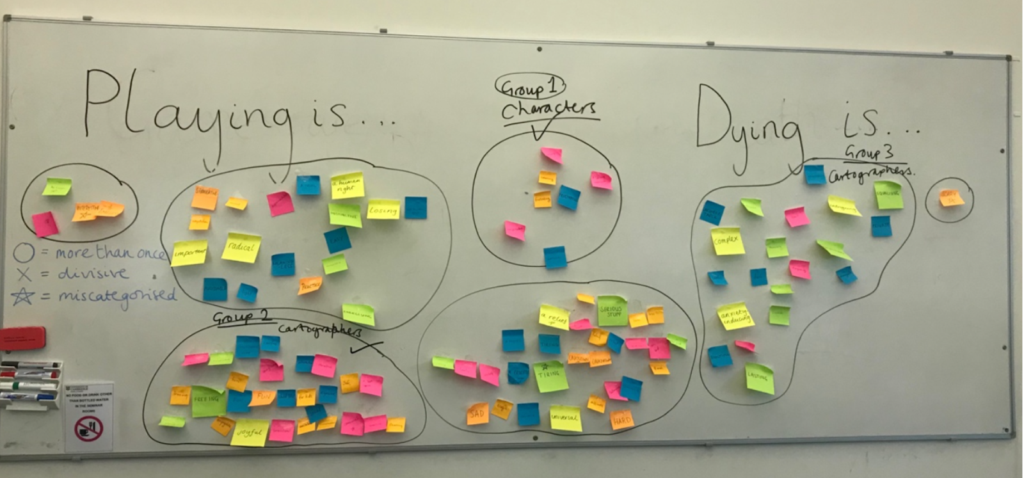
Figure 1: Play and death as a network
These new collocations formed the basis of the next game design activity, where participants were divided into small groups and tasked with either designing gameworld maps that used the contents of the Post-its as landmarks and locations or designing a cast of characters with various attributes and skills inspired by the Post-its. Both challenges required participants to engage in collaborative metaphor-making. Specifically, they were tasked with expressing complex (and sometimes abstract) concepts as navigable spaces or as anthropomorphic beings. The groups that chose to make maps were given A1-size pieces of paper and thick felt tips to materially discourage an over-focus on detail, and the group that decided to create a cast of characters were provided with a template that implemented game designer Hannah Nicklin’s character-creation advice (2020, 189-194) of giving a character a central goal that is undermined by one of the character’s personality traits.
Two of the four groups elected to design maps, and for the purposes of this analysis, it will be instructive to focus on this activity in more detail. One imagined ‘play’ as a navigable world, wherein different modes of play are meaningfully located in relation to one another. The other spatialised a conversation about dying as a journey through different terrains. The map of ‘play’, or the ‘Archiplaylego’ (Fig. 2), demonstrated through its cluster of islands that play occurs in bounded spaces connected by a fluid ‘sea’ that facilitates the import and export of ideas and behaviours from the everyday world. The descriptions of the islands captured some of the contradictions inherent in play – the ‘safe caverns’, for example, reimagine the escapist nature of play as a retreat into a dark but comforting space that one could inadvertently become lost in.
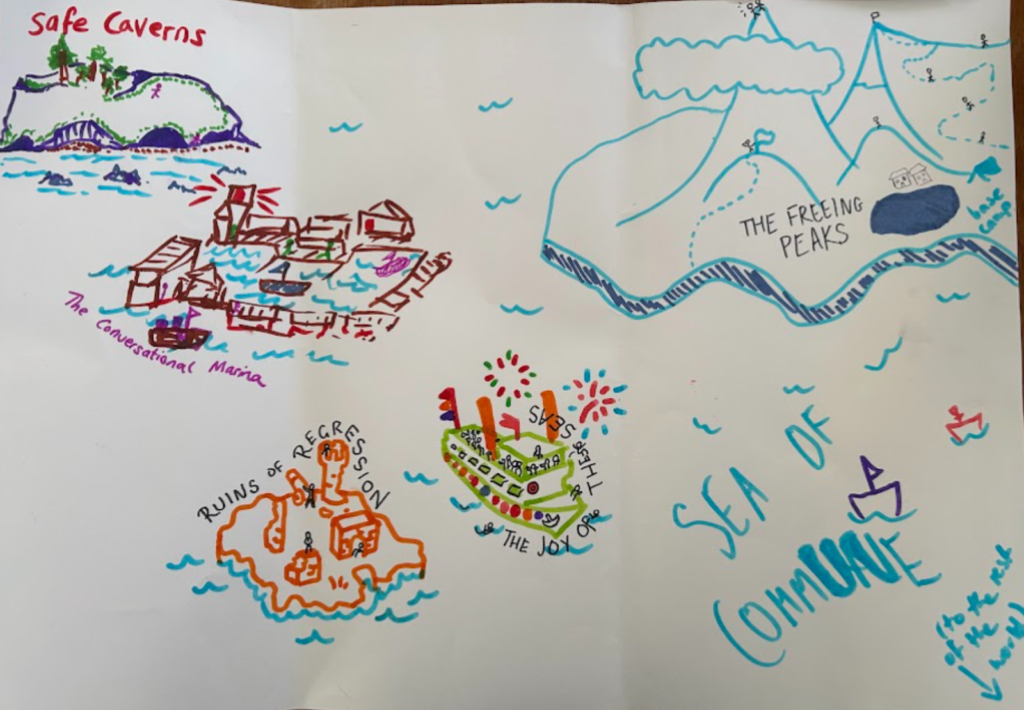
Figure 2. Play Map
The second group of cartographers created a topographical representation of a movement towards death (Fig.3). An optimal trajectory is implicit in the left-right trajectory towards the ‘Sea of Letting Go’, but this map, like the map of ‘Play’, suggests the possibility of numerous start-points and destinations along the way, including pauses, non-linear recursions, and explorations of distinct locations. This is pertinent because the conceptions of the phenomenon of dying, or dying as a concept, tend to imply models of decline, loss, transition or journey that lack nuance and emphasise teleological outcomes. Common misunderstandings of the Kübler-Ross (1969) model of the ‘Five Stages’ (denial, anger, bargaining, depression, acceptance), which she identifies in various forms of loss including death and grief (1974), as a linear series of steps, rather than the back and forth movement that it in fact models, are one famous example of the tendency to elide the inherence of mortality in every aspect of our lives, the uneven or non-sequential quality of some experiences of dying itself, or of the ways individuals can reconcile the knowledge of their own death or bereavement. Therefore, the re-imagining of the various aspects of ‘death’ and ‘(non)-acceptance’ as geographic markers in the manner of a map allows for the possibility of experiences that do not require a purely successive chronology, and in which many aspects of thought and feeling can co-exist at the same time, in varying degrees of proximity to each other.
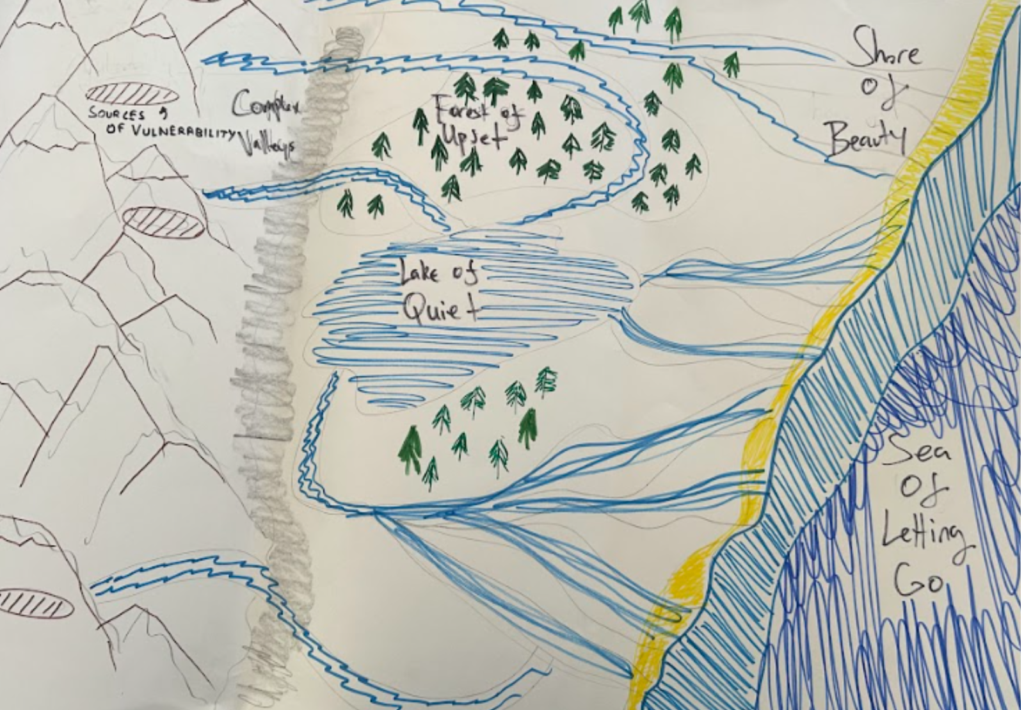
Figure 3. Death Map
What also emerged in the making of maps was a sense that the participants were engaging in acts of translation and remediation: each set of experts was fluent in a discrete language, and both were working towards creating a cipher. The act of writing and drawing on a shared piece of paper enhanced intragroup collaboration, while having two groups create maps generated a low level of motivating intergroup competitiveness. Co-constructing metaphors that spanned verbal, visual, and ludic dimensions moved conversations beyond conveying the different facets of how an experience feels and towards discussions of how the challenges and opportunities of each experience might prompt a set of behaviours or actions. That is to say, the gameworlds were understood to have a toylike ‘operability’, to borrow Seth Giddings’ terminology (2024, 40-41): they were subject to ludic logic that asks ‘how does this work? What actions can the player take? What are the consequences of those actions?’ As the ‘language’ of game design prioritises the procedural, gestural, and tactile over (or alongside) the verbal, participants were engaging in acts of multimodal metaphor-making. The facilitator encouraged participants to reflect on the rhetorical effects of common actions in analogue games such as rolling dice (and the affective difference between rolling a single D6 versus rolling a fistful of different dice), revealing, collecting, and discarding cards, and the emotional valence of different types of in-game tokens/meeples. This led to discussions of the ‘emotions of agency’ and how adjusting the balance of randomness and strategy in a game could express metaphorically the tension between chance and choice that can shape the end of life. Such procedural metaphors for grief and death have the combined power of capturing and conveying aspects of what can be difficult experiences, while also implying that these experiences are subject to change through intervention: they are processes within which agents may take action to produce different outcomes. The former can create a sense of connection and validation, while the latter can encourage the development of strategies for managing feelings of helplessness and hopelessness.
- A Slantwise Approach to Create a Sense of Psychological Safety
Building out from these character-creation and cartographic tasks, by the end of the first workshop series, the participants had created two playable prototypes: one was a concept for a tabletop roleplaying game, which allowed players to practice the interpersonal act of ‘letting go’ within a high fantasy setting, and the other was a trick-taking card game exploring the many forms of ‘closure’ that people aspire to achieve at the end of life. These prototypes set the parameters for a subsequent game created by the facilitator. This new game, which we titled Endgame, was designed to be circulated amongst the participants as a living, interactive record of the workshops, as a further iteration of the insights that inspired the prototypes, and as an invitation to continue engaging with the concept of ‘playing at dying’. Endgame combined the core elements of both prototypes to create a tabletop role-playing game wherein players collect and discard cards as part of a larger fantasy metaphor for approaching the end of life. A draft of Endgame was presented at a subsequent workshop attended by a mix of the original participants and newly recruited participants who had experience with tabletop roleplaying games6. In addition to continuing to explore our original research question—‘can games and play improve conversations about death and dying?’—this final workshop revisited our initial finding that game design was as effective for scaffolding conversations about death as play itself. To this end, we divided the session into two parts: the first two hours were spent playing the prototype, and the following two hours were spent annotating, editing, and adapting the game’s materials. We closely observed each of the three groups’ playthroughs and took detailed notes to capture the subsequent whole group discussion.
The playthroughs elicited exchanges of ideas about death and dying that differed from the sharing of personal anecdotes or beliefs. Cued by Endgame’s ‘almanac’, which offers symbolic prompts to direct the design of the characters and the narrative world and to progress the game’s plot, participants embraced a ‘slantwise’ approach to describing the process of dying. They followed the game’s implied directive to concretise and add detail to an abstract metaphor, but there was reduced pressure to personalise a metaphor and ground it in their own experiences. It was important for this ‘slantwise’ creation of psychological safety that the players were able to hold and suspend a dual sensibility: that they both were and were not engaged in thinking about their own future deaths in the real world. Choices were shaped, primarily, by the fantasy role-playing framework, which encouraged soft constraints on character creation, the relationships they then enacted with others, and the consequences of decisions as they unfolded in the time of the game. It was thus important that some of the created characters were unappealing, and others operated antagonistically. This built-in ‘alibi effect’ freed players to explore ideas connected to dying that might be perceived as less socially acceptable, in order to inhabit them for a while and to see how this feels. For example, there is a common default language, ‘or social script’, of discussing ‘lost loved ones’, which can efface or stigmatise the fact that we sometimes grieve those with whom we did not have ‘loving’ relationships. The game also enables characters to make decisions that are decidedly not noble, brave, or selfless – qualities that are sometimes expected of the terminally ill. Players could choose not to gift other characters cards from their hand, for instance, and in this way to play metaphorically with the possibility of refusing to compromise with, or bow to the wishes of, those affected by your death, or more literally, of choosing not to bequeath your time, energy, or possessions to those who may survive you.
It is important to note at the same time that this ‘slantwise’ approach in fact encouraged moments of emotional intensity or vulnerability. For example, the final sequence of the game invites players to memorialise other characters using a technique common to found poetry: a form that takes words from other texts (in this instance, from the ‘Ship’s Logs’ kept by each player) and reconfigures them into poetry (Fig. 5 and Fig. 6). Reading each other’s lyrical haiku-style commemorations of different characters brought some players to tears, and elicited expressions of gratitude or remorse relating to the extent to which they felt their character was understood by others.
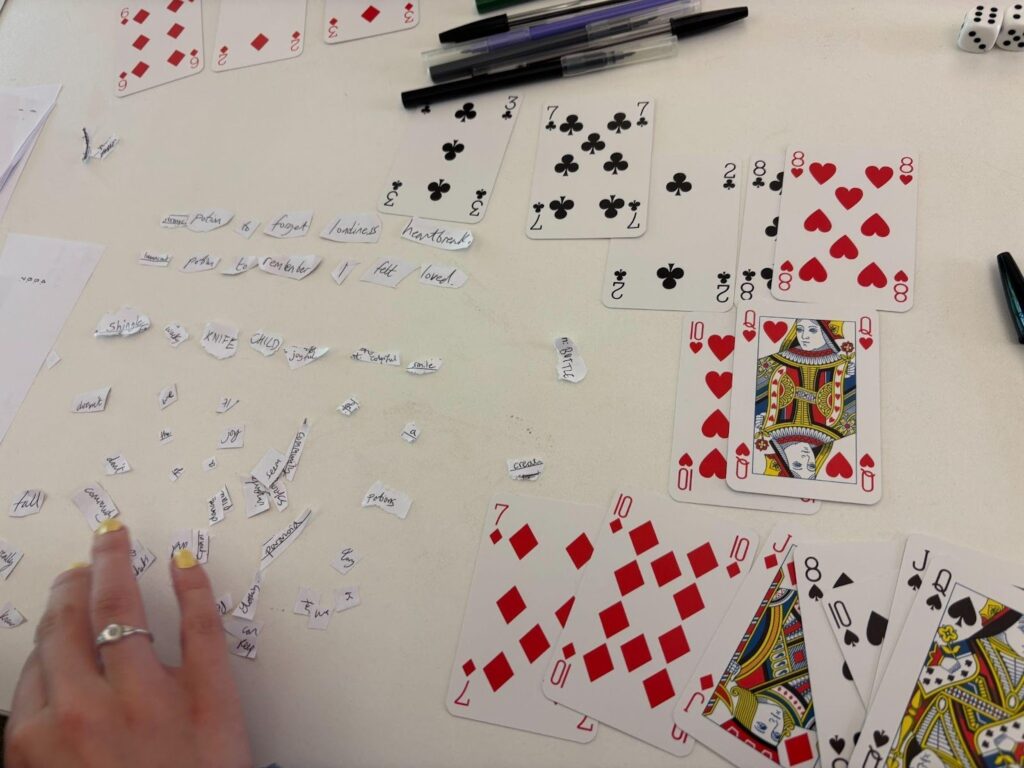
Figure 4: ‘Remembering’ each other’s characters in Endgame. Epitaph reads: “strange potion to forget loneliness heartbreak / imminent potion to remember I felt loved”.
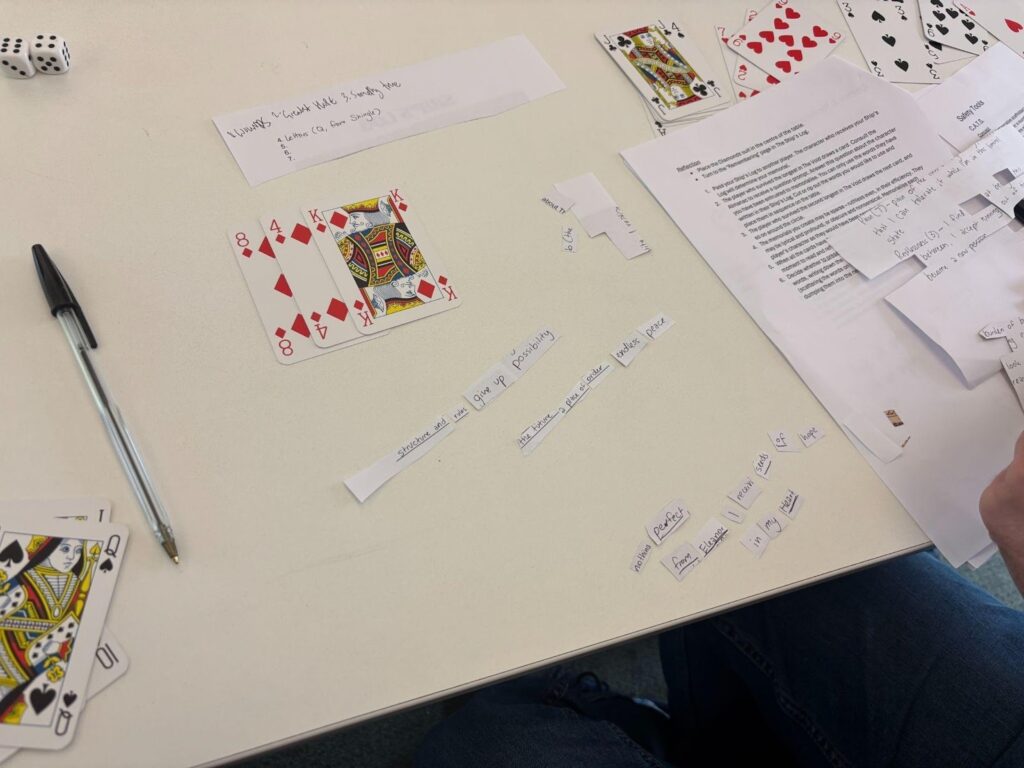
Figure 5: ‘Remembering’ each other’s characters in Endgame. Epitaph reads: “structure and rules give up possibility / the future a place of order endless peace / nothing perfect / from Eleanor I received seeds of hope in my heart”.
CONCLUSION
Conversations about death and dying can be uncomfortable and are often delayed until it is too late. There are many different ways to approach difficult conversations (e.g., the numerous methods discussed in The Handbook of Research on Communication Strategies for Taboo Topics (2022) edited by G.D. Luurs), and ‘playfully’ is just one approach. An important finding of this research, therefore, is simple: it is not disrespectful or trivializing to explore death through play, but instead, by bringing the two together, it is possible to improve and facilitate such conversations and to provide new opportunities for these exchanges to happen. At A Good Death?, we can make direct comparisons between the workshops described in this article and other workshops that use theatre, poetry, and crafting as tools for promoting discussions7. What we have noticed is that while all these different art forms encourage a ‘slantwise’ attitude towards death, games are the most insistently abstract and metaphorical. The metacognitive framework and replayable nature of games allow players to translate their thinking into concrete action and encourage creative, lateral thinking to explore alternative actions and outcomes. When conversations in these game design workshops veered toward the literal and anecdotal, the need to transform them into a ludic system and to ‘make them playable’ shunted conversations back into the realm of metaphor. This sometimes prompted surprising insights by defamiliarising long-held notions and transforming the emotional salience of core beliefs and narratives. Furthermore, the absurdity of trying to model something like death makes laughter – and even silliness – permissible in ways that other art forms do not. We feel that welcoming a diversity of emotional responses to discussions of dying reinvigorates conversations about death and surfaces a desire for curiosity and experimentation that play often prompts.
We hope that this study might give end-of-life care practitioners and game designers alike the confidence to continue exploring the intersection between play and death. We have shown that the bounded, safe space of play can improve the general quality of conversations about death and dying by increasing participants’ confidence to articulate, and practise articulating, their own beliefs and feelings, which can be further encouraged by the shielding alibi-effects of roleplay. Game systems can give players social permission to explore difficult emotions, but rather than games making conversations about death more ‘enjoyable’, they instead increase tolerance for negative affect, disagreement, and ambiguity. Games used by professionals, particularly to address ‘serious’ issues in medical, educational, and therapeutic contexts, are labelled ‘serious games’ (Sipiyaruk, 2018; Migutsch, 2012). This term is vexed by inaccuracy and confusion, and can lead to the erroneous suggestion that a ‘serious’ game must be as solemn as its subject or purpose (Clapper, 2018). Though the perceived antithesis between playfulness and seriousness is an enduring quirk of game studies that finds its origin in Huizinga’s foundational text Homo Ludens (1938), it is only a theoretical obstacle for practitioners who use play beyond its typically happy and positive connotations to address serious concerns (Rodriguez, 2006; Jørgensen, 2014; Beasley-Murray, 2025). Creating space for the ‘unserious’, the counterfactual, and the unrealistic through games and play expedites and enhances conversations about dying. Play allows for the exploration of negative emotions and socially unacceptable ideas without forcing the participant to ‘own’ these behaviours or identify with these beliefs.
Furthermore, we suggest that if play is a ‘meta-activity’—defined by an oscillating awareness that participants are ‘playing at doing/being’— then game design is a meta-meta-activity. It requires participants to ‘play at playing’: to use one’s empathetic faculties to imaginatively step into the role of a hypothetical player in order to iteratively test a game idea. This adds another level of (self)reflection and encourages perspective-taking, while also empowering participants to set the boundaries, focus, tone, and themes for difficult conversations. Thus, the creation of games that are flexible and adaptable, and which can be played, hacked, and modded by participants to suit their interests and the playing context, brings additional value. Our study indicates that games tackling challenging topics, such as death and dying, should not be overly prescriptive or authoritarian in the name of ensuring the playing experience is ‘safe’ and tightly curated. There are other media available for didactic purposes that limit the risk of unexpected outcomes. Unlike other media, games explicitly and unavoidably require a constantly shifting balance of control and submission between designer and player. Rather than attempt to micromanage a player’s experience of a game, it is, perhaps, more effective for the designer to hail the player as a trusted co-designer, providing them with a functioning ludic system and a slantwise angle but ultimately deferring to the player to decide the manner in which – and the extent to which – they play at dying.
WORKS CITED
Alan Wake II. Directed by Sam Lake and Kyle Rowley, Remedy Entertainment / Epic Games, 2023. Sony PlayStation 5 game.
Barr, Matthew and Alicia Copeland-Stewart. ‘Playing video games during the COVID-19 pandemic and effects on wellbeing’.Games and Culture, vol. 17, no. 1, pp. 122-139. https://doi.org/10.1177/15554120211017036.
Bartenstein, Lennart. “Larp in cognitive behavioural therapy: Making larp a standard method.” Nordic Larp, 22 April 2022, https://www.nordiclarp.org/2022/04/22/larp-in-cognitive-behavioral-therapy-making-larp-a-standard-method/.
Beasley-Murray, Tim. Critical games: On play and seriousness in academia, literature and life. Manchester University Press, 2025. https://www.jstor.org/stable/jj.29722252.
Benkel, Inger, et al. ‘Challenging Conversations with Terminally Ill Patients and Their Loved Ones: Strategies to Improve Giving Information in Palliative Care’. SAGE Open Medicine, vol. 2, Jan. 2014, p. 2050312114532456. DOI.org (Crossref), https://doi.org/10.1177/2050312114532456.
Bowman, Sarah Lynne. The Functions of Role-Playing Games: How Participants Create Community, Solve Problems and Explore Identity. McFarland, 2010.
Boldi, Arianna, Maurizio Tirassa, and Amon Rapp. ‘Playing as the world falls apart: The use of video games during the COVID-19 crisis – the case of Italy. Gaming and Gamers in the Times of the Pandemic, edited by Piotr Siuda, Jakub Majewski, and Krzyzstof Chmielewski. Bloomsbury Academic, 2024.https://doi.org/10.5040/9798765110270.
Brothers: A Tale of Two Sons. Directed by Josef Fares, Starbreeze Studios / 505 Games, 2013. Xbox 360 game.
Care Collective, The. The Care Manifesto: The Politics of Independence. Verso, 2020.
Clair Obscur: Expedition 33. Directed by Guillaume Broche, Sandfall Interactive / Kepler Interactive, 2025. PlayStation 5 game.
Clapper, Timothy C. ‘Serious Games Are Not All Serious’. Simulation & Gaming, vol. 49, no. 4, 2018, pp. 375-377. https://doi.org/10.1177/1046878118789763.
Connell, Megan A. Tabletop role-playing therapy: A guide for the clinician game master. WW Norton & Company, 2023.
Danilovic, Sandra, et al. ‘Playful Resilience: Empowering Recovery through Autobiographical Game-Based Storytelling in the Opioid Epidemic’. Proc. ACM Hum.-Comput. Interact., vol. 8, no. CHI PLAY, Oct. 2024, p. 330:1-330:35. ACM Digital Library, https://doi.org/10.1145/3677095.
Danilovic, Sandra. Game Design Therapoetics: Autopathographical Game Authorship as Self-Care, Self- Understanding, and Therapy. 2018. University of Toronto (Canada), Ph.D. ProQuest, https://www.proquest.com/docview/2082280754/abstract/E58C0F0447F348F8PQ/1.
Danilovic, Sandra. Games. Emerald Publishing Limited, 2024. www.emerald.com, https://doi.org/10.1108/9781800435940.
Death Stranding. Directed by Hideo Kojima, Kojima Productions / Sony Interactive Entertainment and 505 Games, 2019. PlayStation 4 game.
Death Stranding: On the Beach. Directed by Hideo Kojima, Kojima Productions / Sony Interactive Entertainment, 2025. PlayStation 5 game.
Deterding, Sebastian. ‘Alibis for Adult Play: A Goffmanian Account of Escaping Embarrassment in Adult Play’. Games and Culture, vol. 13, no. 3, May 2018, pp. 260–79. DOI.org (Crossref), https://doi.org/10.1177/1555412017721086.
Diakolambrianou, Elektra. “The Psychotherapeutic Magic of larp”. Nordic Larp, 19 April 2021, https://www.nordiclarp.org/2021/04/19/the-psychotherapeutic-magic-of-larp/.
Ghost of Yōtei. Directed by Nate Fox and Jason Connell, Sucker Punch Productions / Sony Interactive Entertainment, 2025. Sony PlayStation 5 game.
Giddings, Seth. Toy Theory: Technology and Imagination in Play. The MIT Press, 2024. direct.mit.edu, https://doi.org/10.7551/mitpress/14221.001.0001.
God of War. Directed by Cory Barlog, Santa Monica Studio / Sony Interactive Entertainment, 2018. Sony PlayStation 4 game.
God of War: Ragnarök. Directed by Cory Barlog, Santa Monica Studio / Sony Interactive Entertainment, 2022. Sony PlayStation 5 game.
Goldberg, Rebecca M., and Julia Bailey Stephenson. ‘Staying with the Metaphor: Applying Reality Therapy’s Use of Metaphors to Grief Counseling’. Journal of Creativity in Mental Health, vol. 11, no. 1, Jan. 2016, pp. 105–17. DOI.org (Crossref), https://doi.org/10.1080/15401383.2015.1113396.
Gris. Directed by Conrad Roset, Nomada Studio / Devolver Digital, 2018. Windows PC game.
Guité-Verret, Alexandra, et al. ‘Expressing Grief through Metaphors: Family Caregivers’ Experience of Care and Grief during the Covid-19 Pandemic’. International Journal of Qualitative Studies on Health and Well-Being, vol. 16, no. 1, Jan. 2021. DOI.org (Crossref), https://doi.org/10.1080/17482631.2021.1996872.
Harrer, Sabine. Games and Bereavement: How Video Games Represent Attachment, Loss and Grief. transcript Verlag, 2018. library.oapen.org, https://library.oapen.org/handle/20.500.12657/25213.
Hollow Knight: Silksong. Team Cherry, 2025. PlayStation 5 game.
Jalland, Patricia. ‘A Culture of Silent Grief?: The Transformation of Bereavement Care in 20th Century England’. Bereavement Care, vol. 32, no. 1, Apr. 2013, pp. 16–22. Taylor and Francis+NEJM, https://doi.org/10.1080/02682621.2013.779821.
Jørgensen, Kristine. ‘Devil’s Plaything: On the Boundary between Playful and Serious’. Proceedings of Nordic DiGRA 2014 Conference, 2014, dl.digra.org, https://doi.org/10.26503/dl.v2014i2.700.
Juul, Jesper. Half-Real: Video Games between Real Rules and Fictional Worlds. MIT Press, 2005.
Kübler-Ross, Elisabeth. On Death and Dying. Routledge, 1973.
Kübler-Ross, Elisabeth. Questions and Answers on Death and Dying: A Companion Volume to On Death and Dying. Ross Medical Associates S.C., 1974.
Lawley, James, and Penny Tompkins. “Metaphor, the body and healing.” The Capa Quarterly, 1, 2011, pp. 20-25.
Luurs, Geoffrey D, editor. Handbook of Research on Communication Strategies for Taboo Topics. IGI Global, 2022.
MacDonald, Keza. “What’s behind the phenomenon of ‘gamer brain’”. The Guardian, 14 January 2026, https://www.theguardian.com/games/2026/jan/14/whats-behind-gamer-brain.
MacKenzie, Amy R., and Michelle Lasota. ‘Bringing Life to Death: The Need for Honest, Compassionate, and Effective End-of-Life Conversations’. American Society of Clinical Oncology Educational Book, no. 40, May 2020, pp. 476–84. DOI.org (Crossref), https://doi.org/10.1200/EDBK_279767.
Malaby, Thomas M. ‘Beyond Play: A New Approach to Games’. Games and Culture, vol. 2, no. 2, Apr. 2007, pp. 95–113. SAGE Journals, https://doi.org/10.1177/1555412007299434.
Migutsch, Konstantin, and Narda Alvarado. ‘Purposeful by Design? A Serious Game Design Assessment Framework’. Proceedings of the International Conference on the Foundations of Digital Games, 2012, pp. 121-128. https://doi.org/10.1145/2282338.2282364.
Nadeau, Janice Winchester. ‘Metaphorically Speaking: The Use of Metaphors in Grief Therapy’. Illness, Crisis & Loss, vol. 14, no. 3, July 2006, pp. 201–21. SAGE Journals, https://doi.org/10.1177/105413730601400301.
Neimeyer, Robert A., et al. ‘Grief Therapy and the Reconstruction of Meaning: From Principles to Practice’. Journal of Contemporary Psychotherapy, vol. 40, no. 2, June 2010, pp. 73–83. Springer Link, https://doi.org/10.1007/s10879-009-9135-3.
Nicklin, Hannah. Writing for games: Theory and practice. CRC Press, 2022.
Rusch, Doris C. ‘21st Century Soul Guides: Leveraging Myth and Ritual for Game Design’. Proceedings of Nordic DiGRA 2018 Conference, 2018. Proceedings of Nordic DiGRA 2018 Conference, dl.digra.org, https://doi.org/10.26503/dl.v2018i3.1055.
Rodriguez, Hector. ‘The Playful and the Serious: An approximation to Huizinga’s Homo Ludens’. Games Studies, vol. 6, no. 1, 2006. https://gamestudies.org/0601/articles/rodriges.
Rusch, Doris C. ‘Mechanisms of the Soul – Tackling the Human Condition in Videogames’. 2009. Proceedings of Nordic DiGRA 2010 Conference: Experiencing Games: Games, Play, and Players, DOI.org (Crossref), https://doi.org/10.26503/dl.v2009i1.488.
Rusch, Doris C., and Andrew M. Phelps. ‘Existential Transformational Game Design: Harnessing the “Psychomagic” of Symbolic Enactment’. Frontiers in Psychology, vol. 11, Nov. 2020. Frontiers, https://doi.org/10.3389/fpsyg.2020.571522.
Rusch, Doris. Making Deep Games: Designing Games with Meaning and Purpose. Routledge, 2017.
Segal, Lynne. Lean On Me: A Politics of Radical Care. Verso, 2023.
Seifu, Feven, et al. ‘Death Cafes: An Exploration of the Setting, the Players, and the Conversation’. OMEGA – Journal of Death and Dying, vol. 90, no. 1, Nov. 2024, pp. 237–52. SAGE Journals, https://doi.org/10.1177/00302228221101277.
Sipiyaruk, Kawin, J.E. Gallagher, S. Sipiyaru Hatzipanagos, and P.A. Reynolds. ‘A rapid review of serious games: From healthcare education to dental education’. EUROPEAN JOURNAL OF DENTAL EDUCATION, vol. 22, no. 4, 2018, pp. 243-257. https://doi.org/10.1111/eje.12338.
Southall, David. ‘The Patient’s Use of Metaphor within a Palliative Care Setting: Theory, Function and Efficacy. A Narrative Literature Review’. Palliative Medicine, vol. 27, no. 4, Apr. 2013, pp. 304–13. SAGE Journals, https://doi.org/10.1177/0269216312451948.
Spiritfarer. Directed by Nicolas Guérin, Thunder Lotus Games, 2020.PlayStation 4 game.
Sutherland, Ryan. ‘Dying Well-Informed: The Need for Better Clinical Education Surrounding Facilitating End-of-Life Conversations’. The Yale Journal of Biology and Medicine, vol. 92, no. 4, Dec. 2019, pp. 757–64.
Tekinbas, Katie Salen, and Eric Zimmerman. Rules of Play: Game Design Fundamentals. MIT Press, 2003.
The Last of Us Part II. Directed by Neil Druckmann, Anthony Newman, and Kurt Margenau, Naughty Dog / Sony Interactive Entertainment, 2020. Sony PlayStation 5 game.
What Remains of Edith Finch. Directed by Ian Dallas, Giant Sparrow / Annapurna Interactive, 2017. PlayStation 4 game.
Young, Elizabeth. ‘Figures of Grief: Metaphors from a Bereavement Writing Group’. OMEGA – Journal of Death and Dying, vol. 56, no. 4, June 2008, pp. 359–67. SAGE Journals, https://doi.org/10.2190/OM.56.4.d.
Zimmerman, Eric. The Rules We Break: Lessons in Play, Thinking, and Design. Chronicle Books, 2022.
APPENDICES
Endgame
A roll-and-write TTRPG about the end, for 2-4 players
Approx. 2 hours
Set up:
2 six-sided dice
1 deck of playing cards, sorted into suits
1 printed version of The Ship’s Log per player
1 printed version of The Almanac
The Almanac is intended to be used as a symbolic guide. Interpret its directions in flexible, intuitive ways, leaning into the connotations that resonate for you.
This place was a pause between infinities.
The improbable collision of galactic trash forged something brief but beautiful.
A refuge, a community, a home.
You knew it couldn’t last.
The trembling core, the shifting terra, the increasing volatility of the hydrous planes –
the signs were impossible to ignore.
This planetoid is preparing for the end, and so must you.
So you gather, you reflect, you commiserate.
Sometimes you rage, sometimes you rest.
And in those small breaths between
the Harvests and the Bequeathings and the Goodbyes
you watch the moons spin out in wild ellipses,
you name the morning’s newborn mountains crowning through the crust,
you memorise each other’s faces.
Chapter 1: Heart
Character Creation and World Building
First:
You will collectively describe your planetoid’s decline. Starting with the player who travelled farthest to get here today, complete the world profile on the cover of The Almanac by choosing words to fill the gaps. Take turns to complete one full sentence each, before passing The Almanac to the player who travelled the next farthest to continue with the following sentence.
Next:
· Place the ‘Hearts’ suit in the centre of the table.
· Turn to the ‘Hearts’ page in The Ship’s Log. You will fill out your character’s profile following the steps below:
1. Each player rolls 2 D6 to determine the age of their character. Multiply the dice roll by 10, so that the youngest possible age is 20 and the oldest possible age is 120.
2. Each player draws a card from the top of the stack of Hearts, starting with the oldest character. This card represents your character’s ‘vocation’. Consult The Almanac and note down the symbol in your Ship’s Log.
3. Following the same player order, each player draws a second card from the stack of Hearts. This card represents your character’s ‘virtue’. Consult The Almanac and note down the symbol in your Ship’s Log.
4. Each player draws a final card from the stack of Hearts. This card represents your character’s ‘vice’. Consult The Almanac and note down the symbol in your Ship’s Log.
5. Place your character’s vocation, virtue, and vice cards in front of you. These cards will be important later in the game.
6. Take a moment to flesh out your character’s personality and backstory. You are encouraged to make interesting connections between your occupation, your personality, and your environment. How do the features of your planetoid shape your vocation, virtue, and vice?
7. Complete your character’s profile in the Ship’s Log. Invent a name for your character and then take turns to introduce your characters to each other.
8. After you have introduced your character, turn to the player on your left. You and that player will each roll one dice. If you roll consecutive numbers, you have a familial relationship. If you roll the same number, you are – or have been – lovers. If you roll numbers that are 2 apart (e.g., 1 and 3, 2 and 4, 3 and 5, 4 and 6), you know each other – perhaps you do business together, or you live near each other, or you share a hobby. Otherwise, you are strangers. Record the networks of your relationships in your Ship’s Log. If there are 4 players, let the players who are not sitting adjacent to each other also roll dice to determine their relationship to one another.
Chapter 2: Harvest
Fragmentation is causing time to contract and dilate.
You make the heaviest decisions –
What to take, what to leave.
What to hoard, what to sacrifice.
Necessities: atmosphere, food, fuel.
Necessities: trinkets, talismans, trophies.
The thing about fragmentation
Is that each splinter can splinter
And meaning does not scale with size.
The community splinters into individuals
And yet, within each individual,
Community.
Soon, you will all journey into The Void.
In some ways, the end is an equaliser.
In other ways, the differences between you –
Between your lot in life and your neighbour’s –
Have never been starker.
Inventory
· Place the ‘Spades’ suit in the centre of the table.
· Turn to the ‘Harvest’ page in The Ship’s Log. You will fill out your character’s Inventory following the steps below:
1. Each player takes 3 cards from the deck of Spades. These represent resources that you will take with you into The Void. The higher the card, the more valuable the resource – Face cards are extremely valuable, Ace is the most valuable, 2 is the least valuable. Place the cards in front of you beside your Heart cards.
2. Consult The Almanac to determine which items you have acquired and make a note of them in your Ship’s Log.
3. You have the opportunity now to gift an item to another player. Consider your character’s personality, priorities, and beliefs, as well as the relationships that exist between characters. Record what is given and received in the Ship’s Log. Gifting can happen in any order, and characters are not required to give a gift. If your character does not give a gift, you can write “I gave away nothing because [insert explanation]”.
4. If you receive a gift from another player, write a short message from your character to their character in their Ship’s Log.
5. Once gifting is complete, it is time for The Gathering. The Gathering is an event organised to say farewell – to the planetoid and to each other. Collectively complete the description of The Gathering in The Almanac, starting with the youngest character. Once you have completed a sentence, the next youngest character continues with the following sentence and so on.
6. The youngest character can then turn to ‘The Rumour’ in The Almanac and read the text there. Each character can record their reaction to the rumour in their Ship’s Log.
Chapter 3: Voyage
You wait in the ejection bay,
Together, but alone.
Occasionally, your eyes meet.
Words said and unsaid
Wash over you like the wake
Of an invisible ship.
The frantic energy of final preparations
Has been spent
What is left is fear and hope
Pain and numbness
A desperate need to know
And a desperate need to look away.
The countdown to launch
10, 9, 8…
Ends abruptly at 7
And you are flung into The Void.
Challenge
· Place the Clubs suit in the centre of the table.
· Turn to ‘The Voyage’ section of the Ship’s Log.
1. In the Void, each character will face 3 challenges, represented by 3 cards. If they surmount all 3 challenges, they reach the Harbour. If they surmount some but not all the challenges, their journey ends in The Void. If they fail all 3 challenges, they are obliterated without a trace.
2. Starting with the oldest character, turn over a card from the deck. Consult the Almanac to see what kind of challenge it is. Describe how your character experiences that challenge.
3. There are two ways to surmount a challenge – spending cards or rolling the dice. If you have a card in front of you (either a Heart or a Spade) that matches the challenge card (the Club), you can choose to sacrifice that card to surmount the challenge. If you have two or more cards whose combined value exactly equals that on the challenge card, you can spend those cards instead. Narrate how that item(s) / attribute(s) helps you to surmount the challenge, and what it means to your character to have to let them go. Scrub out the item(s) / attribute(s) relating to the cards you have spent from your Ship’s Log. You must render them illegible.
4. You may not have a card / combination of cards that matches the value of the challenge card. Or you may feel that the price is too dear – your character would never relinquish that belonging or that attribute, no matter the consequence. If so, you can roll the dice instead.
5. Roll two dice. If you roll a number that is higher than the value of the card (Face Cards = 11, Ace = 12), you surmount the challenge. Narrate what happens. If you roll less than the value of the card, you do not surmount the challenge. Narrate what happens.
6. If you gifted any cards to another character, you may re-roll one dice an equal number of times to the number of cards you gifted.
7. After you have resolved a challenge, the next player draws a card.
8. The round ends when every character has faced 3 challenges.
Chapter 4: Remembering
You are condemned
Yet you are free
Your mortality confirmed
Your existence defined
You are now all you will be
You now know all you will know
No experience will now enhance
Your life
Except death
Now you are free to give
With no need to take
No needs to fill
Reflection
· Place the Diamonds suit in the centre of the table.
1. You cannot write your own memorial – you will be remembered by another character.
2. Each player draws two cards from the deck of Diamonds. Consult The Almanac to receive a question that will prompt the memorial your character will write.
3. Pass your Ship’s Log to another player. The character who receives your Ship’s Log will write your memorial. They can only use words you have written in your Ship’s Log. They can cut or rip out the words they would like to use and place them in sequence on the table. If your character reached the Harbour, all of the words you have written can be used to construct your memorial. If your character remained in the Void, they can only use words you wrote before you were evacuated. If your character was obliterated, your Ship’s Log must be thoroughly shredded.
4. Answer the two questions about the character you have been entrusted to memorialise using a collage of their words. The memorials you create may be sparse – ruthless even, in their efficiency. They may be lyrical and profound, or obscure and nonsensical. Memorialise each player’s character as they would have been perceived by your character.
5. When the memorials are complete, take a moment to read and reflect on your character’s legacy.
6. Decide whether to preserve (by taking a photograph, collecting the ripped-out words, writing down the elegy) or to destroy your character’s memorial (by scattering the words on the wind, setting the words alight, unceremoniously dumping them into the nearest recycling bin).
Ship’s Log

Hearts
Vocation: Virtue: Vice:
My name is _____________________, but people call me ____________. I’m ___________ years old and stand _________________ tall. I work as _______________________.
When people see me, they first notice my __________________, _________________, and ___________________.
I believe in ___________________, but my ____________________ side can get in my way.
I will most miss _____________________ when it is gone.
Relationships
Home is not always a place, sometimes it is a person. For me, that means ___________________________________________________________________________________________________________________________________________________________________________________________________________________________________________________
Spades
Inventory:
1.
2.
3.
I gave away ____________________ because _________________________.
At the Gathering, I ________________________________________________.
I have heard a ____________ rumour. I think _____________________________ ______________________________________________________. I feel ______ _________________________________________________________________.
Clubs
On the first day, I faced ________________________________________________ ___________________________________________________________________ ______________________________________________________________________________________________________________________________________.
On the second day, I faced ______________________________________________ ___________________________________________________________________ ______________________________________________________________________________________________________________________________________.
On the last day, I faced ________________________________________________ ___________________________________________________________________ ______________________________________________________________________________________________________________________________________.
The Harbour
I made it to The Harbour and it____________________________________________________ ________________________________________________________________________________
The Almanac

Home
The planet’s bazaars / bastions / bridges are still __________________, so most days you can ______________________. But the climate, once __________________, is now ___________________, and the atmosphere has become ____________________. When you first arrived, the planet’s many moons / mountains / monsters were ______________, but now even they are __________________. Winged / eyeless / subterranean beings ______________ through the ____________, and the beautiful _________________ have lost their ______________. Sometimes you travel to the ___________________, tracing your fingers over the __________________, smelling the _______________, and listening to the ________________. Sinkholes / slums / shadows have replaced the citadels / suntraps / seas. How could something so ________________ become so ________________?
Name of planetoid: _______________________________________________________
(Option: You may like to devise a name for your planetoid by creating an anagram of the first letters / syllables of your names)
The Gathering
It is a sombre / spiritual / scandalous affair. Held in the ________________ – which is decorated with _____________ – there are music and games / rites and rituals / awkward silences and stifled giggles. The children ________________ and the elders ________________. The attendees are dressed in __________________, eat ___________________, and drink ___________________.
At the Gathering, there is an announcement. The prophets / geologists / leaders say time has run out: evacuations must commence at once or _________________ _______________________________. The escape pods / dream tunnels / lightsails / smart arks have been readied with three days’ worth of ________________. The crowd _______________________.
Hearts
Ace A Mirror
2 A Child
3 A Bridge
4 A Door
5 A Timepiece
6 A Tunnel
7 A Bottle
8 A GAVEL
9 A Knife
10 A Plant
J A Candle
Q A Feather
K A Fang
Spades
Ace Something Miraculous
2 Something Broken
3 Something Edible
4 Something Inherited
5 Something Comforting
6 Something Practical
7 Something Illuminating
8 Something Alive
9 Something State-of-the-art
10 Something Ancient
J Something Unique
Q Something Expensive
K Something Beautiful
Clubs
Ace Loneliness
2 Disintegration
3 restlessness
4 humiliation
5 paralysis
6 darkness
7 pain
8 burden
9 disfigurement
10 Mania
J Heartbreak
Q Disconnection
K Regret
Diamonds
Ace What brought them happiness?
2 What caused them pain?
3 What was their biggest fear?
4 What was their greatest hope?
5 What was their biggest regret?
6 What was their greatest achievement?
7 What gifts did they bestow on others?
8 What wounds did they inflict on others?
9 What was their body like?
10 What was their mind like?
J What would they say about themselves?
Q Say something kind.
K Say something true.
The Rumour
I have heard a rumour.
It began as a faint rustling – a sigh, a wish, a prayer.
But now, it blusters through every conversation.
There are theories, hypotheses, calculations.
There is even a name: The Harbour.
They say it is a place we might reach.
All of us, some of us.
A lucky few. A chosen few.
They say we will be safe there, they say.
We will be together again.
Reconstituted. Whole once more.
They say we must hold onto hope.
The longer we last in The Void,
The greater the chance
That we might moor,
Endure.
Others say,
It’s a delusion.
A cruel one.
One that will make our time in The Void
More treacherous, more desperate.
One that will unmake us.
What matters in the end,
They say,
Is controlling what we can
And letting go of what we can’t.
We can choose –
To grasp, claw, cling on to hope
Or let it go.
Set it free
Along with all the other beautiful,
Fragile, feathered things.

Emma Reay
University of Southampton
Emma Reay is an Assistant Professor in Emerging Media at the University of Southampton. Her research interests include gaming and mental health, gaming and dying, and gaming and motherhood.
LinkedIn: @emmajoyreay
Substack: https://emmajoyreay.substack.com/
www.emmajoyreay.com

Laura Davies
University of Cambridge, UK
Laura is Director of Studies in English Literature at King’s College, University of Cambridge She researches the literature of the long eighteenth century, with a particular focus on the ways in which writing can enable forms of reflection on phenomena and experiences that exist at the end of our comprehension: time, dreams, religious faith, and death. She founded the ‘A Good Death?’ project in 2018 and leads the team in their various projects, at the core of which are the creation of original arts-based resources to encourage positive conversations around death, dying and bereavement.
X: @what_death
Jack Heath
- One example of a board game is Holding On: The Troubled Life of Billy Kerr by MIchael Fox and Rory O’Connor. ↩︎
- A programme providing a detailed description of these activities can be found here: https://good-death.english.cam.ac.uk/collab/. ↩︎
- This aligns with the need to improve ‘honest conversations’ as set out in the UK’s National Health Service framework for palliative and end of life care: https://www.england.nhs.uk/wp-content/uploads/2022/02/ambitions-for-palliative-and-end-of-life-care-2nd-edition.pdf. ↩︎
- An anonymised summary of the observation data can be found here: https://good-death.english.cam.ac.uk/?page_id=1215. ↩︎
- Guidance for holding your own death café and an outline of the movement’s ethos can be found at https://deathcafe.com/how/. ↩︎
- This draft is included in the appendices. ↩︎
- Our archive of past workshops, and advert for future collaboration, can be accessed on our website: https://good-death.english.cam.ac.uk/?page_id=14. ↩︎