
September 2025
Misty Novitch
The unpublished cooperative storytelling board game, LIFE Reimagined, is a potential case study for how we might use tabletop gaming to facilitate larger collective conversations, education, and action on the overwhelming topics around where “We the People” go from here. In this intense, make-or-break historic moment, our task is to protect people and our planet—on the timeline of the climate clock—while maintaining ourselves. Ultimately, we must shift the goal of our economy from endless growth to holistic care, as our struggles and solutions are connected. LIFE Reimagined offers an alternative narrative to the traditional, iconic Game of LIFE.
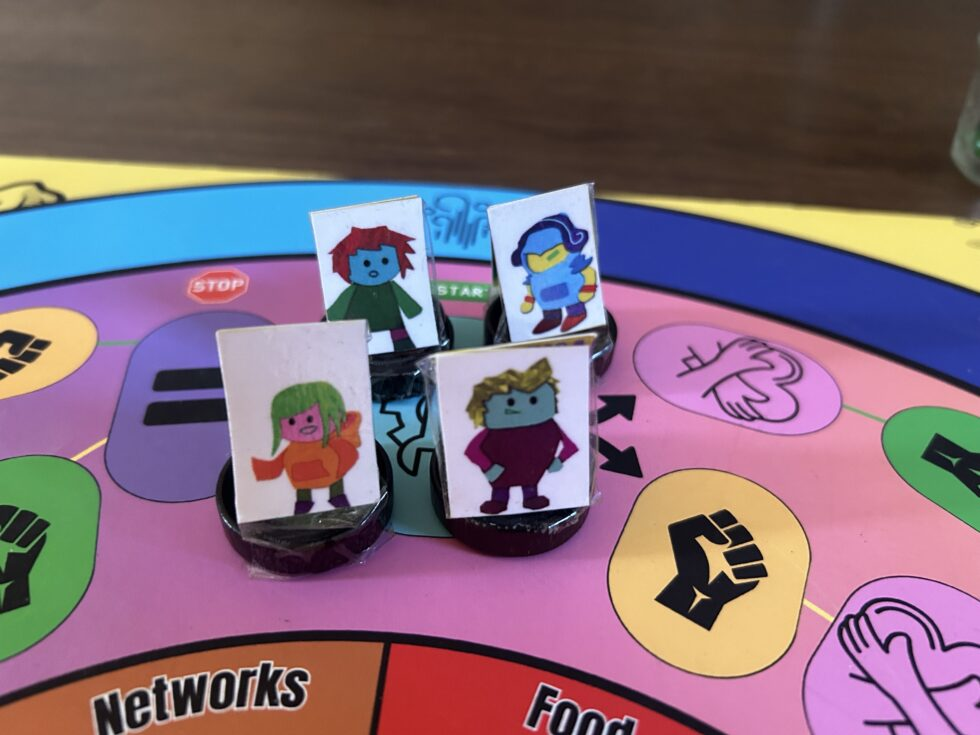
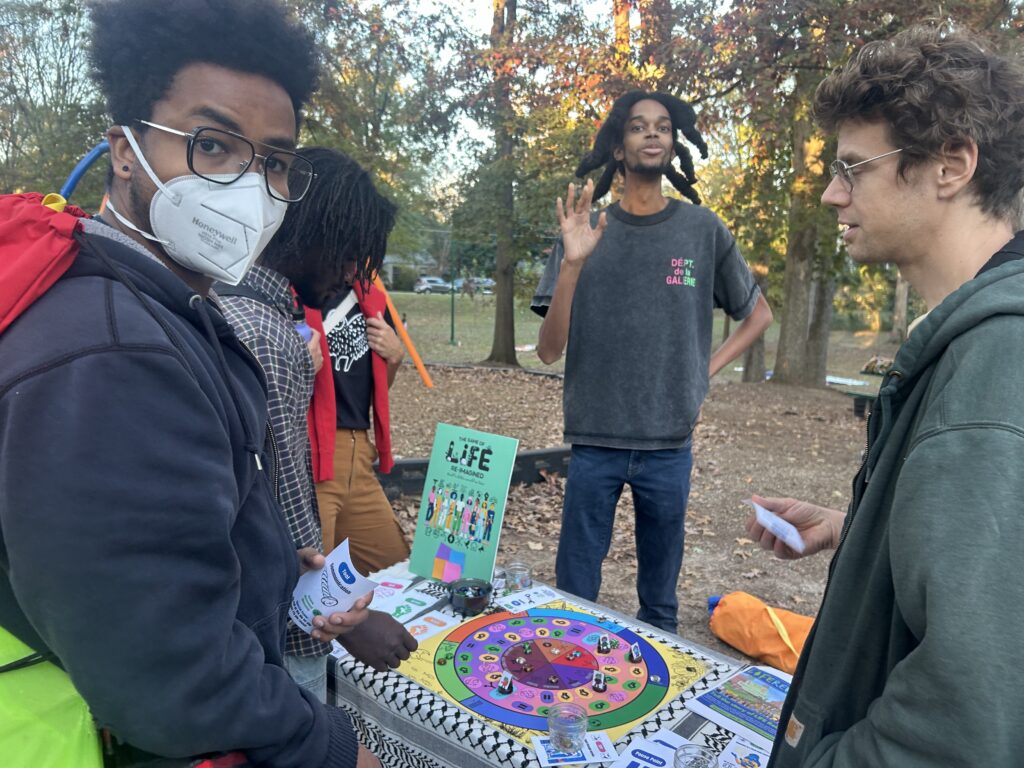
While in LIFE, players win by competing to accumulate the most money by retirement (atomized American capitalism), in LIFE Reimagined, players win by cooperating to achieve social and climate justice using Doughnut Economics (a cooperative and circular economy) without burning out. If life imitates art, then we need art that reflects the world we want and how we get there. The goal of the Life Reimagined Coalition (the grassroots development team making the game) is to support players to learn, think, and organize through the vehicle of the game, as a spark, supported by coalition partners with shared goals.
Doughnut Economics
Doughnut Economics is the model the LIFE Reimagined game board is based on. In her TED Talk about it, Kate Raworth says that it’s time to shift the goal of the economy from endless growth and profit (the current system, capitalism) to humanity and nature thriving in balance (a cooperative and circular economy, “distributive and regenerative by design”). She developed a “dashboard of indicators” for economic success using a Doughnut model: human rights on the inside and ecological needs on the outside, creating a safe space for humanity that resembles a doughnut, above the social floor of human needs and below the ecological ceiling of climate considerations (see image above). The LRC simplified the model to serve as the basis of our game board, with the same overall goal: to shift the economy from profit to thriving. There are multiple developers making games about Doughnut Economics as we speak, who have connected through the Doughnut Economics Action Lab (DEAL). The shift is being explored in every aspect of society globally, and climate justice organizers like Drawdown are using their social and climate health indicators already in their focus on the most useful climate solutions for human needs simultaneously.
How to Play
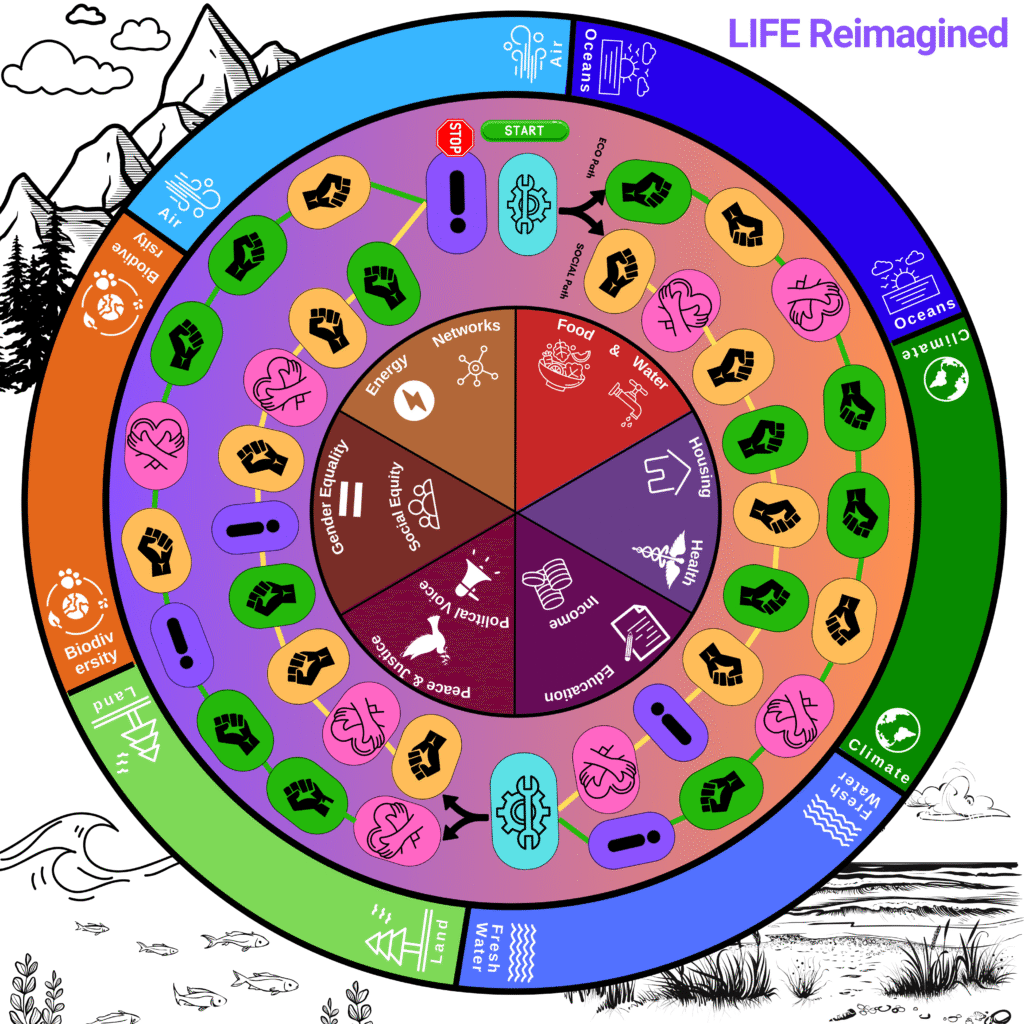
(image in the LIFE Reimagined game board)
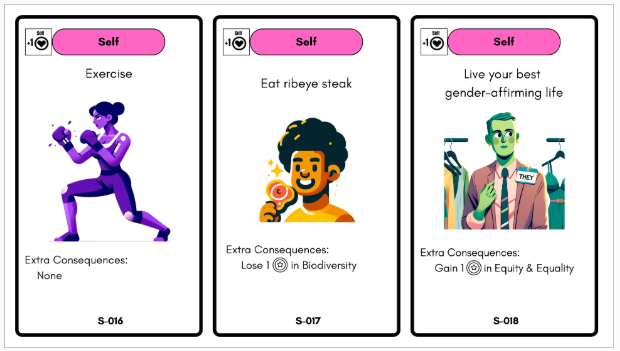
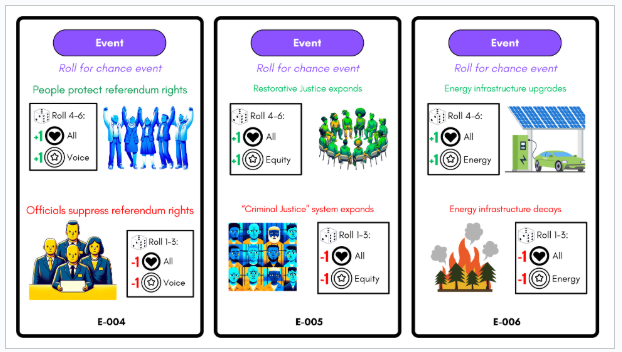
In LIFE Reimagined, players cooperatively move around the board trying to fill in all twelve doughnut categories for social and climate justice—both top (climate, oceans, land, etc) and bottom (food, water, housing, equality, etc)—with enough tokens by the time they all reach the last space without running out of self points. Players tell their story along the way! They take actions, which cost a self point, that hopefully become movements, where other players join and add their collective impact to fill in the doughnut. Players use tools (theories of change) like alternatives, advocacy, or civil disobedience, to unlock movements in actions and strategize with the tools’ special powers. Players also fulfill their self points by doing what is healing for them, and everyone has to stop at an event to brace for change and hope for the best in chance situations they can’t fully control. The game is meant to simulate the real world (more simply) so that players think about the cards, concepts, and conversations as they move through real life.
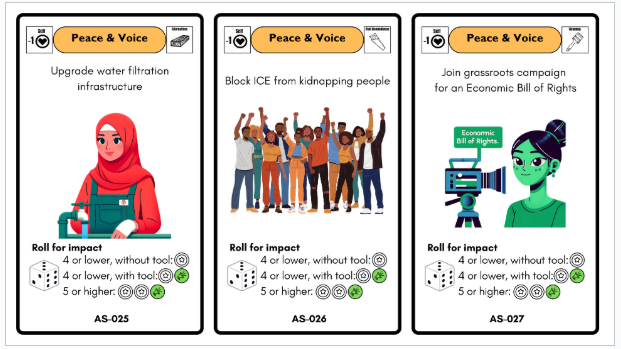
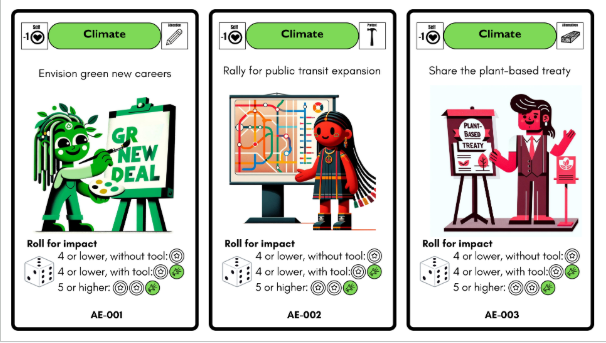
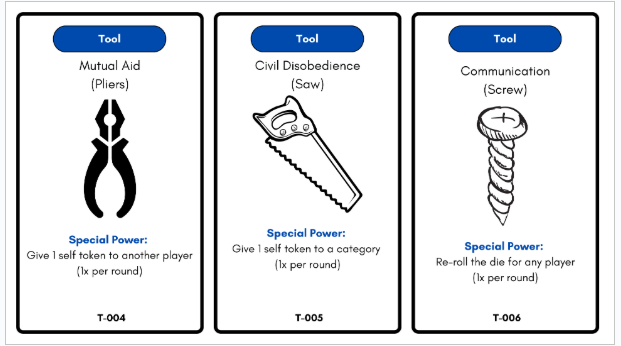
(images are actions (slides 24 and 35) and tools (slide 10) from LIFE Reimagined card deck)
(images are self (slide 65) and event (slide 55) in the LIFE Reimagined card deck)
Games Make Change
Jane McGonigal is a game developer focused on encouraging social and climate action through gaming. She makes the case for how games can change the world in her TED Talk, as well as in her book Imaginable. In her TED Talk she argues that “if we want to survive the next century on this planet,” we need people to play more games, since players become experts at “urgent optimism, weaving social fabric, blissful productivity, and epic meaning…superpowers” which add over 10,000 hours of expertise before the age of 21 on average for gamers. McGonigal also writes in Imaginable about the importance of imagining future scenarios (both good and bad) before experiencing them to avoid shock. She says people who simulated scenarios around a pandemic, for instance, (before the COVID-19 breakout in 2020) fared better in 2020 on average, having experienced the possibility before it occurred in real life.
Many people, however, do not feel as focused, brave, or powerful in real life as they do in games, so we need to adjust this disconnect. Activism (or “The Struggle”) is a lifelong commitment, and we often lose fights if we’re focusing on big goals. It’s understandable that it would be hard to take this on. But without brave people trying, leading… things don’t change for the better. Organized, everyday people have always been the drivers of change historically. And scientifically, the only thing between us and certain doom is one possible variable: mass movement. Therefore, we must do everything possible to organize enough people to take consistent action before time runs out. LIFE Reimagined and similar games have an urgency that is unique to this point in the story, and we still decide what happens next.
The Power of The People
In the current climate (both biological and political), people will need to imagine what they can do to make an impact, and preferably even simulate (or actually experience!) how it feels to take action. Ideally we need to plan and process, together in a safer space – before things really hit the fan in an emergency situation. Many people are already in emergency situations, and we must have solidarity, for it could be us next. In the early twenty-first century, “we must change almost everything in our current societies” (Greta Thunberg). For the biological need of our survival as a species in this climate emergency, for the injustice that so many communities have too long been experiencing, and for the urgency of everyday life under late-stage capitalism, we must change the story, and rise to the occasion as a collective, as many as possible.
Due to the enormity of the task of changing whole systems and cultural norms, feelings of powerlessness, learned helplessness, and the distraction of our own lives often lead many people to dissociate or ignore the state of the world, or simply be hurt by its brutality and wrongness. It’s difficult to process such a massive need for such massive change, and our massive responsibility to lead that change. Games are a great way to facilitate the conversation within and between our communities in healthy, guided ways that can allow folks to really struggle with this (gently), consider their visions, plans, and actions, and intentionally tell the story of our collective life reimagined.
The Team

The Life Reimagined Coalition (LRC) is a grassroots group of activists, artists, teachers, gamers, and game developers that has been volunteering together for the last five years to develop LIFE Reimagined (LR). We have had weekly Zoom meetings since 2020 (during COVID), and we have hosted dozens of in-person play tests. This game evolved from a sculptured art piece and concept, to a video game, to a tabletop board game, with future digital plans. Most of the 300 or so volunteers had not developed games before, and some had rarely even played board games. Many in our team knew very little or absolutely nothing about the game world, but all of us knew one thing: there is immense potential in games to shift culture and change the world. Through all the frustration of making games for the first time, we hope that LIFE Reimagined will fulfill its activist potential to inspire, connect, and mobilize players. We hope players can see themselves in the game and see a reimagined life as they play together.
We wanted to gamify how we win for social and climate justice, specifically implementing the Green New Deal (GND). Our goal was to engage with all people through LIFE Reimagined to facilitate the culture shift. We especially wish to draw from the wisdom and focus of an audience of organizers and “frontline and vulnerable communities – indigenous peoples, communities of color, migrant communities, deindustrialized communities, depopulated rural communities, the poor, low-income workers, women, the elderly, the unhoused, people with disabilities, and youth” (Green New Deal text).
We were part of an effort by an organization called Be The Green to create and promote popular art, such as videos, posters, music, and games, to help communicate the need for and the possibility of climate justice visions, like the Green New Deal. These visions are powerful, but they’re also dense, and we sought to simplify them: make them bite-sized and understandable. When we took on creating the game, we didn’t quite realize the scale of what we were taking on: We knew that “changing almost everything” was a large enough task, as activists and organizers, but we didn’t realize the complexity of designing not only games, but educational games for change – which are also still casual enough to keep uninvested gamers engaged. Over these last five years, we have learned to call ourselves game developers and to appreciate the warmth of the independent game development community, and the gaming community overall, in our various cities and states, specifically in Atlanta, Georgia. We also have comrades in Kansas, D.C., Chicago, California, Florida, and Washington. We have been welcomed and supported in our project, and that is a credit to the game development and gaming communities, as I was brand new in both worlds and appreciated the acceptance.
Games + Activism
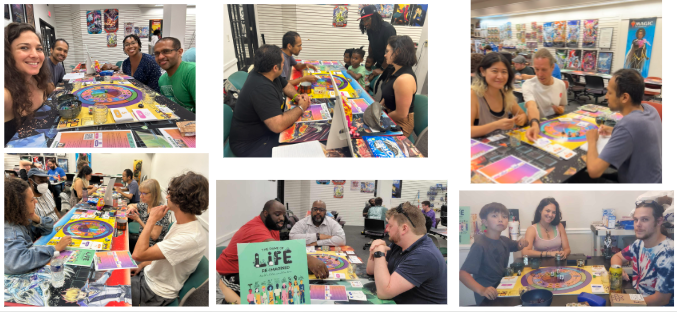
(image is from slide 17 of the LIFE Reimagined deck, playtests in 2024, mainly at Challenges Games and Comics at Northlake Mall in Atlanta, Georgia)
We have noticed how board games, in particular, bring people together, often people who struggle with social interactions. There are over three billion gamers in the world – about a third of humanity. We believe that using games (and culture) to reach people to organize together is essential, as games facilitate relationships, a crucial part of movement work. Activism, likewise, brings people together, and there is nothing more powerful than standing together for justice. We aim to continue the tradition of many activist game developers and gamers (cultural workers) in using LIFE Reimagined and other games to approach the topic of what we do and how in a lighter, accessible manner.
To change everything, we need everyone; therefore, we aim to invite everyone to play, share, and develop the game in coalition. We hope that players and organizers will continue to host plays locally and suggest new cards that can become expansion packs or be easily replaced in a digital format once we reach that stage. If I’ve learned anything in my twenty-two years of organizing, it’s that every single person brings a unique and important perspective to a community or a project, and it’s the more the merrier for collective wisdom. Everyone matters, and the result will generally be better with more eyes on it, like democracy.

(image is from slide 34 of the LIFE Reimagined deck, playtests in 2024, mainly at Challenges Games and Comics at Northlake Mall in Atlanta, Georgia
In the activism space and in the gaming space, especially board gaming, there tends to be a tolerance and inclusivity for divergence and diversity in various forms. This is a natural alliance and crossover, and gaming communities are often progressive. Games like LIFE Reimagined can give us focus to think things through at higher levels, as well as softness in our approach to a heavy task (or lifetime of tasks). Activists and organizers are known for organizing events to move an issue forward, so a focus on inviting people to play a game or a regular gaming time brings more potential gamers into the gaming community. At the same time, more diversity and bravery in calling things what they are improve the gaming community and those within it. Organizers and activists, game developers and gamers, have much to offer each other.
The activism space overall seeks to promote diversity, equity, and inclusion. We are called by a sense of justice and empathy, and often personal experience and need. The game space naturally does this, and accepts social outcasts and gives them a sense of belonging, as it has also done for me, an outsider from the game world coming in with a sense of overwhelm. This natural convergence has encouraged me, an activist and organizer with no prior knowledge of gaming or game development, to continue working on a game for five years to completion, which is the hardest thing I’ve ever done in my life. I – we – wouldn’t have spent so much time, energy, and money on this project if it didn’t have such potential to bring people together – all people – to consider collectively how we make a successful shift to a better world. This task is enormous, but we can do it together. Imagine!
Disclaimer: This game is under Fair Use. It is non-profit in nature, and being created for the purposes of teaching, comment, criticism, parody, news reporting, scholarship and research. Copyright Disclaimer under Section 107 of the Copyright Act in 1976; Allowance is made for “Fair Use for purposes such as criticism, comment, parody, news reporting, teaching, scholarship and research. Fair Use is a use permitted by copyright statute that might be otherwise infringing. Non-profit, educational or personal use tips the balance in favor of fair use. All rights and credit go directly to rightful owners. No copyright infringement is intended.
Works Cited
Eberlien, Sven. (2021). “Life Reimagined: A Quest.” Art of the Green New Deal website. https://artofthegreennewdeal.net/life-reimagined/
Eberlien, Sven. (2022). “Life Reimagined: A Collaboration.” Art of the Green New Deal website. https://artofthegreennewdeal.net/life-reimagined-a-collaboration/
Haboro. (2025). Game of LIFE. https://instructions.hasbro.com/en-us/instruction/the-game-of-life-game
Klein, Naomi. (2013). “How science is telling us all to revolt.” The New Statesman. https://www.newstatesman.com/politics/2013/10/science-says-revolt
McGonical, Jane. (2010). “Gaming can make a better world.” https://www.youtube.com/watch?v=dE1DuBesGYM
McGonical, Jane. (2022). Imaginable: How to imagine the future coming and feel ready for anything – even things that seem impossible today. Spiegel and Grau, New York.
Raworth, Kate. (2018). “A healthy economy should be designed to thrive, not grow.” https://www.youtube.com/watch?v=Rhcrbcg8HBw
Misty Novitch
Misty Novitch is a 22-year veteran social and climate justice movement organizer based in metro-Atlanta, Georgia. She has a background in politics, history, and social work. She is one of the core developers of the cooperative storytelling tabletop board game, LIFE Reimagined. Email LifeReimaginedGame@gmail.com for more information or check out the linktree.