
Three months ago, we shared a collection of insightful, engaging research exploring the possibilities of tabletop games across a wide range of fields. In the second issue for volume 3, we’re excited to add seven additional articles to this year’s publication.
The articles in this issue showcase the breadth of work being done with games across different fields, exploring learning, history, storytelling, sustainability, folklore, contemporary roleplaying games, and how tabletop games can help us better understand both ourselves and the world around us. Each issue reminds me that board games are far more than recreational artifacts; they are sites of culture, identity, learning, design, history, and human connection.
This issue is also a significant one for me personally, as it marks my final issue serving as Editor-in-Chief.
Over the course of four years, I’ve been lucky enough to work with dozens of authors from across the spectrum of academia, from emerging scholars exploring the broader applications of games in their field to scholars who have been studying and working with games for many years.
I’ve marveled at the work being done, exploring how games intersect with all academic fields of study, from practical applications in the classroom to considerations of the role of games in society. Every submission we receive is a reminder of the questions being asked and the discoveries that can come from those inquiries.
Each issue of this journal is the culmination of effort from an array of contributors, from the authors who share their work to the reviewers who donate their time and expertise to assess and evaluate the work being done, and, of course, the editorial staff laboring behind the scenes to ensure each author’s work is presented in the best possible form. I am grateful to everyone who has contributed to this issue and to the publication as a whole over the last four years.
To the authors who have chosen to share their work with Board Game Academics, I am most thankful. You entrusted us with your research, often representing years of work, putting yourself out there to explore new ideas, accept criticism, and continually refine your work. As the field of research around tabletop games continues to grow, it is your work that makes this journal and so many others possible.
I am grateful to have had the opportunity to work with so many incredible scholars over the last four years, and I am confident in the future of the research being done and in the editorial team that will continue this work for years to come.
With gratitude,
Anthony Chatfield
Editor-in-Chief
Board Game Academics
June 4, 2026
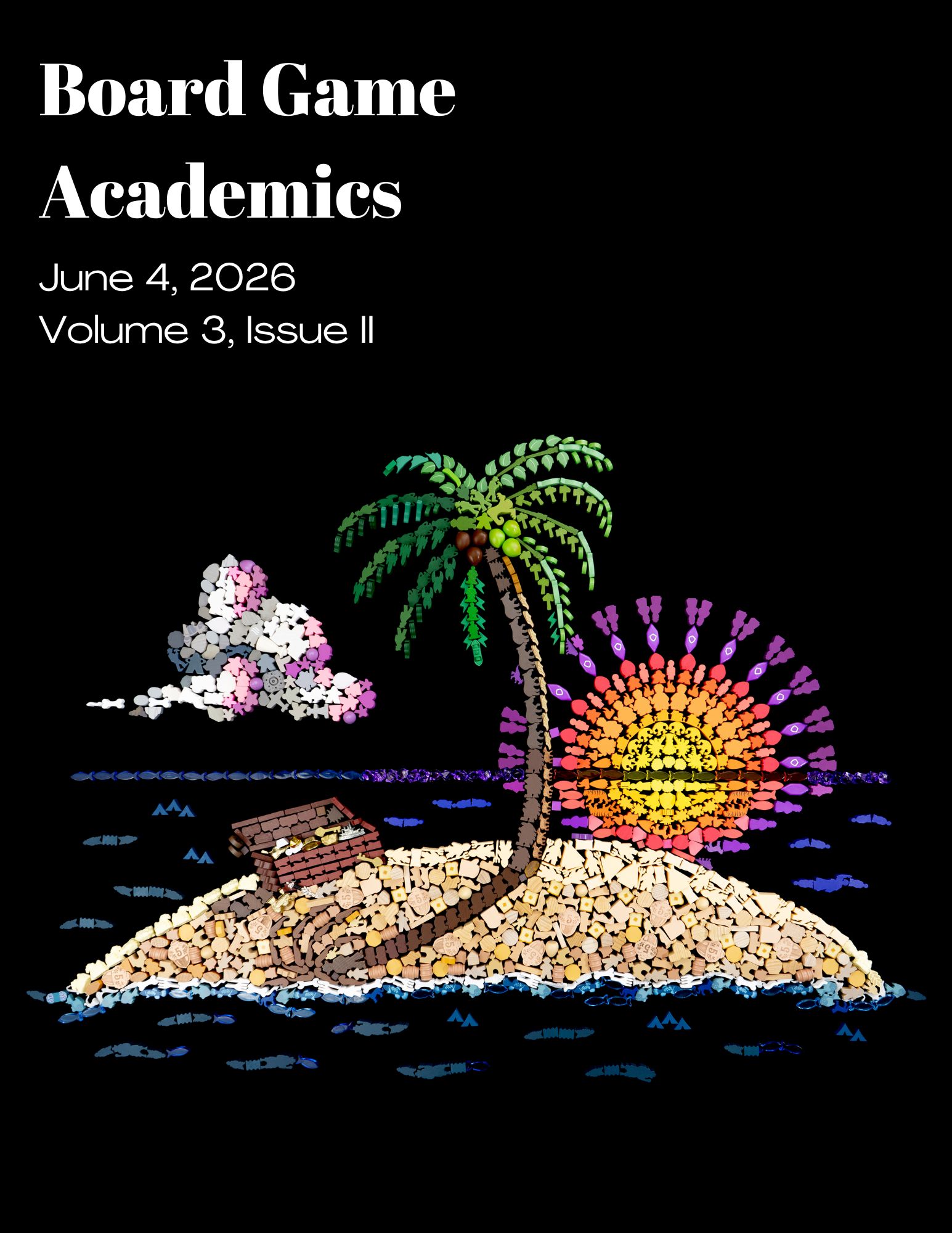
Hand-made by Katia Howatson of Board Game Art Creations
The Cognition of Game Playing: Learning Cognitive Psychology by Playing Board Games
Stephen B. Blessing
Around the Round Table: Fellowship and Cultural Longing in Arthurian Tabletop Games
Camille Deschapelles
Dungeons, Dragons, Difficult Deliberations:
Campaign Settings and Contemporary Considerations
Pascal Verheul
Mapping Common Core Math Standards onto Tabletop Game Mechanics to Enhance Age-Appropriate Gameplay
Jonathan O. N. Croft and Catherine Croft
The Sustainability Lens Game: Using Storytelling as a Creative Development Tool for Connection and Change
Tamara Stenn
Representing Folklore: The Rakshasa in Western Tabletop Games
Caleb Levy
A Framework for Analyzing Board Games and What They Say About the World
Ian Greener