
Board Game Academics, June 2026
Published in Vol 3. Issue II.
DOI: https://doi.org/10.70380/q3w7e1r9t6y2u
Caleb Levy
New York University
Introduction
In November of 2023, Wizards of the Coast [WotC] announced an errata for six cards from their trading card game Magic: the Gathering — part of the company’s attempts “to make our game as inclusive and welcoming as possible” (WotC, 2023). These six cards depicted “rakshasa,” a type of demon from Hindu mythology, and the changes were made to bring them more in line with their traditional Hindu depictions. Rakshasa appear in many Hindu texts, including the Mahābhārata and the Rāmāyaṇa, and are frequently depicted as shapeshifters (Oxford Reference, 2009; Williams, 2003). While the rakshasa might have originated in India, googling the term reveals a majority of results that match not the original Hindu depiction of the demon, but rather the Western version that WotC errata-ed their cards to avoid (Figure 1). This Western rakshasa has its origins in tabletop games—specifically, tabletop roleplaying games—and has become widespread enough to compete for space in reference material with the original.
In this paper, I will present the history of the rakshasa in Western tabletop games, from its introduction in 1975 to the codification of its modern Western form in the third edition of Dungeons and Dragons. Then, I will use that history to discuss the role of games in culture from two perspectives: that of games as folklore, focusing on where games can be situated in relation to existing scholarship on transmission and media; and that of games and Orientalism, focusing on how games form and participate in the kind of discourse described by Edward Said. Finally, I will suggest steps to mitigate potential harm in future designs, arguing that harm prevention in game design must be an active process.
The History
The first reference to the rakshasa in Western tabletop games is in the December 1975 edition of Strategic Review, a magazine published by then Dungeons & Dragons [DnD] publisher TSR, in a section called “Creature Features” (1975), which provided stat blocks for DnD. The entry was short—just one paragraph long with stats and no picture—but contained several things of note. First, the creature’s description begins by claiming that the rakshasa was “known first in India,” making the rakshasa one of the only monsters in the game to reference a real-world place (Gygax, 1974). The player is clearly intended to make the connection between the rakshasa and their pre-existing associations with India. Mechanically, the rakshasa is able to read minds, as well as disguise itself as a humanoid (becoming “what those who have encountered then[sic] deem friendly” (page 14)). It’s immune to non-magic weapons and to spells below 8th level, but has a vulnerability to blessed crossbow bolts—something that Gygax would later attribute to an episode of Kolchack, the Night Stalker (Gygax, 2005).1 The rakshasa is also described as “highly intelligent.”
After “Creature Features,” the rakshasa would next appear in Advanced Dungeons and Dragons—this time in the Monster Manual (Gygax, 1977). This version of the rakshasa is textually almost the same as the version from Strategic Review, with only minor changes to its description and stats, but featured an illustration depicting the creature as a tiger-headed man with a robe and a pipe (page 81). This image is the first time that rakshasa are depicted with the head of a tiger, and despite not referring to this in the text itself (it maintains the Strategic Review description of “evil spirits encased in flesh” as its only physical description), this depiction would go on to become the norm. This version also describes rakshasa as lawful, something that would become standard.
After Advanced Dungeons and Dragons, Adventures in Fantasy (Snider & Arneson, 1979), makes the next big contribution to the Western version, being the first to describe the rakshasa as having fingers that face the back of their hands, rather than their palms.2 By this point, portrayals of rakshasa in Western tabletop games were still largely oriented around the Hindu myth—something that is demonstrated in Dragon #84’s “Never the Same Thing Twice,” by Scott Bennie (1984). “Never the Same Thing Twice” is an attempt to square the contemporary DnD depiction of the rakshasa with its depictions in Hindu myth and folklore. It looks to construct a typology of different depictions of the rakshasa in India, before picking one as the parallel to DnD’s version and diving into specifics from there. This text is specifically interesting for the way that it moves between the cosmology of Hindu myth and that of DnD. Consider the quote: “[i]t is said that rakshasas dwell in the underworld, in a particularly gloomy and dismal place called Patalam. In the AD&D game, this would suggest Acheron as the most likely plane of origin for these creatures, and I have placed them there in my campaign” (Bennie, 1984, page 31). Here, Bennie begins by drawing from Hindu myth, before transitioning to a discussion of the DnD cosmology, bringing the motif of the rakshasa with him and situating it within his new context. It is also an interesting account in that it includes a bibliography, citing several academic texts to back its descriptions. It demonstrates that, as of this point, the rakshasa had not yet been systemically associated with the tiger motif—the image on page 30 depicts an ape-like monster. While it does have backward hands, they are presented as a quirk of the individual rather than a characteristic of the rakshasa as a category.
By Advanced Dungeons and Dragons Second Edition, the rakshasa had started to take the form that would define it in future editions. The second edition’s Monstrous Compendium Volume One (TSR, 1989), while describing the rakshasa as having “no uniform appearance” (page 113), also explicitly states that they have “the bodily features of various beasts (most commonly tigers and apes)” (page 113). This is the first textual connection between rakshasa and tigers in the series.3 The Monstrous Compendium also says that backwards hands “seem to be common.” Mechanically, the ESP and illusion shape changing from the Strategic Review article remain present, as does the spell and non-magic weapon immunity. The rakshasa also still dies if hit by a blessed crossbow bolt. The lore of the Second Edition rakshasa is also noteworthy—while it has dropped the explicit reference to India, it describes rakshasa society as being “bound by rigid castes” (page 113), a clear reference to India’s historic caste system. This suggests the player is still intended to connect the rakshasa with India.
The third edition of DnD further embraces the Westernized version, claiming that rakshasa “look like humanoid tigers,” and that “their hands are backward” (WotC, 2000, page 153). I consider this edition to be the holotype of the Western rakshasa: it is a lawful evil monster connected to other planes, with the head of a tiger and backwards hands that “[uses] its intelligence and power to maintain a decadent lifestyle at the expense of others” (page 153). It can shapeshift, read others’ thoughts, cast minor spells, has immunity to weak magic and non-magical weapons, and has a weakness to blessed crossbow bolts.
In the years since, there has been variation in the depiction of the creature, but it’s centered around the holotype: fourth edition DnD, for example, described the creature’s head as “feline,” rather than specifically tiger-esque (WotC, 2008), but this was changed back for fifth edition (WotC, 2014). Paizo’s Pathfinder, a DnD competitor that for a time overtook it in sales (ICv2, 2013), took a broader stance in saying that the Rakshasa can have the head of any animal, but specifies the tiger as being more common (Paizo Publishing LLC, 2009).4 There has been some recognition of the artificiality of this depiction —this includes forum posts (BESW, 2013), but also official action: notably WotC’s 2023 decision to errata the rakshasa cards in Magic: the Gathering, mentioned at the beginning of this article (WotC, 2023). Yet, this acknowledgment has been piecemeal. The revised fifth edition of DnD’s Monster Manual (WotC, 2025), released by WotC just over a year after Magic announced its errata, still depicts its rakshasa as a tiger.
Theorizing Games and Folklore
Despite having existed as a field of study for over 150 years, an exact definition of “folklore” has proven somewhat hard to pin down. Defined as everything from oral culture to “expressive tradition,” the field has been unified in practice by a general focus on tradition and the mechanisms by which it is transmitted (Bronner, 2017). My claim that games can be folklore might not be surprising given this history. While folkloristics originally focused on oral traditions, the field has spent nearly its entire existence expanding the tent to include new modes of transmission (Noyes, 2012).5 Connecting folklore to games is a logical step forward—research has already been done connecting games as mechanical systems to the cultural context in which they were created (Garcia, 2017), and media and folklore are inseparable from other forms of cultural production (Bacchilega, 2012).
One place in existing folklore scholarship that games can fit into is work on games and literature. Games and literature have been defined as having a three-part relationship: folklore in literature, folklore and literature, and folklore as literature (Bacchilega, 2012). Folklore in literature refers to the way that external folklore is referenced and brought into literature.6 “Folklore and literature” focuses on treating the two as distinct forms with distinct properties, and exploring how they interact and differ. And “folklore as literature” is a perspective on the field of folklore that emphasizes analyzing folklore as a text. Importantly, these three coexist, each describing a different way of understanding the same relationship.
These same three perspectives are also applicable to games. Folklore appears in games, both as a reflection of the culture in which it was created, but also as an active design choice: since players can bring pre-existing ideas about these motifs to their play in a kind of co-authorship (Bacchilega 2012; for more on co-authorship, see Hardwick (2017)). “Folklore and games” considers the unique traits of games not just as an authored medium but also as a ludic one. Traditional folklore is often considered a performance, impacted and shaped by a given social context (Bacchilega, 2012; Noyes, 2012). Similarly, games are a performance both in the sense that they create a unique experience during each playthrough by way of a player’s individual interpretation and understanding (Fernandez-Vara, 2009; see also Bacchilega, 2012’s depiction of literature (page 456)), but also in the way that they facilitate one or more players constructing a unique presentation of their identity, impacted by the mechanics of the game in a similar fashion to the way social norms impact performances of identity in traditional oral interactions (Garcia, 2017; Johnson, 2016).
While there is certainly much to be said about “folklore as games,” in the same vein of “folklore as literature”, for this perspective, I want to switch the order and instead consider games as folklore.7 While “folklore and games” focuses on the properties of the game and then works outward to understand how they might intersect and interact with folklore, “games as folklore” instead focuses on an understanding of traditional folklore and understands games as serving a role therein.
Traditional models of folklore transmission assumed that folklore was transmitted from person to person, describing the movement of a folkloric element as forming a path through a social group determined by who among them the motif was more or less relevant to (Dégh & Vázsonyi, 1975).8 Individual people in this model can serve as either an active bearer—someone who has received an element of folklore, and proceeds to pass it on—or a passive bearer—someone who has received an element of folklore, and then does not pass it on. A single individual may be both an active bearer and a passive bearer depending on context, sharing some kinds of folklore but not others (Dégh & Vázsonyi, 1975; Clements, 1973). A more in-depth consideration of this process can be found in John H. McDowell’s “The Transmission of Children’s Folklore”9 (1999), in which McDowell breaks the transmission process down into five distinct phases across three people. First, the initial person (in McDowell’s case, “child A”) encodes a message (step 1), then a second person decodes the message (step 2), processes the message (step 3), and re-encodes the message (step 4), before finally a third person decodes the message again (step 5).
There are two distinct ways we can incorporate games into this process. The first is provided by McDowell himself—children will often choose to share folkloric elements that they have learned from pop culture. In this way, games can serve as an external original source of the folklore being transmitted—not a direct participant in the transmission, but a reference whose material has been adapted to fit the context of a given social circumstance. The second place that games can be neatly incorporated into this process is as the middle person. If we consider the first person to be the game designer, then the first encoding represents the process of designing the game to include a folkloric element. The next three steps, being applied now to the game itself as the intermediary transmitter, constitute first the mechanics of the specific motif (the first decoding), then the intersection of that mechanic with other mechanics (the processing)10, and third, re-encoding, which would be the presentation of the game for play (i.e. technical writing, page design, etc.). Lastly, the third person represents the player, and the decoding step becomes the process of play, before feeding into another processing step as the player themselves becomes a bearer of tradition, who might then go on to serve the role of the second person.11
McDowell also provides two other notes about his transmission process that are salient to the role of games as transmission. First, he notes that the performance of folklore taken from outside their social sphere (i.e., from adults or pop culture) is a balance between memorization and performance. This is in keeping with other perspectives on folklore, which also emphasize a performative element in transmission (Noyes, 2012). This makes a strong case for incorporating games into the process—games themselves are a balance between rules and play, which represent the same balance of attempting to stick to an outside source and developing novel material through improvisation. Second, McDowell (1999) notes that children interpret material they learn from outside of children’s spaces into their own worldview before sharing it. This is important because it describes a similar process to the one that happens when a motif is incorporated into a larger game. The mechanics that represent the motif need to work within the broader system of the game. An example of this is in the 3rd edition of Dungeons & Dragons, in which the rakshasas’ shapeshifting is described as “similar to the alter self spell cast by an 18th-level sorcerer” (WotC, 2000, page 153). This is reflective of a process of taking the intended ability (“shapeshifting”) and placing it relative to other existing abilities as a method of providing consistent mechanics. Perhaps more important for the transmission of folklore, narrative elements undergo this process as well. Bennie’s (1984) “Never the Same Thing Twice,” for example, reflects this process in the way it finds analogs between the motifs of Hindu myth and the extant lore of DnD, and in so doing describes Hindu mythology in such a way as to make its incorporation into the game more convenient.
While games can be understood as a part of a traditional transmission process, there are differences to consider. Traditional oral transmission is prone to mutation—relatively few transmissions can lead to radically different versions of a single folkloric element (Dégh & Vázsonyi, 1975; Clements, 1973). Games offset this in several ways. First, they reach a wider audience. No single active bearer, no matter how prolific, can reach as many people using traditional methods as a moderately successful published game. This has a consolidating effect because more people are fewer degrees removed from a single source of the folkloric element.12 Additionally, many games can be replayed.13 Limited time to internalize an orally transmitted motif is a contributing factor in mutations (McDowell, 1999). Reducing that element allows for more consistent transmission between the game and the player than would be possible between people. This tendency towards consolidation, in turn, maps onto observations about folklore in general. To quote Noyes (2012)—“[p]arody and poaching necessarily replace autonomous creation in a world so dense with prior discourse” (page 19).
Games as an Orientalist Discourse
“Orientalism,” in the modern sense, comes from Edward Said’s 1978 book by the same name (Said, 1978/1994).14 Drawing on examples from historical fields of study, Said described Orientalism as a process by which a description of a region or culture is defined not by its lived reality, but by pre-existing Western ideas surrounding it. This process occurs as new ideas are developed based on pre-existing Western ideas and descriptions of the subject, rather than on observations of the subject itself. Over time, inaccuracies build up in a way that becomes increasingly resistant to change. The more precedent there is backing a representation, the harder it is to turn away from. Ultimately, this becomes another method of exerting institutional control: marginalized groups have agency over their very definition stripped away. Put another way, Orientalism describes the point at which new portrayals of a region or culture serve primarily not to describe the culture, but to match and build upon existing presuppositions and expectations of what a portrayal should be.15 The pressure to conform to audience expectations is no stranger in game design. David “Zeb” Cook (lead designer for the 2nd edition of Dungeons and Dragons) said as much in his introduction to the aptly named sourcebook Oriental Adventures: “the world presented had to be what people think the Orient is, not what it actually is” (TSR, 1985, page 4).
The history of the Western rakshasa is a clear example of this process: the rakshasa was brought into tabletop games as a vague reference to existing pop media that itself referenced Hindu mythology (Gygax, 2005). From there, earlier texts—such as Adventures in Fantasy (Snider & Arneson, 1979) and “Never the Same Thing Twice” (Bennie, 1984)—depict the Rakshasa in differing ways. As time went on, however, certain elements became increasingly popular, leading them to be standardized—not because they were present in the myth the games were supposedly referencing, but because they were present in earlier depictions that helped define the discourse in which the newer installments were published.
I am not the first to apply Orientalism as a lens for analyzing games. Robinson (2014) describes how market incentives (in this case, game awards) can encourage Orientalist representations of history. These market pressures reinforce the discursive pressure that encourages the adoption of existing representations, a pressure that is connected to the well-documented historical position of white men as the presumed market audience for games (see Garcia, 2017; Stang & Trammell, 2020; Trammell, 2023).
Dickey and Coslar (2025) look specifically at DnD, considering the way that the representation of the monk class serves to “other” the Orient. They also raise another point: the alienation of players whose backgrounds are tied to regions of the world so “othered.” This alienation is described in part by Mukherjee (2018), who describes the way that players from formerly colonized countries encounter representations of their home countries and cultures that are blatantly inaccurate, even in the face of highly accurate depictions of the West; as well as by Trammell (2023), which describes how the complex lived experiences of BIPOC players are denied representation by existing paradigms of design. Additionally, while Stang and Trammell (2020) don’t directly address the issue of Orientalism, they do describe how harmful stereotypes are perpetuated by “ludic bestiaries”—like those that portray the rakshasa in TTRPGs—and how these portrayals are themselves perpetuated by the discursive nature of bestiary design.
It’s also worth considering the work done on the presence of Orientalism in other art forms. Both Nochlin (1989) and Macfie (2002) look at how Orientalism presents itself in painting traditions. Macfie emphasized the way that paintings reflected the Orientalist assumptions of their cultures, irrespective of the intent of the painter. Nochlin took a more direct approach, discussing the way that colonialism and art intersect: emphasizing how paintings use their ability to make meaning to construct a version of the Orient that is palatable to Western societies, and how those constructions are distorted even in spite of attempts at “accuracy.” She also explores the way that the Orient could serve to distance the artist from their subject, enabling them to create more subversive art by leveraging the Orient’s otherness. Nochlin’s ideas have parallels in discussions of games: Johnson (2016) explores how games use aesthetics to hide grim themes in much the same way as the paintings analysed by Nochlin. Similarly, Nochlin’s points about the presence of white Europeans not in the painting itself, but in the gaze of the painting is similar to the way that Garcia (2017) describes mechanics themselves as culturally informed structures that shape meaning-making.
There are two properties of Orientalism I want to explore in their connection to games and folklore: first, the way that Orientalism serves to construct society; and second, that Orientalism is a discourse. Regarding the first: one of the roles that Orientalism plays in its relationship to colonialism is that it constructs “Oriental” society—reducing, consolidating, and categorizing it so as to be understandable and therefore controllable by Occidental colonial powers (Said, 1978/1994). In this way, folklore and Orientalism are related: folklore (both the material and the field of study) has long been used as a tool for the constructing and imagining of societies (Noyes, 2012).16 As Bacchilega (2012) said, “[t]he interlingual and intercultural translation of folktales and fairy tales has naturalized gender and ethnic stereotypes, promoted exoticizing fantasies, and played major roles in colonizing projects” (page 457). This property serves to establish stakes in game design: since games present and transmit a specific version of folklore, they can and do also participate in the often-colonial process of constructing societies. Because of this, there is a heightened burden to portray cultures in a way that avoids perpetuating cycles of colonial violence.
This brings us to the second property of Orientalism I want to discuss: its nature as a discourse. Orientalism, being a discourse, constructs meaning not just on the level of an individual work, but cumulatively as the product of many works and their interactions (Said, 1978/1994). Applied to games, this means that to properly understand the impact that a game might have on culture, one needs to consider how that game relates to existing works and ideas. Here, also, the rakshasa is a worthwhile example. In DnD’s third edition (my “holotype” from before; WotC, 2000): the rakshasa has a head of a tiger, a symbol charged with the history of British colonial rule of India (Sramek, 2006).17 Additionally, the rakshasa is depicted as “maintain[ing] a decadent lifestyle at the expense of others” (page 153). This plays into stereotypes from British colonial rule, evoking overindulgence as well as laziness, both of which were used to smear Indians and the Orient more generally (Sramek, 2006; Said, 1978/1994; Nochlin, 1989; Druce, 1997). This is perhaps the most sinister way games can cause harm—not by presenting a message directly, but by reinforcing one that already exists in the discourse. It might seem benign to portray a demon as greedy, manipulative, and lazy, but because that demon is associated with India, and because India is itself already stereotyped in those terms, the result is a reinforcement of harmful stereotypes.
This stereotyping is part of a broader trend in games. Many games engage in Orientalism (Robinson, 2014), including many that harmfully represent India specifically (Mukherjee, 2023). In fact, Dungeons and Dragons specifically has been connected with the establishment of “systemic violence” in gaming communities that led to events like Gamergate (Garcia, 2017).
The potential harm caused by Orientalism can be difficult to spot. First, it can easily hide behind apparently self-explanatory decisions. Take, for instance, the depiction of the rakshasa in second edition as living in a heavily patriarchal caste system (TSR, 1989). Even though the game portrays class divides and patriarchal power systems in a negative light, it is doing so in such a way as to perpetuate racist associations of those societal flaws with historically colonized groups. This can make identifying the harm hard, because it comes alongside other values that might serve to deflect criticism (in this case, criticizing the perpetuation of stereotypes might come off as defending class and gender hierarchies). Second, the harm is often distanced from society by its presentation, since games are often set not in the real world but in a fictional setting.18 This can be misleading, however, because art has always been able to disguise unpalatable material by distancing itself from the society in which it’s released (Nochlin, 1989; Hardwick, 2000).19 The otherness of fantasy can serve the same role in games that the Orient served in 19th-century painting—allowing for the presentation of themes and ideas that might otherwise be seen as unacceptable. And third, and in some ways most importantly, the harm is separate from the intent of the creator of the work. While it might be tempting to interpret the harm of Orientalism as the result of the negative intent of the designer, in truth, much of historic Orientalism in the arts was established and perpetuated by artists seeking to express genuine appreciation of their subject (Macfie, 2002).20 Despite this, their work reflected the underlying Orientalist biases present in the power structures of their societies, leading to products that in turn reinforced systems of oppression. The process of avoiding Orientalist assumptions must therefore be active and intentional.
Takeaways: Steps for Game Designers
What, then, does this mean for game designers? I would propose three steps for designers to take to avoid causing unintentional harm through their games:
- Treat avoiding harm as an active, rather than a passive, process.
Because the harm caused by including Orientalist assumptions into a design can be so hard to spot, it is important to treat harm reduction as a distinct part of the design process, rather than as something that will happen naturally over its course. This also means being willing to change or scrap ideas that might appear on the surface to be benign.
- Critically evaluate sources of information before using them for a design.
Orientalism muddies the water on sourcing information—both in the way that it prioritizes re-interpretation of existing sources, as well as in the way it incorporates biases into otherwise reliable work.21 Avoiding this means emphasizing primary sources, while for secondary sources, prioritize those that center direct observation of primary sources, rather than prior interpretation. Additionally, consider the biases that the author, their sources, and the canon might have accrued. Does their work reflect existing stereotypes? Is there a survivorship bias in what versions of the source are most available? Wherever possible, avoid relying on limited sources when portraying a motif in your design.
- Consider the discourse that your game will be published into when evaluating its potential harm.
Consider what you intend to portray with your game: How are you portraying it? How are you not portraying it? Are there omissions that might shape the audience’s interpretation of it? What connections might your audience make between your portrayal and the broader world? What harmful stereotypes already exist, both of what you’re portraying and what people might associate it with? Does your design align with or break from those portrayals?
Ultimately, Orientalism is present in many forms and can be hard to remove entirely. But in taking steps to mitigate its effects, designers can play an active role in reducing the harm that it causes and build towards a more equitable society.
Conclusion
Since its introduction to Western tabletop games in 1975, the rakshasa has evolved into a stable form divorced from its original source material. This is indicative of an under-studied property of games: that of a medium of transmission for folklore and folkloric motifs. As games become increasingly popular, this property of transmission will only become more important in how folklore travels. Games are more than just an expression of the designer: through play, game systems intersect with each other and with the beliefs, knowledge, and worldview of the player in a form of co-authorship (Fernandez-Vara, 2009; Hunicke et al., 2004). In this way, games occupy a place in the transmission of folklore that imitates that of another human. Future models of folklore transmission must be willing to consider games as active tradition bearers in and of themselves.
This transmission, in turn, sheds light on another property of games in society: they participate and form discourses. These discourses, in turn, can feed into the broader social issue of Orientalism, in which representations of marginalized communities become divorced from their reality and thereby become a tool for domination under the existing social paradigm. The incorporation of folklore, which has a long history of use to define “peoples,” into this process can produce subtle yet harmful instances of this, as portrayals of folkloric motifs that seem benign can play into broader stereotypes regarding the cultures from which they arise. The rakshasa is an example of this phenomenon—its Westernized version, disconnected as it is from the original myth, both plays into existing stereotypes surrounding South Asia and its peoples, and competes for attention with the original depictions. This risk of Orientalism demands that game designers approach harm reduction as an active part of the development process. Only by actively considering their designs in the context of broader discourses can designers be sure their work does not perpetuate harmful or dangerous stereotypes.
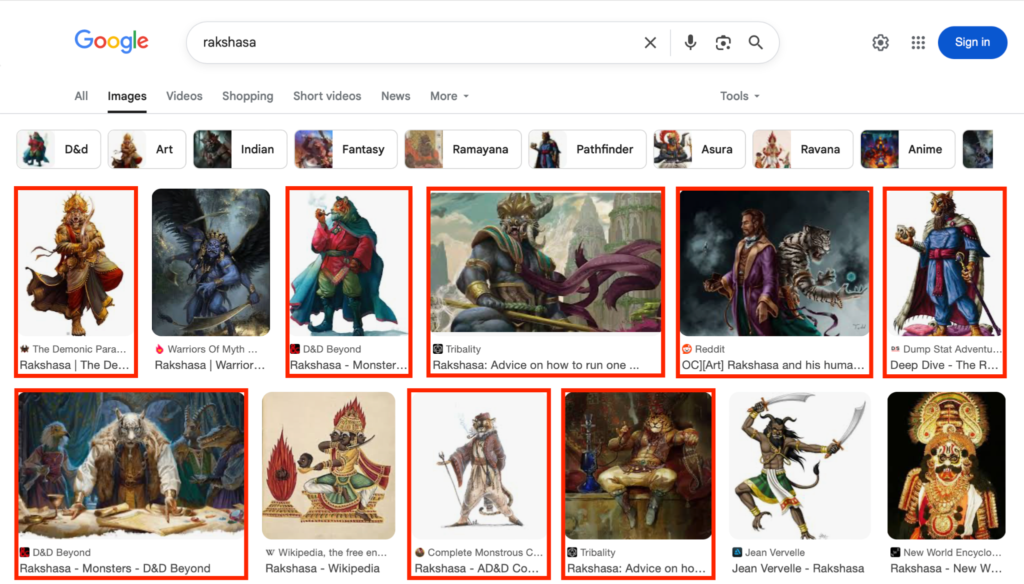
Figure 1: google image search results for the word “rakshasa”. Results that portray the Western version have been outlined in red.
End Notes
- While Gygax has said he got his inspiration from The Night Stalker, this does parallel how Ravana, a major rakshasa figure, was killed by Rama in Hindu myth. Similarly, some Hindu versions depict the rakshasa as being able to shapeshift (Oxford Reference, 2009). ↩︎
- The overall depiction of the Adventures in Fantasy rakshasa is quite different from what would become the standard DnD one—with yellow, green, or blue skin and five feet. They’re also described as “relatively stupid,” (page 15), in contrast with the typical DnD depiction, but in line with the depiction in Knights and Berserkers and Legerdemain’s 2nd edition (Hams, 1985). ↩︎
- It’s possible it’s also the first example of this anywhere, but I doubt it. I suspect instead that title goes to The Palladium Roleplaying Game, either its 1983 original edition or its 1984 revised edition. The edition I was able to read—the twelfth printing of the revised edition (Siembieda, 1994), contains references to the rakshasa (which it spells “raksasha”) as having “the head of a feline (lion or tiger)” (page 179)—if this was included as is in any printing before 1989, that would make this apparently the first explicit textual reference to the rakshasa being tiger-headed in Western tabletop games. Unfortunately, while the changes between the editions of the game seem to have been minimal (GROG, 2009; Prysus, 2017), there have been at least some changes (Lionheart, 2009), and I haven’t been able to find an official change log to be able to know if this affected the rakshasa entry. In addition to the description of the tiger head, Palladium also states that “the rakshasa are generally arrogant, cunning creatures. They enjoy toying with mortals, humans in particular,” (page 179), a sentiment that will become relevant in the section on orientalism, as well as claims that the “Lord of the Rakshasa” is “Abdul-Ra” (page 181)—an assertion which could probably have an entire article dedicated to its analysis. ↩︎
- It also used a tiger-headed example in the illustration. The second edition bestiary (Paizo Inc., 2019) followed much the same approach, referring to the head as being any animal, but using the rakshasa as its examples (though the second edition has two types, only one of which (the “Raja Rakshasa”) maps onto the typical Western rakshasa). ↩︎
- I should specify that I’m talking here about authored, published games—that is to say games that are designed or developed by a defined person or group of people. Games like rock paper scissors, which have no traceable designer and are frequently passed from person to person orally, are considered folklore by default. ↩︎
- This was the backbone of much of the early work done by folklorists with literature—folklorists sought to uncover folkloric material about a culture by looking at the references made to it in literature (Bacchilega 2012). ↩︎
- “Folklore as literature” is concerned mostly with how folklorists approach folklore outside of literature by using methods from the academic study of literature—the emphasis is on an improved understanding of folklore, not literature. I want to focus here on how we might use folklore methods to better understand the social role of games, hence my reversal. ↩︎
- There are broadly two types of approaches to modeling folklore transmission: mechanical approaches, which focus on viewing folklore transmission as a system with specific rules and properties, and serendipitous approaches, which views folklore in a more human lens, considering transmission as a personal interaction (McDowell 1999). This model falls in the former category. ↩︎
- While McDowell’s work addresses childlore specifically, the structure he proposes is generalizable. He addresses this point himself in his work, saying on the matter that “the child’s processing of folkloric materials can be taken as a microcosm of the process of folklore transmission in general” (page 52). This can also be seen in the way that the constituent ideas with which he builds his model can be found elsewhere, across many fields, in work centering adults (e.g. Barnlund, 1970; Dundes, 1985; Pârlog, 2019). The advantage of McDowell’s model, and the reason I chose it specifically, is that it centers transmission itself by defining the process over two interactions and three bearers. ↩︎
- Processing in McDowell’s work is about both having limited exposure to the performance of the motif (due to the inherently impermanent nature of oral communication—something that is not as much of a limitation in game design), but also about considering the motif in the context of other things the recipient knows or believes; hence why I attribute it to the intersection between the original and other mechanics. As an example of what I mean by this, the Strategic Review rakshasa having immunity to low level spells and non-magic weapons, as well as being instantly killable by a blessed crossbow bolt, is a matter of reencoding, since it’s the representation of the motif of the rakshasa itself. The extent to which this makes the rakshasa either challenging (because it limits how many options non-cleric players have for dealing with it) or easy (because having a cleric provides an easier path to victory) is a matter of intersection between the mechanics of the rakshasa itself and the broader game, and is thus a matter of processing. This could also be extended to the narrative—there’s certainly a post-colonialist argument to be made about the fact that the rakshasa, a motif connected explicitly to India, is placed in a game to be killed by characters that are heavily encouraged by the rules to represent Western icons and tropes. It’s possible to draw comparisons between this step of the process and the “dynamics” layer of the Mechanics, Dynamics, Aesthetics (MDA) model put forward by Hunicke et al. (2004). This is complicated, however, by the fact that the MDA model assumes that this process happens during play—at “run-time” for video games—an assumption that has been incorporated into work that builds on the model (e.g. Fernandez-Vara, 2009). This would place it in the fifth step of my model, the second decoding, rather than the third. My model instead describes these interactions in potentia, as a property of the game itself. A thorough analysis of this difference is beyond the scope of this paper. ↩︎
- Notably, despite the game serving as a person in the chain of transmission, they cannot transmit directly from one game to another: there must be an intermediary person to design the next game. This is an important consideration when looking at the development of a motif in games: the step between portrayals in two games is actually multiple steps of transmission, each of which engages in a form of reimagining that must be considered. ↩︎
- This might also reduce oicotypification, or the development of specific versions of a folkloric motif in distinct geographic regions (McDowell, 1999), but more research would need to be done to know for sure. ↩︎
- It should be noted that many games can not be re-played, for one reason or another. Online games may shut down, patches or live updates may render old builds unusable, or infrastructure vital to their play may be lost. ↩︎
- To clarify—“Orientalism” refers to the process of cultural replacement described by Said, to a historic field of study in Europe, and to a historic painting style (also in Europe). These terms are connected (all relate to European descriptions and representations of “the Orient”), but differ slightly in what they describe. In this paper I’ll stick to the first definition unless otherwise noted. ↩︎
- To put it in other terms—Orientalism in games can be thought of as the difference between authenticity and accuracy, terms that come up in some fields of game studies (McCall, 2022; Pötzsch, 2022). ↩︎
- The Brothers Grimm, for example, used their collection of folklore to advance their cause of a unified Germany (Noyes, 2012). ↩︎
- In talking about Sramek (2006)—there’s maybe something to be said about the parallel between the game action of killing a tiger headed demon infiltrating the nobility, and the British use of tiger hunting to ritually assert claim to power over a people whose nobility they viewed as undeserving. ↩︎
- The rakshasa serves as a specifically good example of this point, because while the tabletop games it appears in prefer fantasy settings, multiple of its portrayals cross that boundary and refer to India specifically. Even in a fictional setting, it cannot be separated from its origins. ↩︎
- While in painting this was often done by representing sex or violence in the Orient, to distance itself from Europe (Nochlin, 1989), games can do this through multiple avenues. For an example of how this might play out, see Johnson (2016)’s discussion of Smallworld, a game in which the depiction of genocide is couched with fantasy themes and playful presentation. ↩︎
- This can in part be understood in terms of folklore transmission—because people are inclined to reinterpret external sources of folklore to match their own construction of the world before sharing it within a given social sphere (McDowell 1999), this opens the door both for the designer to accidentally encode passive biases in their work, as well as for the player to interpret the game along the lines of their own biases, potentially in ways the designer would not have predicted. ↩︎
- Said (1978/1994) takes specific note of the way that the veneer of academic work, even if it was improperly conducted, can lend legitimacy to Orientalist assumptions. ↩︎
Works Cited
Bacchilega, C. (2012). Folklore and Literature. In Bendix, R. F. & Hasan-Rokem, G. (eds.) A Companion to Folklore (pp. 447-463). Blackwell Publishing Ltd. https://doi.org/10.1002/9781118379936.ch23
Barnlund, D. C. (1970). A Transactional Model of Communication. In Akin, J., Goldberg, A., Myers, G., Stewart, J. (Eds.), Language Behavior: A Book of Readings in Communication (pp. 43-61). Mouton.
Bennie, S. (1984, April). Never the Same Thing Twice: Filling out Facts and Figures on the Rakshasa Family. Dragon, 84, 30-33.
BESW. (2013, April 10). What inspired the D&D version of the Rakshasa? [online forum post]. RPG Stack Exchange. https://perma.cc/74ZZ-WHHU
Bronner, Simon J.. (2017). Folklore: the Basics. Routledge.
Clements, W. M. (1973). Unintentional Substitution in Folklore Transmission: A Devolutionary Instance. New York Folklore Quarterly, 29(4), 242-253.
Creature Features. (1975, December). The Strategic Review, Vol 1(No. 5), 14.
Dégh, L., & Vázsonyi, E. (1975). The hypothesis of multi-conduit transmission in folklore. In Ben-Amos, D. & Goldstein, K. S. (eds.), Folklore: Performance and Communication (reprint 2013, pp. 207-252). Mouton. https://doi.org/10.1515/9783110880229.207
Dickey, K. & Coslar, J. (2025). Orientalist misadventures: An examination of Monk Class Narratives and Mechanics in Dungeons and Dragons, 1975-2024. Board Game Academics, 2. https://doi.org/10.70380/3czjhl8t1
Druce, R. (1997). National and Racial Stereotypes in the British Raj. In Barfoot, C. C. (ed.), Beyond Pug’s Tour: National and Ethnic Stereotyping in Theory and Literary Practice (pp. 183-212). https://doi.org/10.1163/9789004490123_015
Dundes, A. 1985. “Nationalistic Inferiority Complexes and the Fabrication of Fakelore: A Reconsideration of Ossian, the Kinder- und Hausmärchen, the Kalevala, and Paul Bunyan.” Journal of Folklore Research. 22(1), 5-18. https://www.jstor.org/stable/3814466
Fernandez-Vara, C. (2009). Play’s the Thing: A Framework to Study Videogames as Performance. 2009 DiGRA International Conference: Breaking New Ground: Innovation in Games, Play, Practice and Theory.
Garcia, A. (2017). Privilege, Power, and Dungeons & Dragons: How Systems Shape Racial and Gender Identities in Tabletop Role-Playing Games. Mind, Culture, and Activity, 24(3), 232-246. http://dx.doi.org/10.1080/10749039.2017.1293691
GROG (Guide du Rôliste Galactique). (2009, May 8). Palladium. GROG. https://perma.cc/U6RZ-N5R3
Gygax, G., & Arneson, D. (1974). Monsters and Treasure [tabletop roleplaying game]. Tactical Studies Rules.
Gygax, G. (1977). Monster Manual [tabletop roleplaying game]. TSR Games.
Gygax, G. [Col_Pladoh]. (2005, July 9). Heh… That was covered earlier, here I think, although it might have been on another board. No Matter. I was [comment on the online forum post Q&A with Gary Gygax]. Enworld. https://perma.cc/3ZSZ-YE6H
Hams, E. T. (1985). Expanded Creature Catalog for Kabal (2nd ed.) [tabletop roleplaying game]. Kabal Gaming Systems.
Hardwick, L. (2000). Translating Words, Translating Cultures. Redwood Books Ltd.
Hardwick, L. (2017). Myth, Creativity and Repressions in Modern Literature: Refigurations from Ancient Greek myth. Journal of Comparative Literature and Aesthetics, 40(2), 11-26.
Hunicke, R., LeBlanc, M., Zubek, R. (2004).. MDA: A FormalApproach to Game Design and Game Research. AAAI-04 Workshop on Challenges in Game AI.
ICv2. (2013, October 29). TOP 5 RPGS–SUMMER 2013. ICv2. https://perma.cc/6QUA-69PS
Johnson, A. (2016). Positionality and Performance: A Player’s Encounter with the Lost Tribes of Small World. Analog Game Studies, 3(5).
Lionheart, J. (2009, September 19). 1st edition vs revised 1st edition [online forum post]. Forums of the Megaverse. https://perma.cc/J8GQ-CU75
Macfie, A. L. (2014). Orientalism. Routledge. https://doi.org/10.4324/9781315837925
McCall, J. (2022). History Games. In Grabarczyk, P. (ed.), Encyclopedia of Ludic Terms (Spring 2022 Edition). URL: https://eolt.org/articles/history-games
McDowell, J. H. (1999) The Transmission of Children’s Folklore. In Sutton-Smith, B., Mechling, J., Johnson, T. W., McMahon, F. R. (eds.), Children’s Folklore: A Source Book (pp. 49-62). University Press of Colorado. https://www.jstor.org/stable/j.ctt46nskz.9?seq=1
Mukherjee, S. (2018). Playing Subaltern: Video Games and Postcolonialism. Games and Culture, 13(5), 504-520. https://doi.org/10.1177/1555412015627258
Mukherjee, S. (2023). Videogames in the Indian Subcontinent : Development, Culture(s) and Representations. Bloomsbury Publishing India Pvt. Ltd.
Nochlin, L. (1989). The Politics of Vision: Essays on Nineteenth-century Art and Society. Routledge. https://doi.org/10.4324/9780429495960
Noyes, D. (2012). The Social Base of Folklore. In Bendix, R. F. & Hasan-Rokem, G. (eds.) A Companion to Folklore (pp. 13-39). Blackwell Publishing Ltd. https://doi.org/10.1002/9781118379936.ch1
Oxford Reference. (2009). Rākṣasa(s). In A Dictionary of Hinduism. Oxford University Press.
Paizo Inc. (2019). Pathfinder: Bestiary (2nd edition) [tabletop roleplaying game]. Paizon Inc.
Paizo Publishing, LLC. (2009). Pathfinder Roleplaying Game: Bestiary [tabletop roleplaying game]. Paizo Publishing, LLC.
Pârlog, A. (2019). Intersemiotic Translation: Literary and Linguistic Multimodality. Palgrave Macmillian. doi.org/10.1007/978-3-030-16766-0
Pötzsch, H. (2022). Games and Realism. In Grabarczyk, P. (ed.), Encyclopedia of Ludic Terms (Autumn 2022 Edition). URL: https://eolt.org/articles/games-and-realism
Prysus. (2017, May 20). Greetings and Salutations. While I’ve never read them from cover to cover, I’m fairly sure 1E and 1E Revised are [comment on the online forum post Differences (if any?) in the art used in 1E, 1E rev and 2E]. Forums of the Megaverse. https://perma.cc/4ARU-8AG4
Robinson, W. (2014). Orientalism and Abstraction in Eurogames. Analog Game Studies, 1(5).
Said, E. W. (1994). Orientalism (Vintage Books edition). Vintage Books. (Original work published 1978).
Siembieda, K. (1994). The Palladium Roleplaying Game (Revised ed., twelfth printing) [tabletop roleplaying game]. Palladium Books inc.
Snider, R., & Arneson, D. L.. (1979). Adventures in Fantasy: Book of Creatures and Treasure. Excalibre Games.
Sramek, J. (2006). “Face Him like a Briton”: Tiger Hunting, Imperialism, and British Masculinity in Colonial India, 1800-1875. Victorian Studies, 48(4), 659-680.
Stang, S. & Trammell, A. (2020). The Ludic Bestiary: Misogynistic Tropes of Female Monstrosity in Dungeons & Dragons. Games and Culture, 15(6), 730-747. DOI: 10.1177/1555412019850059
TSR Inc. (1985). Oriental Adventures [tabletop roleplaying game]. Random House Inc.
TSR Inc. (1989). Advanced Dungeons and Dragons 2nd Edition Monstrous Compendium Volume One [tabletop roleplaying game]. Random House Inc.
Trammell, A. (2023). Repairing Play: A Black Phenomenology. The MIT Press. https://doi.org/10.7551/mitpress/14656.001.0001
Williams, G. M. (2003). Handbook of Hindu Mythology. Bloomsbury Publishing USA.
Wizards of the Coast. (2000). Monster Manual (3rd ed.) [tabletop roleplaying game]. Wizards of the Coast.
Wizards of the Coast. (2008, June). Monster Manual (4th ed.) [tabletop roleplaying game]. Wizards of the Coast.
Wizards of the Coast (2014, September). Monster Manual (5th ed.) [tabletop roleplaying game]. Wizards of the Coast.
Wizards of the Coast (2023, November 3). Card Updates Coming With Khans Of Tarkir On MTG Arena. https://perma.cc/3T2K-QKVGWizards of the Coast (2025, February). Monster Manual (5th ed., 2025 version) [tabletop roleplaying game]. Wizards of the Coast.

Caleb Levy
New York University
Caleb Levy is a student at New York University’s Gallatin School of Individualized Study, where he studies folklore, mythology, and game design – and the intersections between the three. Caleb is thrilled to be making his debut as an academic conference speaker at Board Game Academics. His research primarily focuses on the ways that analog and digital games interact with, participate in, and co-opt folklore from different parts of the world. In addition to his academic research, Caleb has been a member of the Folklore Society since high school; helps run Critlab Review, a student-produced art criticism magazine; and engages with the Irish-speaking community at ciorcal comhrás around New York City.