
Board Game Academics, June 2026
Published in Vol 3. Issue II.
DOI: https://doi.org/10.70380/a7f3k9l2q8x5m
Jonathan O. N. Croft and Catherine Croft
Catlilli Games
Abstract
The unique mathematical demands of tabletop games require game designers to be mindful of the mathematical abilities of their players to plan and execute moves. In particular, designers producing games for children need to consider when their target audience is explicitly taught mathematical concepts that may be taken for granted in an adult audience. It is straightforward for a child to learn how to execute a legal move in a game, but selecting the best possible move requires mentally evaluating many possible game states quickly. This necessitates a level of fluency with mathematical skills that is above their nominal grade level standards. By examining Common Core Mathematics standards longitudinally across grade levels within the domains of number sense, time, money, measurement, shape, and other miscellaneous skills, this paper hopes to build a deeper understanding of the difference between when a child has mastered these skills in a classroom setting vs when they have built sufficient fluency to execute those skills in a much more challenging game setting. By illustrating standards with specific gameplay examples from popular board games, this paper also aims to highlight the implicit mathematical skills needed to execute these mechanics effectively. This is done with the goal of empowering designers to simplify their mechanics or to revise the intended age of their products to better reflect when their target audience can play their games effectively.
Introduction
Tabletop games often require a significant amount of mathematical ability for players to evaluate possible moves and properly resolve their effects. While a child may be able to execute a move, a lack of fluency in certain implicit math skills may mean the child is unable to simultaneously evaluate several possibilities to select an optimal move (Zsoldos-Marchis and Juhasz, 2020). This places younger gamers at a strategic disadvantage and likely leads to frustration and souring on tabletop games in general.
A systematic review of game-based learning studies shows that tabletop games improve learning outcomes, both cognitive and psychological (Sousa et al., 2023). In particular, early math skills can be developed by playing tabletop games, whether they are games created by educational or mainstream companies (DePascale and Ramani, 2025; Hawes, 2019; Mayer and Harris, 2010; Moon et al., 2024; Siegler and Ramani, 2009). Although math standards can be met with variations of card games (McAllister et al., 2010), games with storylines and characters can be especially powerful motivators (Escalante et al., 2022).
This paper aims to highlight the implicit mathematical skills required of modern mainstream tabletop games, along with the ages at which they are introduced and mastered in the classroom. It is important to note that children can play above their level if scaffolded learning is present from parents, teachers, or other older players. Also, some children may have the natural ability to play above the level recommended for their age. However, we focus here on what average children can handle if playing with people of similar age, according to widespread standards. This will help inform game designers of the cognitive space they are working with for young gamers and allow them to make more accurate age recommendations.
Use of Common Core State Standards for Mathematics
The Common Core State Standards Initiative was a voluntary effort between governors, educators, and regulators in over 40 states to create a set of nationwide standards for Mathematics (Common Core State Standards Initiative, 2021). These standards aimed to outline what skills a child in a given grade level or class should master by the end of the year while providing a cohesive and evidence-based framework for their overall math progression. They were based on principles outlined by the National Council of Teachers of Mathematics, with a strong focus on learning fewer topics with greater depth compared to previous curricula .
Not all states adopted the standards at the time of their introduction. Many have since modified or wholly repealed and replaced them. However, these standards provide a basic framework that even standards in non-compliant states are similar to. While school children may be exposed to a given skill or topic earlier or later than what the Common Core standards outline, the vast majority of children in the United States will master a given standard in the grade specified by the Common Core. Therefore, in terms of providing a basic idea of what math a child of a given age in the United States can perform, the Common Core standards provide the most relevant roadmap.
Common Core Organization
Common Core standards are organized into “Domains” that represent overarching mathematical concepts that span many years. Examples of domains are concepts like “measurement and data” or “geometry.” Within these domains are “clusters” of closely related standards.
For example, being able to count ten, twenty, thirty, forty, etc., is known as “skip counting.” Grade 2 students (ages 7-8) have a standard that says they should be able to skip count by fives, tens, and hundreds (2.NBT 2). This specific standard is clustered with several other standards that all relate to understanding place value, such as comparing three-digit numbers (2.NBT 10) or thinking of 100 as ten groups of ten (2.NBT 1a). This cluster of place value-centric skills, in turn, is grouped with other clusters relating to using place value to add and subtract under the domain of “Number and Operations in Base Ten.” In later years, skills related to multiplying and dividing, along with more advanced operations, are all under this overarching domain.
Bloom’s Taxonomy and Demonstrating Mastery
One important distinction to make regarding standards in the context of game design is the difference between displaying mastery in the classroom and the real world. Using a mathematical skill quickly and independently in a game is a significantly more demanding task, both cognitively and developmentally, than demonstrating that skill in a controlled classroom setting (Cavanaugh, 2008).
In 1956, educational psychologist Benjamin Bloom proposed a framework for ranking the complexity of classroom tasks called the “Taxonomy of Educational Objectives.” Bloom’s Taxonomy, as it is now commonly known, classified objectives into categories by increasing complexity (Bloom, 1956). These objectives have since been revised in language and category (Armstrong, 2010) and can be summarized as the levels of remember, understand, apply, analyze, evaluate, and create (Anderson and Krathwohl, 2001) (Figure 1). The underlying concept is universal that it is easier for students to recall a mathematical fact than to apply it to a situation, and harder still to use that skill in novel ways to achieve a greater goal. Therefore, a student who can demonstrate higher levels of the taxonomy shows evidence of deeper mastery of the skill.
While standards dictate when a student should be able to demonstrate mastery of a skill, they may be only able to do so at a level lower than what is demanded of a player in a game.
For example, in the classroom, a student can be given the task to identify the probability of rolling a seven on two six-sided dice. They have to remember that simple probability is the number of favorable outcomes divided by the number of possible outcomes, understand that in this situation, there are 36 possible outcomes, and apply that six of those outcomes can produce a seven for a final answer of ⅙. However, while this demonstrates “mastery” of understanding probability for the purposes of mathematical education, this still falls on the bottom half of the taxonomy.
In contrast, while playing a game, a player needs to analyze the game state to recognize how a dice roll of a given number will affect it, evaluate multiple possibilities to determine that a seven is the most favorable outcome, and possibly create a situation that produces the roll of seven if the game allows for rerolling some or all of the dice on a turn. A game designer utilizing dice rolls may naively assume that a grade school student who has been exposed to probability in the classroom can effectively apply those concepts to their game. However, this ignores the significant cognitive gap between executing a well-defined problem on a test and recognizing and applying concepts to a real-world situation.
Further compounding this gap is the lack of tools and time for a child to think. A student in a classroom can focus on a single question for several minutes and use paper and pencil or even calculators to aid in their computation. In contrast, a player has to perform multiple similar computations mentally within the span of a few seconds when taking their turn. By removing the scaffolding of tools and time, this again significantly raises the cognitive demands of mathematics in a game compared to a classroom.
Therefore, when reviewing the ages at which these standards are mastered in the classroom, game designers should look at these as the minimum age at which they can expect a player to be able to use these skills. If the task is the sole focus of the game, a student should be able to execute successfully at grade level. However, if the task is one part of the game that has to be combined and evaluated routinely with many other decisions, then the child will be overwhelmed (Nelson et al., 2025). They will likely substitute a simpler move instead of evaluating all possibilities of the decision space. Even if they nominally have the skills to evaluate each possibility individually, the cognitive load is too high for them until they have built up more expertise and familiarity with these concepts in later grades.
Framework
This paper synthesizes Common Core standards documentation with developmental psychology literature to produce practical guidelines for game designers. We map mathematical standards to game mechanics by breaking down relevant Common Core standards (National Governors Association Center for Best Practices, & Council of Chief State School Officers, 2010), longitudinally, examining their development within a single domain over multiple years. Similar domains and skills have been grouped together for clarity. The following domains will be discussed: Number Sense, Time/Measurement & Units/Money, Shape, and Miscellaneous Skills.
Number Sense
Number sense (Table 1) refers to a child’s ability to interpret a series of digits as representing a quantity, along with the ability to compare that amount to other quantities. In addition to recognizing and ordering digits, children have to understand place value to properly evaluate the meaning of a number. In the context of games in particular, children need to be able to quickly take in and compare information from multiple cards, pieces, or dice rolls simultaneously to make their decisions. The inability to properly read a number is a prime location for young players to make inappropriate simplifications in their assessments.
The concept of numbers is built up over time from a small set of counting numbers to the full set of reals. Prior to Kindergarten, children can recognize numbers as glyphs or symbols independent of their meaning to represent quantity. A pre-schooler (ages 4 or below), for example, might be able to play Uno by matching the numbers as arbitrary symbols, though asking them to keep track of color and symbol is cognitively demanding for that age. Asking them to order the cards in their hand from least to greatest would exceed their abilities.
By the end of Kindergarten (ages 5-6), children have mastered the concept that numbers map to specific quantities and can be ordered. In theory, they can count up to 100, but they have a much stronger understanding of whole numbers less than 20, even stronger with less than 10, and strongest with less than 5. For example, kindergarteners are expected to have their sums and differences of numbers within 5 fully memorized, meaning they could be expected to perform several calculations like that in quick succession as part of playing a game. They could roll two dice and add the results together, for example. They could do addition and subtraction with bigger numbers, but many would need to model the calculation somehow to perform it. They would know that 73 is much bigger than 26, but would not necessarily be able to calculate specifically how much bigger it is without manually counting from 26 to 73.
In grades 1 (ages 6-7) and 2 (ages 7-8), students fully master the concept of whole numbers as representing quantities. They may need to break out models and algorithms to work with larger numbers, but they have a much stronger sense of a number like 85 as being “close” to 100 without needing to do specific calculations. The concept of victory points is more manageable for a child in these grades, as they can calculate how far away each player is from victory without having to manually count squares on a tracker. This is still something they have to pay active attention to, so keeping track of multiple players is still difficult.
Grade 3 (ages 8-9) is where fractions are introduced, starting with unit fractions, which are of the form 1/b where b is a whole number. While grade 3 students do work with fractions with numerators other than 1, they are much more comfortable with these unit fractions. Working with ⅕ is much easier for them than working with ⅗. Fractions in general are difficult for children to manage, and anything requiring comparing fractions with different denominators is particularly challenging and will distract from gameplay.
Grade 4 (ages 9-10) has students working with mixed numbers such as 2 ½. Again, they will have an easier time working with unit fractions or with operations that do not require “regrouping.” Adding ⅕ to 2 ⅗ is an easier calculation for this age than adding ⅗ to 2 ⅗. This age can start the process of converting between fractions and decimals, but aside from rote memorization (such as ¼ is the same as 0.25), they can only really perform it in terms of fractions with 10 or 100 in the denominator.
Grade 5 (ages 10-11) sees more familiarity with working with decimals. They can use division algorithms to convert between representations. Most notably, students at this age can effectively round decimals. Many students are much more comfortable working with decimals rather than fractions since place value is less cognitively demanding than dealing with denominators. With full mastery, adding 1.2 and 3.5 is the same mental load as adding 12 and 35, but adding 1 ⅕ to 3 ½ is much more intimidating to younger players, even though it is mathematically equivalent. It is generally advised to either use decimals or to scale up all numbers to avoid dealing with anything other than whole numbers. Monopoly, for example, deliberately sets its prices to avoid having to deal with anything other than the whole numbers children have the most experience with.
Negative numbers are not introduced until 6th grade (ages 11-12). Prior to this, students are simply told that larger numbers can’t be taken from smaller ones. Students CAN model opposite quantities if they are grounded in real-world concepts such as elevation above and below sea level. They can even “cancel out” physical models, such as +1/+1 counters in Magic: The Gathering canceling out -1/-1 counters. However, it is not until the 6th grade that they have negative numbers to model the concept of absence or penalty in a way that can be added directly.
Therefore, prior to 6th grade, zero is a hard limit on subtraction, and this should be reflected in game mechanics intended for young players. For example, in Machi Koro, a player who has run out of coins to pay other players pays what they can, and the remaining debt disappears. After sixth grade, players can go into debt and be expected to pay it off. Paying off a debt incrementally (requiring adding a positive to a negative and getting a negative solution) is a harder task than only being able to pay it off once you have enough money to pay off the entire debt. For example, when healing the negative hit points of a downed adventurer in Dungeons and Dragons, a young player might not see how to “chip away” at the debt and mistakenly believe they have to heal all or nothing.
Grade 7 (ages 12-13) sees the mastery of rational numbers, proportions, and percentages. A seventh-grade student can be reasonably expected to work with any number that can be represented as a ratio of two integers, though more complicated fractions will require physical calculations. For example, a young player who lands on the Income Tax square in a classic version of Monopoly must choose between paying $200 or 10% of their total worth. They might choose to pay the flat fee instead of actually calculating what 10% of their total worth would be, even if the flat fee is higher, because it is a simpler calculation.
Grade 8 (ages 13-14) children can work fully with irrational numbers, exponents, and scientific notation. While they may not be fluid enough with these concepts to work with them without formal calculation, they can ascribe meaning to these numbers and are not scared off by those symbols.
Time, Measurements and Units, and Money
Many games use real-world concepts of time, units of measurement, and money (Table 2). However, skills such as making change or reading a clock must be explicitly taught like any other. Innocent assumptions like using the term “clockwise” or including a limited number of coins while expecting players to consistently cash out for higher denominations may be developmentally inappropriate.
[Table 2 Time, Measurements and Units, and Money]
Throughout their math classes, students are expected to be able to read and work with time on analog and digital clocks. From early to later grades, students start with reading to the nearest hour or half hour, before reading to the nearest 5 minutes, to being able to read to the nearest minute. By grade 3, students can add and subtract time effectively, but don’t develop full mastery over all four operations with time until fourth grade. Once again, avoiding regrouping and focusing on key fractions of quarter hours lowers the effective age of calculations. Adding is also easier than subtracting since time naturally moves forward. A fourth grader can subtract 13 minutes from 2:06 PM, but may need to model it or write a calculation. They will have an easier time adding 15 minutes to 1:30 PM and should be able to do so mentally. Games with time as a mechanic might consider representing it with an hourglass (which uses simple integer operations) rather than a clock face (which requires regrouping every sixty minutes).
Measurement focuses primarily on length early on. Even the concept that measuring implies taking a unit object (such as a centimeter) and repeatedly placing it to generate a measurement of the whole object requires several years to construct. Young children often misuse rulers until the relationship between units and measurement is established through length. Playing a tabletop miniatures game that relies on accurately gauging and measuring physical distances is beyond them. Measuring volumes and masses is not covered until grade 3, and the focus in grade school is always on using units within a single system of measure (either metric or customary). Converting from large units to smaller ones is simpler than going from small units to larger ones. A student can convert 10 feet to 120 inches earlier than they can convert 9 inches to ¾ of a foot. This again demonstrates the concept that addition/multiplication is easier than subtraction/division and that whole numbers are easier to work with than fractions and decimals. Games with inventory systems, for example, should focus on one system of measurement (customary OR metric) and one type of measurement (volume OR weight). This simplifies the calculation step and frees up cognitive load to focus on the actual gameplay mechanic of managing what to take and what to leave behind.
Money may be introduced in younger grades, but is not mastered until grade 2. By the end of grade 2, students can see a group of bills and coins of varying denominations and convert it to a total sum of money. This is critical for quickly evaluating the resources of other players in a game. Without strong money sense, a young player may mistakenly believe they are too far behind (or too far ahead) to consider certain moves without actually finding the exact amount.
In the United States, students routinely work with pennies, nickels, dimes, and quarters alongside bills. However, it is recommended to use different colors along with numerals to show value. For example, in Machi Koro, a 1-value coin is copper colored, a 5-value coin is larger and silver colored, while a 10-value coin is larger and gold colored. Using larger coins and different colors of coins to represent larger values is probably more intuitive, especially for international audiences, than following American sizing and metal conventions. Students routinely assume that a dime is less valuable than a nickel because it is so much smaller.
Adding and subtracting money can be done by grade 2 students. However, it isn’t until the end of grade 4 that we would expect children to be able to fluidly work with all four operations with money and to identify what is the appropriate operation to match a given situation. As the popularity of playing the banker in Monopoly can attest, children do enjoy the act of physically handing money and making change, but they require a lot of work with operations to do it effectively. For example, a young child who needs $7 from the bank in Monopoly would likely count seven $1 bills and be frustrated if the bank runs out. An older child can recognize that 7 can be thought of as 5 + 2 and pull a $5 bill and two $1 bills instead. A middle school child would recognize that they can put 3 of their $1 bills in the bank and draw out a $10 bill. The amount and denominations of money included in a game likely assume that players are making change and regrouping, but this is only something they can do with full fluidity after grade 4.
Shape
Many tabletop games utilize shape (Table 3) along with color to convey information about how objects can be grouped together. In some cases, such as Ticket to Ride, games use shape as an auxiliary grouping mechanism for players with color-impaired sight. Small symbols on the board associated with particular colors allow color-impaired players to quickly see what train routes require which cards to complete. In others, shape is a core mechanic for grouping objects together. In Set, for example, players have to group cards by color, shape, or number of objects on them. Games also utilize shape to constrain movement. In Chess, younger players tend to understand the orthogonal movement of the rook more easily than the diagonal movement of the bishop since the rook neatly aligns with the squares of the chessboard. Players consistently struggle with the L-shaped movement of the knight, which is almost completely conceptually divorced from the boundaries of the squares. However, the ability to work with and understand shapes is a skill that must also be explicitly taught, and it is one that is easy to take for granted.
Kindergarteners are familiar with basic shapes by the time they matriculate. However, they may misidentify them in alternate orientations. Many students see the shape of a baseball diamond as distinct from a square, so games where shapes are jumbled or at different orientations will present a higher cognitive task for kindergarten students. Spot It, for example, requires players to identify the single pair of symbols common to a pair of cards, but these symbols vary in size and orientation. Because identifying these objects in different orientations is the challenge of the game, younger players can be successful with it. However, a game that requires players to quickly and effectively read shapes and icons in different orientations as one step in many for determining a move will be too difficult for them.
Partitioning shapes and trapezoids are introduced in grade 1, but pentagons and irregular quadrilaterals aren’t introduced until grade 2. Games that require breaking up spaces or allocating plots along irregular borders will be extra challenging for these children. For example, Cathedral requires players to place several oddly shaped buildings within a confined space. Younger players who have a less sophisticated sense of shape may focus inappropriately on placing their rectangular buildings because they are easier. Alternatively, they may oversimplify their irregular pieces, treating them as larger rectangular pieces and ignoring the extra empty space their opponent can take advantage of.
These types of space allocation games often require scoring based on the sizes of such plots. Children in Grade 3 can calculate areas and perimeters of rectangles, and this skill is fully mastered in Grade 4. Prior to this, a student would score these games by manually counting occupied squares on the board, while an older student could quickly identify rectangles, find their areas, and add the results. While this is not a critical distinction for scoring a game at the end, it is an advantage while evaluating moves during the game. An older child who can quickly calculate the resulting score of their possible moves will have an advantage over a younger player who only has a vague sense of which move might cover more tiles.
Most tabletop games utilize flat polygons, but three-dimensional solids and circles can also be used in game design. However, both of these concepts represent an escalation of complexity compared to basic polygons. Students in Grade 5 can calculate volumes of rectangular prisms. Grade 6 is where surface area is first covered, primarily through nets of rectangular solids. This is also the youngest a player can be expected to make decisions about the various sides of a die based on which one is showing. Younger players would have to manually look at all sides to see if turning a die to an adjacent face would be advantageous. Angles are covered in depth starting in grade 7. Prior to this, students are much more comfortable working with 90-degree angles. Grade 7 is also where area and circumference of circles are covered, along with volume of cylinders and cones. Working with spheres is delayed until the end of grade 8.
Combining simple shapes together is more intuitive than the ability to decompose complex shapes into simpler ones. Starting from a complex shape and breaking it into constituent parts is not explicitly covered until grade six. Earlier grades can certainly handle a classic puzzle like Tangrams, where a set of simple shapes is arranged to match a complex silhouette, but only if that is the sole focus of the game.
Miscellaneous Skills
There are many “hidden” skills that players need in order to make quick judgments that are not explicitly part of the rule book. As a result, they are easy to take for granted and contribute to the gap many young children experience between being able to play a game and being able to play a game well. These miscellaneous skills are listed under various other domains but are vital to many aspects of game design and are therefore worth clustering together (Table 4).
[Table 4 Miscellaneous Skills]
Counting scattered objects such as pips on dice is not a skill that children have until Kindergarten. They can handle up to ten scattered objects or up to twenty arranged objects. A kindergartener who rolls a die might have to turn their head or turn the die to read it properly. A game like King of Tokyo, where the resources a player has on a turn are determined by the symbols they roll on a set of dice, may be particularly challenging. This is especially true if the dice have different numbers of resources on different faces, such as having two hearts on one side but only one heart on another.
Likewise, kindergarteners will have a more difficult time reading cards or resources placed in front of a player across from them or to the side of them. They may have to manually count them from a different orientation or simply substitute “a lot” for an opponent’s resource they can’t put a specific number to. Having rules about how cards are laid out, like the Pokémon trading card game, helps mitigate this since children can count ordered objects more efficiently than scattered ones.
The greater than ( > ), less than ( < ), and equal signs ( = ) are not introduced until Grade 1. In the case of the first two symbols, there is consistent confusion as to “which direction” they should face throughout grade school. Game designers looking to indicate that something should be higher than a number might consider using a plus sign (5+ vs >5), though there is no similar intuitive substitution for the less-than symbol. Children are exposed to the plus sign convention frequently in the real world, such as “18+” restrictions on games or movies. However, words are usually used to imply maximum limits, such as “10 items or fewer” in a supermarket rather than 10 . This is possibly another consequence of subtraction being perceived as more difficult than addition and being introduced later.
By the end of grade 1, children can look at a situation involving addition and subtraction and identify a missing number. For example, if they know they have 11 victory points and need 15 to win, they can quickly determine they need four more points. It is not until the end of grade 3 that they can do similar operations with multiplication and division.
Children in grade 2 can skip count by 5’s and 10’s. Games where pieces represent larger groups of units will be difficult for younger children to play effectively because either they will internalize those representations simply as “a lot” or they will inappropriately substitute a 1:1 ratio regardless. For example, in Risk, armies are represented by an infantry soldier, but five armies can be swapped out for a single cavalry unit to keep the pieces manageable. A young child seeing four infantry vs one cavalry might perceive the cavalry piece as being stronger since they cannot swap it out for 5 pieces in their head and just know that it is a lot of units. In contrast, another child might attack two cavalry with two infantry because they simply see two pieces attacking two other pieces. However, an older student can quickly skip count the pieces on the board, going by tens for every cannon, then fives for every cavalry , then ones for every infantry, to quickly determine the strength of the forces on the board.
Students in grade 3 see many new number skills developed, but one must keep in mind that they practice these skills in a limited context. In many classrooms, they are presented with a problem with one clear solution approach and one right answer. Most of these skills, however, are only useful in a game context if a player uses them on their own initiative in non-obvious situations. Division, multiplication, and identifying arithmetic sequences (where the number goes up or down by a fixed amount each time) are critical for identifying how many turns of a game are left. For example, one way to lose a game of Pandemic is to run out of cards to draw from the player’s deck. Starting in grade 3, a particularly adept child might know they can count the cards left in the deck and divide by the two cards drawn per turn to see how many more turns the group collectively has to work with. Even though they routinely divide whole numbers by two in class, they are unlikely to arrive at that application of division on their own. However, once they see that application, they can understand the theory behind it and apply it going forward.
Grade 4 sees the ability to decompose a whole number into a factor pair, such as twelve being equal to four times three or six times two. Games where resources scale up multiplicatively often require these hidden calculations, and students who struggle with them will undervalue multiplicative strategies in favor of inferior additive ones that are simpler to calculate.
Grade 4 also sees a focus on symmetry, which is useful for games involving laying out tiles. Being able to identify a configuration as a reflection or rotation of another allows for simplification of decision trees and a better strategy. Tic Tac Toe is a challenge for young children because of the perceived difficulty in evaluating every possible move. In reality, if the first player takes the center, there are only two distinct moves for the second player: take a corner or take an adjacent square. By the time they reach grade 8, a child can easily rotate and mirror. They can shrink the decision tree and focus on a handful of configurations that can force a draw. A younger child, unable to juggle all of the possibilities and unable to collapse them into their simpler isometries, instead struggles under the cognitive load and makes a mistake in what should otherwise be a trivial game.
Grade 5 has the introduction of the coordinate plane, though only the positive axes of quadrant one. Specifying a location using a horizontal and vertical component is a key feature of games like Battleship, which uses letters instead of numbers for the horizontal axis to help differentiate coordinates. It should be noted that in many games that use grids, children will intuitively prefer to place objects in the spaces of the grid instead of on the intersection of the gridlines. Game designers should generally avoid negative numbers when possible, so going twice as far in quadrant one alone is preferable to a board centered on the origin. Grade 6 students and above should be able to handle the latter, but working with only positive values is almost universally a better design choice.
Grade 7 sees the introduction of many probability concepts, especially the ability to infer about a population from a random sample. For example, The Quacks of Quedlinburg is a push your luck game where players have to decide whether they should keep drawing ingredient tokens from a bag to advance their potion, which risks a bad draw that could spoil the entire batch. A grade 7 player has the mathematical skills to make informed decisions about what is left in the bag based on what they have drawn. A younger student would likely fixate on the original probability, or have no sense of the likelihood of busting at all.
Grade 8 sees students master the skills of pre-algebra, especially linear models and slopes. While few games see explicit graphing of equations of the form y=mx+b, any game featuring resource collection follows the same model, where the y-intercept is their current amount of a resource and the slope is their income per turn. For worker placement games, this can allow a player to identify when it is worthwhile to upgrade a revenue source or if the game will end before they would make back their investment. These crossover problems are a staple of pre-algebra, but are very demanding for anyone below middle school math.
Discussion
The mathematical demands of tabletop games are a unique design consideration of the medium. Many gameplay mechanics implicitly require sophisticated mathematical understandings to properly execute. However, the cognitive load of identifying and applying mathematical relationships to a real-world situation is significantly more challenging than what is required to demonstrate mastery in a classroom setting due to the need to make many mental calculations and compare them quickly (Nelson et al., 2025). Children instead may fixate on a simple, suboptimal move that is easy to execute rather than consider all of their options, leading to frustration.
Implications for Game Design
Mathematical abilities that game designers might take for granted are ones that young players have not been exposed to. While games can be an excellent way to introduce or practice these skills, in general, players will experience more frustration when trying to play games that utilize concepts they have not been formally taught yet. Because evaluating multiple possible moves requires significantly more cognitive load than solving a single explicit problem, even a grade-level concept may not be properly executed by a child, leading them to substitute simpler but suboptimal plays.
By focusing on mechanics that utilize math below the grade level of the target audience, game designers can better ensure that their players have fully mastered the concepts needed to play. Designers should have players dedicate their cognitive load towards making meaningful gameplay decisions instead of calculations. In general, game designers should focus on using positive integers rather than negative numbers or decimals and fractions. Where needed, decimals are preferred to fractions. Addition and multiplication are easier for children to work with than subtraction and division. Utilizing smaller numbers when possible also aids in mental computation. Orienting game pieces orthogonally instead of scattering them or arranging them in an alternative configuration will make it easier for younger players to interpret the game space.
Tabletop game companies designing for children must ensure they test with a wide range of ages to obtain an accurate estimation of the recommended target age. In a similar vein, hobbyist game designers with children who play tabletop games should be cognizant that their children may not be representative of the abilities of their age cohort. Children who are routinely exposed to game mechanics will have an easier time learning a new game because they can map previous vocabulary and concepts onto novel situations. For example, Lorcana refers to turning a card sideways to show it has been used in a turn as “exerting.” However, someone who has played Magic: The Gathering will likely still call it “tapping” using the latter game’s nomenclature because they are interpreting the “new” mechanic through the lens of a different previously mastered ruleset. A game designer’s child who has played Magic: The Gathering can master the exert mechanic with a single sentence. However, a child who has never played a collectible card game will need even the general concept of players having different decks of cards (or even there being more than one deck of cards in a game) explicitly explained to them. Children who have only been exposed to more basic mechanics will have to dedicate cognitive load to understanding merely how a game is played, detracting from their ability to make meaningful decisions. Designers intending their products for a general audience must therefore be careful when testing with children who have significant tabletop game experience. Testing with such children makes it difficult to distinguish between whether a child’s ability to execute a task comes from their universal classroom experience or their more limited tabletop game experience.
Finally, game complexity is another factor that affects a young player’s ability to execute optimal moves. If there is only one task or one decision to focus on, young players can execute at very high levels. However, if they are required to evaluate multiple possibilities, each requiring independent calculations, they will start to falter. Designers should therefore either give players lots of tasks that are below grade level or a single task to focus on at grade level. Being able to support young players by evaluating options in cooperative rather than competitive games is also a potential way to lower the effective age of complex calculations. For example, in Forbidden Desert, players must have a minimum amount of water to survive and perform other actions needed to escape the desert. Adults playing with children can help them monitor their levels of water and suggest possible moves. This helps trim the children’s decision space to two or three viable actions.
Table 5 summarizes the tabletop games discussed in this paper, along with their corresponding standards. It also marks the complexity of the games relative to the age of the skill listed. For instance, some games, such as Uno, include the listed skill as their central focus and can be played by younger audiences. Other games, such as King of Tokyo, illustrate a skill learned by younger audiences but also require other complex skills, making them more appropriate for older children.
[Table 5 Summary of Example Games with their Corresponding Standards]
Limitations
Whereas this framework aims to provide guidelines for mathematical competency for game designers, it should be noted that there are several limitations. As mentioned in the Introduction, the NGSS has not been adopted by all the states. Nine states use alternative standards of learning. However, the NGSS is the most widespread framework of standards and is therefore the most relevant option to approach developmental mathematical knowledge.
Additionally, even though we use the NGSS as a guidepost, individual mathematical ability may vary. Children may reach mathematical milestones at different rates, which may affect their capability to perform computations needed for the game, depending on the group playing the game. We caution that these are average expectations gathered from the most common framework available.
Furthermore, our analysis was centered on standards formed in the United States. However, the NGSS was developed based on performance on international benchmarks (International Science Benchmarking Report, 2010). Its formation due to an international approach suggests that the mental milestones described in this paper may also be applicable to global standards.
Conclusion
Overall, game designers looking to have players divert their cognitive load to meaningful gameplay decisions should design their games to utilize math below the grade level of their target audience. This ensures that players have the mathematical fluency to execute and compare multiple mental calculations quickly during their turn, which then allows them to focus on deeper strategic decisions. In general, this means that designers should utilize additive or multiplicative mechanics and use smaller positive integers whenever possible.
Acknowledgements
We thank the support of the Nysmith School in Herndon, Virginia, which was instrumental in providing some of our real-world opportunities to observe elementary and middle school students in both game and classroom settings.
Works Cited
Anderson, L. W., & Krathwohl, D. R. (2001). A taxonomy for learning, teaching, and assessing: A revision of Bloom’s taxonomy of educational objectives: complete edition. Addison Wesley Longman, Inc..
Armstrong, P. (2010). Bloom’s Taxonomy. Vanderbilt University Center for Teaching. https://cft.vanderbilt.edu/guides-sub-pages/blooms-taxonomy/
Bloom, B.S. (1956). Taxonomy of Educational Objectives, Handbook: The Cognitive Domain. David McKay, New York.
Cavanagh, S. (2008). Playing games in classroom helping pupils grasp math. Education Week, 27(35), 10.
Common Core State Standards Initiative. (2021). Development Process. https://www.thecorestandards.org/about-the-standards/development-process/
DePascale, M., & Ramani, G. (2025). The Role of Math Games for Children’s Early Math Learning: A Systematic Review. Journal of Numerical Cognition, 11, e14897.
Escalante, D., Casey, B. M., Pezaris, E., & Bronson, M. (2022). Harnessing the Power of Card Games to Teach Developing Math Skills. Childhood Education, 98(6), 66-73.
Hawes, Z., Cain, M., Jones, S., Thomson, N., Bailey, C., Seo, J., … & Moss, J. (2019). Effects of a teacher‐designed and teacher‐led numerical board game intervention: A randomized controlled study with 4‐to 6‐Year‐Olds. Mind, Brain, and Education, 14(1), 71-80.
International Science Benchmarking Report. (2010). Achieve, 1-65. www.achieve.org/publications/international-science-benchmarking-report.
Mayer, B., & Harris, C. (2010). Libraries got game: Aligned learning through modern board games. American Library Association.
McAllister, D. A., McDonald, S. A., & Bothman, S. M. (2010). Meeting Mathematics Standards with a Deck of Playing Cards. Online Submission.
Moon, J., Yeo, S., Si, Q., & Ijeluola, A. S. (2024). A scoping review of game-based learning for mathematics teacher education. International Journal of Mathematical Education in Science and Technology, 1-29. https://doi.org/10.1080/0020739x.2024.2337934
National Governors Association Center for Best Practices, & Council of Chief State School Officers. (2010). Common Core State Standards for Mathematics. http://www.corestandards.org/Math/
Nelson, G., Boedeker, P., Devlin, B. L., Lesner, T., Drake, K. R., Sutherland, M., Wilke, E. J., Cook, M., & Schmitt, S. A. (2025). Investigating Main Effects and Moderators of Linear Number Board Games: A Meta-Analytic Review. Review of Educational Research, 0(0). https://doi.org/10.3102/00346543251383552
Siegler, R. S., & Ramani, G. B. (2009). Playing linear number board games—but not circular ones—improves low-income preschoolers’ numerical understanding. Journal of educational psychology, 101(3), 545.
Sousa, C., Rye, S., Sousa, M., Torres, P. J., Perim, C., Mansuklal, S. A., & Ennami, F. (2023). Playing at the school table: Systematic literature review of board, tabletop, and other analog game-based learning approaches. Frontiers in Psychology, 14, 1160591.
Zsoldos-Marchis, A. Juhász (2020) Board-Games In The Primary Classroom: Teachers’ Practice And Opinion, INTED2020 Proceedings, pp. 7573-7582.
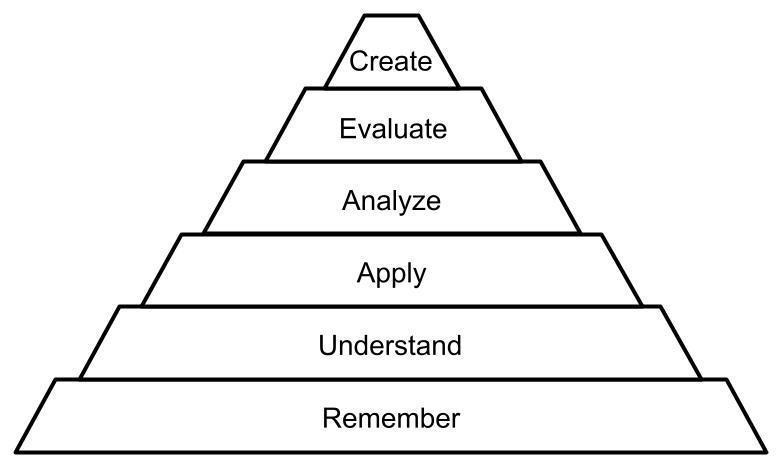
Figure 1. Bloom’s Taxonomy
| Grade Level (Age) | Number Sense |
| Kindergarten (5-6) | Whole numbers up to 20 (much more comfortable with 1-10 but can count up to 100) |
| Grade 1 (6-7) | Whole numbers up to 120 |
| Grade 2 (7-8) | Basic operations with whole numbers |
| Grade 3 (8-9) | Fractions (much more comfortable with unit fractions like ½, ⅓, etc |
| Grade 4 (9-10) | Mixed numbers, can convert fractions with denominators of 10 or 100 back and forth to decimals |
| Grade 5 (10-11) | Decimals to the hundredths place |
| Grade 6 (11-12) | Negative numbers |
| Grade 7 (12-13) | Rational numbers, percentages |
| Grade 8 (13-14) | Irrational numbers, radicals, scientific notation |
Table 1. Concepts of Number Sense Across Grade Levels
| Grade Level (Age) | Time | Measurement and Units | Money |
| Kindergarten (5-6) | – | Compare one attribute between two objects (i.e., which is taller) | – |
| Grade 1 (6-7) | Read hours and half hours | Order three objects by length, measure whole number units of length | – |
| Grade 2 (7-8) | Read nearest 5 minutes, AM and PM | Measure lengths of objects | Identify values of coins and dollar bills (quarters, dimes, nickels, pennies), use $ and ¢ symbols |
| Grade 3 (8-9) | Read to the nearest minute, add and subtract time | Measure liquid volumes, measure mass of objects in metric units | – |
| Grade 4 (9-10) | Solve word problems with all four operations (simple fractions OR decimals) | Measure mass in customary, compare units within one measurement system, convert from larger to smaller units in one system, solve word problems with all four operations (simple fractions OR decimals) | Solve word problems with all four operations (simple fractions OR decimals) |
| Grade 5 (10-11) | – | Convert smaller units to larger ones within a given system | – |
Table 2. Concepts of Time, Measurement/Units, and Money Across Grade Levels
| Grade Level (Age) | Shape |
| Kindergarten (5-6) | Identify shapes by name (square, circle, triangle, rectangle, hexagon, cube, cone, cylinder, sphere) |
| Grade 1 (6-7) | Identify trapezoids, identify quarter and half circles, identify rectangular prisms, partition circles and rectangles into halves and quarters |
| Grade 2 (7-8) | Identify quadrilaterals and pentagons, identify thirds of a circle, partition rectangles and circles into thirds |
| Grade 3 (8-9) | Calculate the area of rectangles using unit squares, calculate perimeter |
| Grade 4 (9-10) | Solve area and perimeter word problems with all four operations for rectangular situations (simple fractions OR decimals) |
| Grade 5 (10-11) | Calculate the volume of rectangular prisms using unit cubes |
| Grade 6 (11-12) | Calculate the area of right triangles, decompose shapes into right triangles, find the volume of rectangular prisms with fractional side lengths, identify nets of solids, calculate surface area of rectangular solids |
| Grade 7 (12-13) | Create and use scale drawings, determine angle measures of shapes, calculate area and circumference of circles, calculate area of non-rectangular 2D shapes (triangles, quadrilaterals, polygons), calculate surface area and volume of cubes and right prisms |
| Grade 8 (13-14) | Calculate volume of cylinders, cones, spheres |
Table 3. Concepts of Shape Across Grade Levels
| Grade Level (Age) | Miscellaneous Skills |
| Kindergarten (5-6) | Count scattered objects up to 10, count arranged objects up to 20 |
| Grade 1 (6-7) | Determine unknown number in addition/subtraction problems, mentally add or subtract 10 from a number, identify and use > = < symbols |
| Grade 2 (7-8) | Skip count by 5 / 10 / 100, unit bar graphs, picture graphs up to four categories |
| Grade 3 (8-9) | Determine unknown number in multiplication and division problems, identify arithmetic patterns (add or subtract the same number each time), compare fractions with the same numerator OR the same denominator, scaled bar graphs |
| Grade 4 (9-10) | Find factor pairs of whole numbers, compare fractions with different numerators AND different denominators, measure and add angles, identify parallel and perpendicular lines, determine lines of symmetry, create and interpret line/dot plots |
| Grade 5 (10-11) | Rounding decimals, using the coordinate plane (only positive coordinates) |
| Grade 6 (11-12) | Determine the greatest common factor of two numbers, use positive and negative coordinates on the coordinate plane, interpret histograms and box plots |
| Grade 7 (12-13) | Infer about a population from random sampling, calculate probabilities, read scale drawings, identify and use properties of supplementary/complementary/vertical/adjacent angles |
| Grade 8 (13-14) | Calculate slopes and use linear models (y=mx+b), apply transformations (translation, rotation, reflection, dilation), use the Pythagorean theorem and calculate distance, create and interpret scatter plots |
Table 4. Miscellaneous Skills Across Grade Levels
| Game | Mechanic | Related Math Skill | Grade Skill is Taught |
| Uno | Identify numbers as glyphs | Recognize numbers 1-10* | Kindergarten (5-6) |
| Monopoly | Collect income, spend money, make change | Operations with whole numbers | Grade 2 (7-8) |
| Magic the Gathering | +1/+1 and -1/-1 counters | Operations with negative integers | Grade 5 (11-12) |
| Dungeons & Dragons | Healing negative hit points | Operations with negative integers† | Grade 6 (11-12) |
| Machi Koro | Spending coins | Recognizing coins with different values† | Grade 2 (7-8) |
| Set | Matching shapes | Identifying Shapes* | Kindergarten (5-6) |
| Spot It | Matching scaled and rotated objects | Rotation, dilation, recognizing unorganized objects* | Kindergarten (5-6) |
| Cathedral | Placing oddly shaped pieces | Partitioning space* | Grade 6 (11-12) |
| Tangrams | Assembling pieces into a shape | Arranging shapes* | Grade 2 (7-8) |
| King of Tokyo | Rolling dice with symbols | Recognizing scattered symbols† | Kindergarten (5-6) |
| Risk | Assessing the strength of forces on the board | Skip Counting† | Grade 2 (7-8) |
| Pandemic | Determining the number of turns left | Arithmetic sequences† | Grade 3 (8-9) |
| Tic Tac Toe | Recognizing equivalent board states | Symmetry and rotation* | Grade 4 (9-10) |
| Battleship | Identifying locations with coordinates | Coordinate Plane* | Grade 5 (10-11) |
| Quacks | Press your luck | Probability from sample† | Grade 7 (12-13) |
* This skill is the exclusive focus of the game, allowing younger children to play effectively. These are good games to introduce math skills to younger audiences
† This skill is just one part of a player’s turn, making the overall game appropriate for older audiences. These are good games to reinforce previously learned material
Table 5. Summary of Example Games and Corresponding Standards

Jonathan Croft
Catlilli Games
Jonathan Croft (formerly Nardolilli) is a middle school mathematics teacher with a passion for using games in the classroom. He graduated from Carnegie Mellon University with a degree in civil engineering but immediately switched into teaching at a charter school in Washington DC. After a few years of various educational jobs ranging from being a tour guide at National Cathedral to hosting science themed birthday parties, he settled into being a fulltime classroom teacher at the Nysmith School in Herndon, Virginia. For the past decade, his classes there have utilized projects and simulations to empower gifted students to use math to solve relevant and interesting problems. He adapts many of these classroom tasks into marketable tabletop games with his wife, Dr. Catherine Croft, and their company Catlilli Games.
Facebook: https://www.facebook.com/CatlilliGames
Instagram: @catlilli15
Bluesky: @catlilli.bsky.social
www.catlilli.com

Catherine Croft, Ph.D.
Catlilli Games
Catherine Croft, Ph.D., earned her B.S from Duke University and her Ph.D. in Neuroscience from the University of Virginia. Dr. Croft then performed neurobiology research for eight years, mostly at the National Institutes of Health (NIH). Although she loved research, she ultimately gave in to her passion for teaching and transitioned to a career in education. She became a teacher in 2016, focusing on subjects including Biology, Anatomy & Physiology, Chemistry, and AP Research. Games are a centerpiece of her teaching style, and she co-founded the STEM game design company Catlilli Games with Jonathan Nardolilli (now Croft) out of her desire to reach a nationwide audience. Their games have won numerous awards, including from Serious Play (gold, silver, bronze) and Imagination Gaming (silver, bronze). Her mission in life is to enhance public knowledge of STEM concepts, and she views board games as a powerful tool to accomplish that.
Facebook: https://www.facebook.com/CatlilliGames
Instagram: @catlilli15
Bluesky: @catlilli.bsky.social
www.catlilli.com