
Board Game Academics, June 2026
Published in Vol 3. Issue II.
DOI: https://doi.org/10.70380/z4p8r1t6w0y3n
Tamara Stenn
Suffolk University
Abstract
This study examined how an experiential, analog card game can support sustainability learning in business education, and how the context in which gameplay is presented shapes psychosocial outcomes. The Sustainability Lens Game is a tabletop simulation designed to help business students and emerging entrepreneurs generate practical sustainability-enhanced enterprise solutions by linking business practices (“coin” micro-solutions) with Sustainable Development Goals (SDGs) across the Business Model Canvas (BMC). While experiential games can increase engagement through applied experimentation, creativity, and emotional involvement, prior research and classroom experience suggest that games alone may not reliably produce deeper learning. Facilitation context, such as storytelling and debriefing, may independently influence outcomes.
A classroom-based gameplay study was conducted with 52 undergraduate business students across three conditions: gameplay only, gameplay with structured debriefing, and gameplay preceded by a personal storytelling intervention. Pre- and post-surveys and observational notes were used to assess changes in eight psychosocial orientations associated with sustainability leadership, including connection/empathy, personal responsibility, intent, action intention, motivation, engagement, capacity/self-efficacy, and collaboration. Results showed that personal responsibility demonstrated the most consistent and statistically significant positive change across participants, with additional directional gains in intent and motivation. However, meaningful differences emerged across conditions: when gameplay was preceded by personal storytelling, students reported stronger increases in responsibility and collaboration, suggesting that narrative priming can activate a more caring and relational mindset that carries into applied problem-solving. Observations also indicated that much reflective processing occurred during gameplay, which may help explain limited engagement in the post-game debrief condition.
Gender-based differences were also observed: men reported stronger gains in responsibility and intent, while women, who entered with higher baseline scores across several measures, demonstrated increased motivation. Together, findings suggest that the Sustainability Lens Game can strengthen responsibility and sustainability-relevant intent, and that pairing experiential gameplay with storytelling may amplify psychosocial buy-in and collaborative engagement, helping bridge complex sustainability theory and applied practice in entrepreneurship-oriented education.
Keywords
Sustainability education; experiential learning; analog tabletop games; game-based learning; storytelling; psychosocial orientations; sustainability leadership; Business Model Canvas (BMC); Sustainable Development Goals (SDGs); higher education pedagogy
Introduction
Sustainable development presents a set of interdependent, high-stakes challenges that are difficult to address through linear planning or single-discipline expertise. It has been framed as a “harmonious coexistence between man and Nature” amid industrialization and accelerated resource use, requiring decisions that integrate environmental protection with social and economic well-being (Piwowar-Sulej et al., 2021). The United Nations’ Sustainable Development Goals (SDGs) reflect the scope of this agenda and the need for leaders to consider impacts that extend beyond firm or sector boundaries (Cesário et al., 2022). Within this landscape, businesses play a pivotal role because enterprise decisions shape sourcing, labor conditions, energy use, product design, distribution systems, and community relationships; each with potential for positive or negative effects on people and planet (Avery, 2005; Liao, 2022). Yet sustainability involves continual tradeoffs and cumulative choices over time, and even when leaders express interest in sustainability, uncertainty about where to begin and how to operationalize sustainability across business functions remains common (Kumar & Kiran, 2017; Liao, 2022).
These realities elevate the importance of sustainability leadership as a field of practice and scholarly inquiry. Sustainable Leadership has been examined through models of leadership development and organizational culture-building, emphasizing the leader’s role in shaping values, motivation, competencies, and practical pathways for sustainability inside and outside the organization (Avery & Bergsteiner, 2011; Hargreaves & Fink, 2004; House et al., 2004; Liao, 2022). As sustainability leadership scholarship expands, it increasingly highlights the challenge of preparing students to navigate complexity, uncertainty, and stakeholder interdependence in ways that are both ethically grounded and operationally feasible (Eustachio et al., 2023). Traditional instructional methods can struggle to bridge abstract sustainability frameworks and the lived decision-making pressures of entrepreneurship and enterprise building, where time constraints, competing objectives, and incomplete information are routine.
Experiential learning approaches, including game-based learning, offer one pathway for connecting conceptual sustainability knowledge to applied practice. Games can provide a structured environment for iterative experimentation, imaginative problem-solving, and low-risk exploration of decisions that may be difficult to simulate through lecture or case discussion alone (Gibb, 2002; Moizer et al., 2004). In higher education, non-digital (analog) tabletop games have been increasingly recognized for fostering engagement, collaboration, and conceptual understanding through social, embodied interaction and shared meaning-making (Conway & Smith, 2026; Rye, 2023). When paired with storytelling and role-based explanation, analog gameplay can further support empathy, compassion, and connection; qualities that are frequently linked to moral sensitivity and sustainability-oriented reasoning (Creed et al., 2021; Gillespie, 2022). Debriefing and structured reflection can consolidate learning by helping students process emotions, surface tacit assumptions, and connect gameplay outcomes to real-world contexts, aligning with experiential learning cycles that translate concrete experience into reflective and actionable insight (Hayse, 2018; Kolb, 1984). Design thinking scholarship similarly emphasizes iterative, participatory processes that support shared understanding, empathy, and the co-creation of solutions under complexity (Di Leo & Massari, 2024; Razzouk & Shute, 2012).
Despite this promise, gaps remain in entrepreneurship-focused game research and in understanding how facilitation context shapes learning outcomes. While evidence supports the value of game-based learning broadly, research remains limited regarding the impact of learning games on entrepreneurial intentions and related psychosocial outcomes (Wang et al., 2015). In addition, relatively less is known about how the presentation of a learning game – such as embedding storytelling before play or structured debriefing after play – may influence student experiences and outcomes independent of the game mechanics themselves (Hayse, 2018; Kolb, 1984). These gaps are particularly relevant for sustainability leadership education, where affective dimensions such as empathy and personal responsibility may meaningfully shape subsequent motivation, intent, and action (Creed et al., 2021; Liao, 2022).
To address these needs, this study examines the Sustainability Lens Game, an analog, card-based experiential learning simulation designed to help business students and emerging entrepreneurs generate sustainability-enhanced enterprise solutions by connecting business practices, micro-solutions, and SDG targets within a Business Model Canvas framework (Osterwalder & Pigneur, 2010; Stenn, 2026). The game can be played in-person and, in the study setting, included optional AI facilitation support intended to assist idea generation and structured summarization (Hou & Keng, 2021; Stenn, 2026). Using a three-condition quasi-experimental design with undergraduate business students, the study compares gameplay alone, gameplay paired with structured debriefing, and gameplay preceded by a personal storytelling intervention, assessing changes in psychosocial orientations associated with sustainability leadership (Kolb, 1984; Creed et al., 2021). The study is guided by three research questions: (1) How does the Sustainability Lens Game facilitate engagement with sustainability concepts through storytelling? (2) In what ways does the game create interpersonal connections that foster empathy and deeper understanding? and (3) How can the game function as a pedagogical tool for enhancing creative problem-solving and promoting real-world impact? (Stenn, 2025). By investigating both the game experience and the instructional context in which it is embedded, this paper contributes to sustainability leadership pedagogy and to the growing, yet still limited, research base on entrepreneurship learning games and their psychosocial impacts (Eustachio et al., 2023; Wang et al., 2015).
Sustainable Development is Complicated
Sustainable development is a difficult problem to solve, involving many complex parts and outcomes. It is defined as a “harmonious coexistence between man and Nature,” environmental protection in an era of industrialization and accelerated resource use (Piwowar-Sulej et al., 2021). Sustainable development includes challenges related to climate change, health, well-being, and the elimination of inequality and poverty. It is considered a global challenge with 17 sustainable development goals (SDGs) being adopted by the United Nations to help guide leaders in making choices that benefit not just their industry or place, but all the planet (Cesário et al., 2022). Businesses play a key role in sustainable development as they have the power to decide how to source materials, use energy, engage people, and create products and services that can have positive or negative impacts on the people and the planet. Business leaders engage with a wide range of stakeholders from global communities to the world environment. Sustainability-minded business leaders who embrace the concept of sustainable development are key to enterprise transformation and the advancement of sustainability practices with positive impacts. (Avery, 2005; Liao, 2022).
Sustainability in businesses is viewed through resource use and lifecycle, product and service access and impact, and community engagement. A business that is regenerative in its energy use, managing closed-loop cycles of materials, and is active in community development is considered more sustainable than a business solely focused on earning income (Kumar and Kiran, 2017). Sustainability is a long-term gain made up of many short-term decisions and actions. For example, consumers rarely pay attention to the materials in the clothing they wear, looking more at price and style. Meanwhile, the materials, not the price or style, are where the environmental and social impacts happen; organic fibers support healthy farming and clean environments, and fair wages help garment workers and their communities. The costs associated with safer materials and production are tradeoffs for the consumer who is looking for the best price and style. This tradeoff needs to be carefully managed by the business if they are seeking to appeal to the consumer while also managing a more environmentally and socially sustainable operation (Piwowar-Sulej et al., 2021).
Sustainability is not just an aspiration or a good deed, but a necessary responsibility and benefit for a business (Liao, 2022). While business leaders and individuals express interest in achieving sustainability, many are uncertain as to where and how to start. Hargreaves and Fink (2004) developed a seven-step model of sustainable leadership development on a personal level, while Avery and Bergsteiner (2011) examined the leadership role in creating an organizational culture that focuses on innovation and sustainability within an organization. Sustainability leaders develop organizational cultures that promote sustainability concepts, values, and goals within the organization to induce internal motivation for sustainability while also creating key competencies, products, and models for experiencing sustainability externally (Liao, 2022). In other words, leaders play a key role in influencing, motivating, and enabling other people to contribute to the organization’s effectiveness and success (House et al., 2004, p.56). Sustainability Leadership (SL) is a growing field of academic study (Eustachio et al, 2023). The demands on leadership, mixed with the complexities and risks of sustainable development, make Sustainability Leadership rich for experiential learning and games. Games and experiential activities enable learners to explore a variety of outcomes based on different decisions in a safe, supportive learning environment. The Sustainability Lens Game in this study was created to meet this need for Sustainability Leadership simulation activities to better explore and engage in sustainability practices (Stenn, 2026).
Experiential Learning – A Need to Better Understand Games
Games help build creative solutions and a safe place for risk-taking and imagination. In the Sustainable Leadership world, they are seen as a convenient way to experience the complex and uncertain lifeworld of the entrepreneur (Gibb, 2002). Students can play in an environment that protects them from key risks, such as bankruptcy or emotional trauma, and can experiment and learn through iterative game plays with different outcomes (Moizer et al., 2006). Games on their own give a single sensation, the act of playing and winning.
Games come in different formats, which lead to different levels of engagement and learning. There are analog games, virtual games, alternative reality games, and a large range of game types in between. Analog games are also known as tabletop games or non-digital traditional games, such as board and card formats. They are increasingly recognized as valuable tools for active learning in higher education as they promote engagement, collaboration, and conceptual understanding through embodied and social interaction with students being present together in the same space and playing the game together (Conway & Smith, 2026).
Dr. Sara Rye, a game-based learning researcher, explores how tangible, analog games foster conceptual learning, critical thinking, and engagement in higher education. She found benefits to analog games that online games do not share. Analog games, live, face-to-face interactions, and hands-on manipulations, often consisting of cards, dice, and playing pieces, reduce cognitive load and bridge abstract concepts with real-world application (2023). Analog game playing emphasizes multisensory, active engagement and social interaction as mechanisms that deepen understanding and support transfer. In addition, cooperative play, discussion, and a game’s alignment with learning objectives have been found to be keys to effective conceptual learning in higher education (ibid).
There are many benefits to game playing, that go beyond the simple game mechanisms. Analog games support active storytelling and role playing as participants are required to take on different characters and make and explain game-based decisions. This act of game-based storytelling builds compassion and connection as participants together imagine and engage in the scenarios participants present (Creed, Ross & Ross, 2021). Storytelling also aids in theory engagement as participants need to create meaning and connection between their story and the theoretical conditions the games present (Gillespie, 2022). Theory engagement through storytelling and game play improves students’ conceptual learning in higher education as complex theories and now applied in logical, believable ways (Rye, 2023). Studies have found that this type of analog, story-based gameplay grows students’ creative potential and emotional creativity as teammates buy into each other’s stories and further engage with imaginative play, boosting confidence and encouraging more imaginative solutions (Dyson, et al, 2016). Storytelling is a way to surface values of “sensitivity, compassion and connection” and to translate those morals into organizational and sustainability practice (Creed, Ross & Ross, 2021). Stories can be carriers of humane, relational wisdom that can guide contemporary management. For example, stories can be presented in a way to reinforce desired outcomes by “generate(ing) an original matrix of storytelling morals…for the benefit of present and future applications of sustainability” (Creed, Ross & Ross, p.32). This is important because stories are how we make sense of the world. They help us connect emotionally to problems that might otherwise seem distant or abstract. Storytelling and games affect students behaviorally, emotionally, and cognitively being effective curricular lever for improving engagement and linking concepts to practice (Guillespie, 2022).
Debriefing a game by reviewing what happened, how it happened, and discussing next steps or shared learning moments, further solidifies learning. Debriefing helps students process emotions, connect gameplay to course concepts and real-world contexts, and enables learning transfer by providing a shared protocol of feelings, notable events, skills, connections, rule and strategy reflections (Hayse, 2018). Online and virtual game elements also benefit players. Technology in online games can help to build the digital storytelling flow and aid in the acceptance of game playing lessons (Hou & Keng, 2021). The Kolb learning cycle, based on concrete experiences, provides a framework to turn experiences such as game play into deeper learning and future actions (Kolb, 1984). To personalize learning, Kolb created a small experience and guided participants through a questioning what the experience was, first personally and then as a group experience. He focused on the actual event, questioning participants go deeper, applying their insights to larger learning. Gameplay creates Kolb-style experiences by enabling participants to try new ideas and see how they play out in a safe environment, without the risk of harm or unintended consequences. Game play coupled with reflective learning, such as that of Kolb, has been an effective way to engage students in new experiences, creating a place for applied learning outcomes (Usart & Romero, 2014; Panoutsopoulos & Sampson, 2014).
Another part of imaginative game play is the use of design thinking skills, which build interconnectedness and socialization through collective visioning (DiLeo & Massari, 2024). Design thinking is a non-linear, iterative process that can be guided by concepts, images, and stories, which teams use to understand users, challenge assumptions, redefine problems, and create innovative solutions (Razzouk & Shute, 2012). Design thinking, a way for teams to collectively share in creating solutions, is seen as an effective method for interconnectedness, socialization, and collective visioning (DiLeo & Massari, 2024). More specifically, design thinking’s structured, participatory processes built shared understandings of sustainability, systems thinking about interconnected issues, and “socialization of participant thinking” toward a collective sustainability vision. Using storytelling and experiential learning, design thinking fosters empathy, inclusive conversations, team collaboration, and rapid prototyping as a vehicle for learning and alignment. In summary, games are more than a social diversion or a play mechanism; they are an opportunity for creative sharing, community building, experimentation, learning, and growth.
Problem
This paper addresses several problems around academic learning through gameplay.
- A lack of game studies in entrepreneurship. However, we have engaged in a literature review about gameplay in general. Gameplay in the entrepreneurial context is still lacking research. Though strong evidence exists for supporting the value of game-based learning, there is still a need for a body of research concerning the impact of learning games on entrepreneurial intentions (Wang et al., 2015). This paper contributes towards the need for further study of the impact and effectiveness of game play in the entrepreneurship context, and more specifically, around Sustainability Leadership within entrepreneurship.
- A lack of study of the context of gameplay. Though there is a degree of literature about the usefulness of games in learning, there is not much data about the way in which games are presented in the classroom affects learning outcomes. Storytelling before a game play and debriefing after a game play could affect the learning experience of students, independent of the game itself. More studies about the context and placement of games in learning are needed.
Research Questions
To address the problem of a lack of research in entrepreneurship game play and the unknown impact that context has on student learning experiences, a study of the Sustainability Lens Game was developed. The mechanisms studied included storytelling, role playing, design thinking, and AI digital assistance. These were presented in three different game-play contexts with a survey tool measuring students’ experiences.
The study was guided by the following research questions:
- How does the Sustainability Lens Game facilitate engagement with sustainability concepts through storytelling?
- In what ways does the game create interpersonal connections that foster empathy and deeper understanding?
- How can the game function as a pedagogical tool for enhancing creative problem-solving and promoting real-world impact?
These questions led to an examination of emotions and action. Based on the literature about the impact AI-assisted, design thinking-based, analog gameplay has on cognitive and learning states, eight statements were created to measure changes in student psychosocial orientations toward sustainability leadership after gameplay.
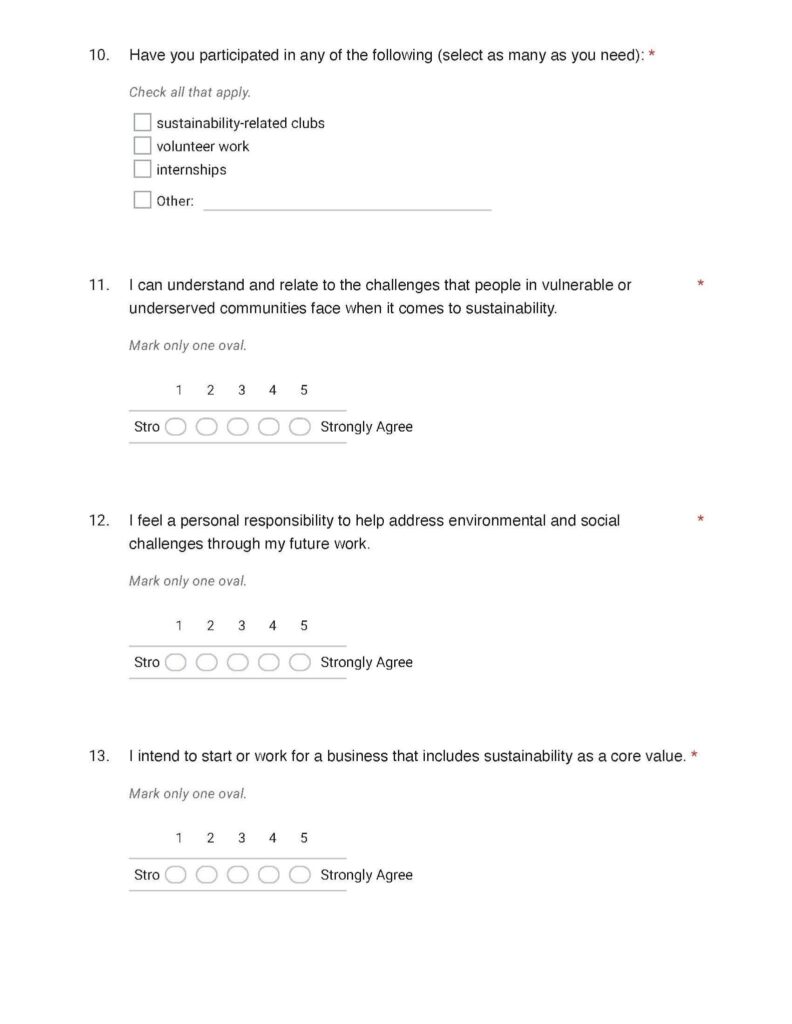
- I can understand and relate to the challenges that people in vulnerable or underserved communities face when it comes to sustainability (Connection).
- I feel a personal responsibility to help address environmental and social challenges through my future work (Personal Responsibility).
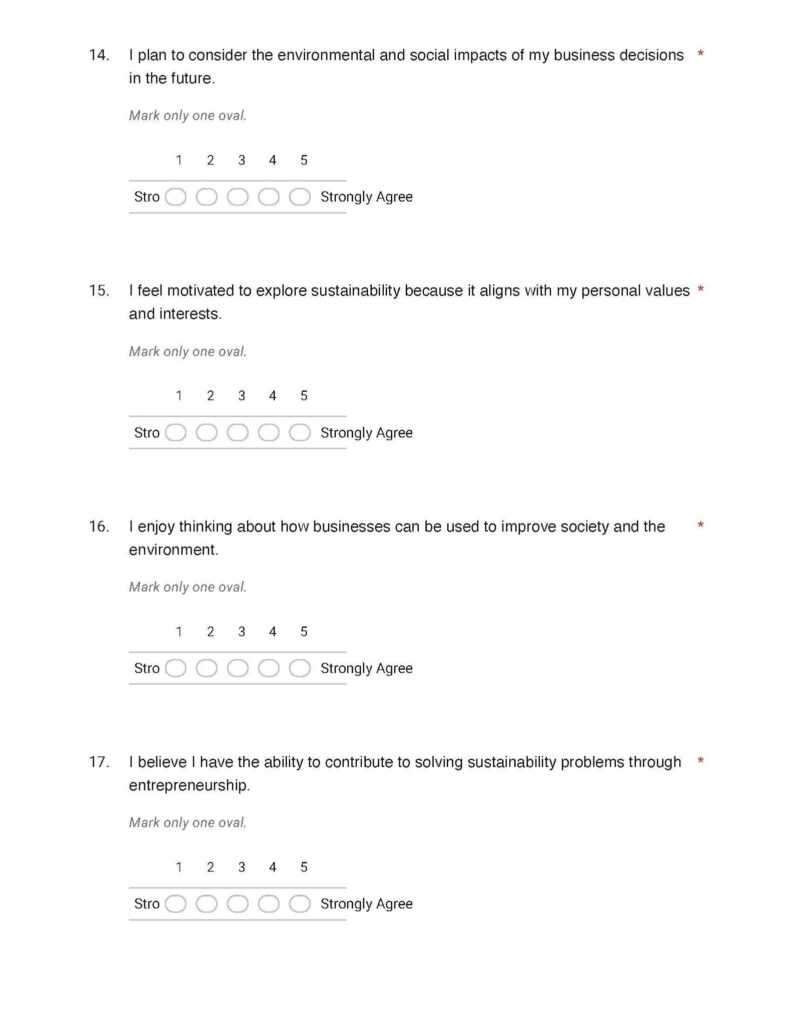
- I plan to consider the environmental and social impacts of my business decisions in the future (Intent).
- I intend to start or work for a business that includes sustainability as a core value (Action).
- I feel motivated to explore sustainability because it aligns with my personal values and interests (Motivation).
- I enjoy thinking about how businesses can be used to improve society and the environment (Engagement).
- I believe I have the ability to contribute to solving sustainability problems through entrepreneurship (Capacity).
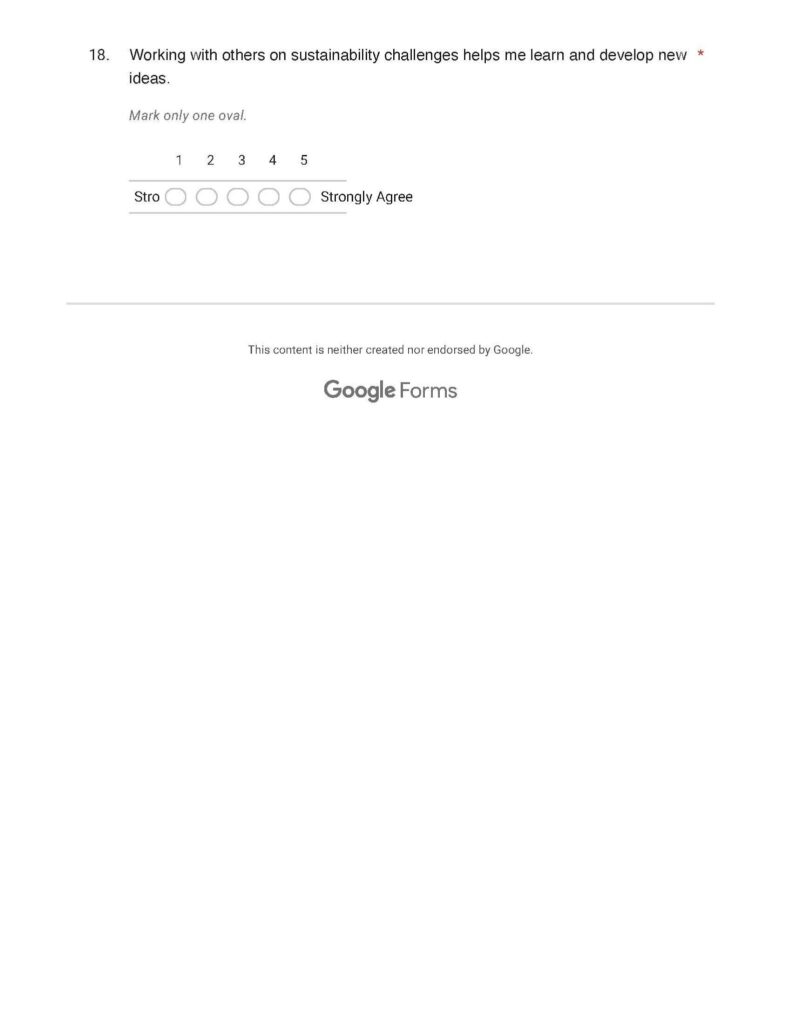
- Working with others on sustainability challenges helps me learn and develop new ideas (Collaboration). (Stenn, 2025)
These statements respectively reflect the following psychosocial orientations: Feeling Connected, Personal Responsibility, Intent, Action (Behavioral Intention), Motivation, Engagement, Capacity (Self-Efficacy), and Collaboration. Across student-led game development projects, psychosocial orientations can be framed as an “explored state” sequence that helps explain how learners move from relational awareness to sustained leadership-oriented action (fig. 1).
First, feeling connected (e.g., empathy and relational awareness of vulnerable communities) is commonly positioned as a pathway into ethical consciousness and social responsibility, helping students bridge “us vs. them” divides and ground value tradeoffs in lived human contexts; this aligns with emotional intelligence work that treats empathy as a core component and with sustainability education research linking positive social emotions to greater willingness to act (Munira et al., 2022; Grund et al., 2024). Building from connection, personal responsibility reflects the internalization of moral agency or prosocial motivation, where sustainability-relevant commitments become part of identity; entrepreneurship work suggests values and orientations can be drivers of sustainable entrepreneurial orientation, while also noting limited direct linkage between “personal responsibility” as a discrete emotional state and sustained leadership action (Lazarte-Arguirre, 2024). In social-psychological terms, intent is a key antecedent to behavior, and sustainability-oriented scholarship often treats intention (including sustainable entrepreneurial intention) as a bridge between awareness, values, and subsequent action (Zanardo et al., 2024). Moving beyond intent, action intention/behavioral commitment represents a stronger pivot toward execution; work in environmental leadership and sustainability entrepreneurship frequently operationalizes behavioral intention or commitment to sustainable practice, including evidence that transformational leadership processes can induce pro-environmental behaviors (Sai, 2024).
Within this framing, students’ persistence in complex design cycles can also be connected to motivation, where internally aligned, values-based motivation is described as more enduring than compliance and is associated with sustainable leadership outcomes in emotional-intelligence-to-sustainable-leadership research (Munira et al., 2022). Engagement (reflective, cognitive–emotional engagement) further emphasizes depth; reflection, dialogue, and iterative experimentation are highlighted in transformational learning scholarship as mechanisms supporting shifts in meaning and behavior (Bryant et al., 2023). Because game development can demand risk-taking, iteration, and problem-solving under uncertainty, capacity/self-efficacy becomes central: beliefs about one’s ability to contribute are treated as crucial for mobilizing resources and persisting, and related work links emotion regulation to sustainable leadership capacity (Ballarotto et al., 2024). Finally, collaboration is characterized as essential for scaling ideas, pooling resources, and sustaining accountability; sustainable leadership literature emphasizes stakeholder networks, partnerships, and co-creation as key mechanisms through which entrepreneurs and change agents leverage collaboration to innovate (Liao, 2022; Doornich et al., 2025).
The Study Tool: The Sustainability Lens Game
Academic games such as the Sustainability Lens Game, which is grounded in academic theory and business-building experience, are designed to inspire and motivate business students, entrepreneurs, and developers to try new things, take risks, and explore sustainability methods in a safe, supportive, educational environment (Stenn, 2026). This paper sets out to understand how this happens by quantitatively exploring how the Sustainability Lens Game gives people a chance to try new things, take risks, think differently, create stories, and work together. It also looks at the context in which the game is presented in the classroom to determine if there is a best way for games to be introduced. The Sustainability Lens Game was selected for this study because of the author’s familiarity with the game, which they created. Though the author set up the study, game plays were performed by third parties, and data were analyzed by independent experts, to address any conflict of interest the author may have had in studying their own game and its outcomes.
The Sustainability Lens game is a physical, analog, card game that can be played in a hybrid environment. Students participated in in-person teams of four to five players assisted by Sustainability Sam, an artificial intelligence AI bot, accessed through a smartphone QR code with a Wi-Fi connection. Sustainability Sam was a GPT trained on the Sustainability Lens Game and the book, The Profitable Good, which archived the theoretical background for the game. If WIFI were not available, the game could be played purely analog, though the benefit of Sustainability Sam, a knowledgeable facilitator, score keeper, and assessor, would be lost. Sustainability Sam played the role of a facilitator, helping prompt students with new ideas and ways to imagine sustainability across business sectors. Sustainability Sam also provided assessment tools to bring teams into an actionable reality by providing a sustainability action summary, SWOT analysis (an assessment of the action’s strengths, weaknesses, opportunities, threats), actionable next steps, and a short elevator pitch for the new, sustainability-enhanced enterprise. Sustainability Sam’s AI-driven guidance and communications captured the “aha moment” in the Sustainability Leadership experience, building credibility and confidence as participants took concrete steps towards sustainable development (Stenn observation, 2025). In this way, the game helped to transform fantasy into reality.
Another important aspect of the Sustainability Lens Game was its deep theoretical base. The Sustainability Lens Game was built on 25 years of primary research and practitioner experience in sustainable business development, including a Fulbright research study, three published books, and many peer-reviewed papers and conference presentations (Stenn, 2026). The Sustainability Lens Game included 64 micro tools known as coin cards, which were mini sustainability solutions vetted for their impact and practicality. In the game, coin cards were matched with the 17 Sustainable Development Goals (SDGs) and played across the nine sections of the Business Model Canvas (BMC). The BMC was an open source, design thinking tool that laid out the areas of an enterprise, including materials sourcing, product development, audience development, allies, marketing, and financials (Osterwalder & Pigneur, 2010). Using the BMC as the foundation for the Sustainability Lens game board, created the design thinking environment necessary for the game to be collectively engaged in and shared. All players could see the entire game structure together as they singularly chose which area to work on, with input from the others around them. Completed turns and solutions (solved cards) were left on the board as a reminder to all of what was solved. When looking at each BMC sector in relation to the coin cards and SDGs, a total of 9,792 different sustainability solution combinations and endless gameplays emerged (Sustainability Lens Game blog, 2026).
In the Sustainability Lens gameplay, the team mapped out an ordinary business plan as guided by the BMC and shared this plan with Sustainability Sam (if they were playing the AI-assisted version). For each turn, one player chose which sector of the BMC to focus on and selected 3 random coin cards with different point values and 1 random SDG card, which was worth 5 points. The player then had two minutes to weave together seemingly disparate sustainability solutions into actionable steps, using storytelling to explain how the business will now function in its specific BMC area while accommodating the new sustainability solutions. Points were awarded for every solution that was presented within two minutes and accepted by the team. Sustainability Sam listened to and recorded players’ solutions and was available for tips if needed during a team member’s turn. Then the next player went, and the turn began again until all sectors of the BMC were addressed or the team felt they had enough direction to move forward. Sustainability Sam kept track of the myriad solutions and stories that arose from players as they wove together solutions to the coins and SDG prompts across the BMC. At the end of the gameplay, Sustainability Sam provided teams with a gameplay summary, SWOT analysis, next steps, and a Sustainability pitch. Because the game is built on the human input and creative thinking of the players, no gameplay was ever the same, even if the same game scenario was played more than once.
The Study
The Sustainability Lens Game plays for this study took place over a two-week period in different business school classrooms and meetings at a local university. To keep the game plays congruent, but to prevent teams from overhearing each other’s conversations and solutions, two different business scenarios were used: a dog walking service and a lemonade stand (product) at a farmer’s market. The businesses were mapped out on the BMC with the most basic elements present: a customer base, production, a product or service, costs for a month of operations, and earnings. The BMC showed each business as a small, profitable, part-time enterprise. The Sustainability Lens Game goal was to grow this basic enterprise into something more – making it more competitive, profitable, and meaningful, a truly sustainable enterprise.
Though the game was played in turns with a single person taking ownership and getting credit for their turn, all players together helped to meet the game’s goal of building a more sustainable enterprise. This is known as competitive collaboration or “coopetition” and mimicked the way sustainability works, where systems working together achieved more, often blurring the distinction between competitor and collaborator and resulting in mutual benefits that neither could have achieved alone (Taylor & Ball, 2023; Heinrich, 2025). The collective nature of the gameplay leads to a shared development of emotional responses. As participants grappled to make sense of sustainability solutions, new ways of thinking about a business began to emerge with patterns of responses appearing, such as “donating to local causes,” “providing branded refills,” “carbon-free delivery options,” and “engaging in beneficial partnerships with local organizations” (Stenn, 2025). With a timed two-minute turn per player, there was a sense of urgency that pushed players forward, creating a sense of competition with time, rather than with each other.
In the Sustainability Lens Game, the winner was the player with the most points. At the same time, no one lost because, as a collective team, they gained a vetted sustainability plan for their enterprise. In addition, everyone had a chance to lead and contribute equally. This resulted in a more positive, high-energy, low-stakes experience where players could relax and have fun with their creativity, while the two-minute timer kept things moving forward. Though the game plays were different, the emotional experiences were congruent. The gameplay experience was more about solving problems and creating new solutions than what the actual starting business was (Stenn, 2025).
Methodology
This study employed a three-condition quasi-experimental design to examine how each storytelling, structured debriefing, and gameplay alone influenced business students’ psychosocial orientations toward sustainability. The intervention used The Sustainability Lens Game, a 30-minute experiential simulation card game designed to support creative problem-solving on sustainability concepts. Ross proposed including a short empathic story to foster greater empathy in gameplay (Ross, 2025). For one game play group, Froese shared an empathy-invoking story told about their own difficult experiences, before a group of students engaged in gameplay (Froese, 2025).
Participants and Setting: The studies were conducted during September 2025 at Suffolk University’s Sawyer Business School in Boston, Massachusetts. Participants included 52 undergraduate business students. Students were recruited through classroom sessions and student club meetings. Data collection and facilitation were overseen by graduate research assistants under the supervision of the game’s creator, Dr. Tamara Stenn. Dr. Stenn is also an entrepreneurship professor at the school.
Experimental Conditions: Participants were assigned to one of three experimental groups, each designed to test the differential effect of storytelling or debriefing on the game’s psychosocial impact:
- Story + Gameplay (n = 16): Participants viewed a 10-minute live Zoom testimony delivered by an individual describing personal experiences of marginalization, followed by 30 minutes of gameplay.
- Gameplay + Debrief (n = 24): Participants engaged in 30 minutes of gameplay, followed by a structured 15-minute debrief session designed to facilitate reflection (see Appendix A for debrief protocol).
- Gameplay Only (n = 12): Participants played the game for 30 minutes without additional storytelling or debriefing.
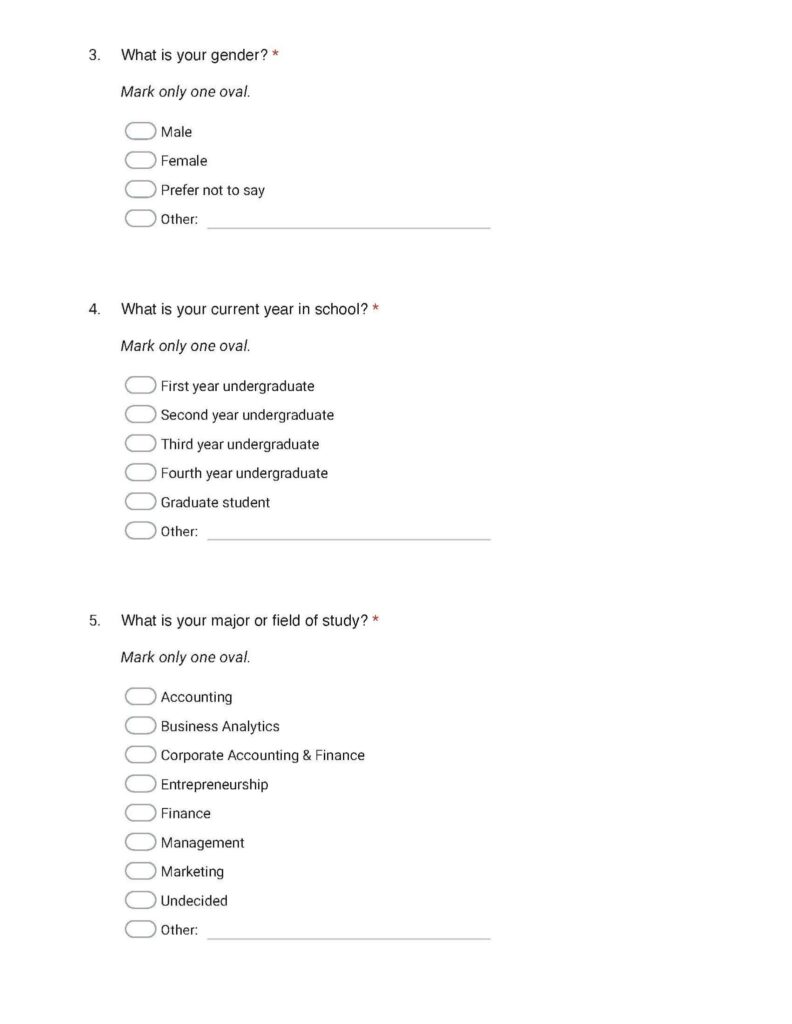
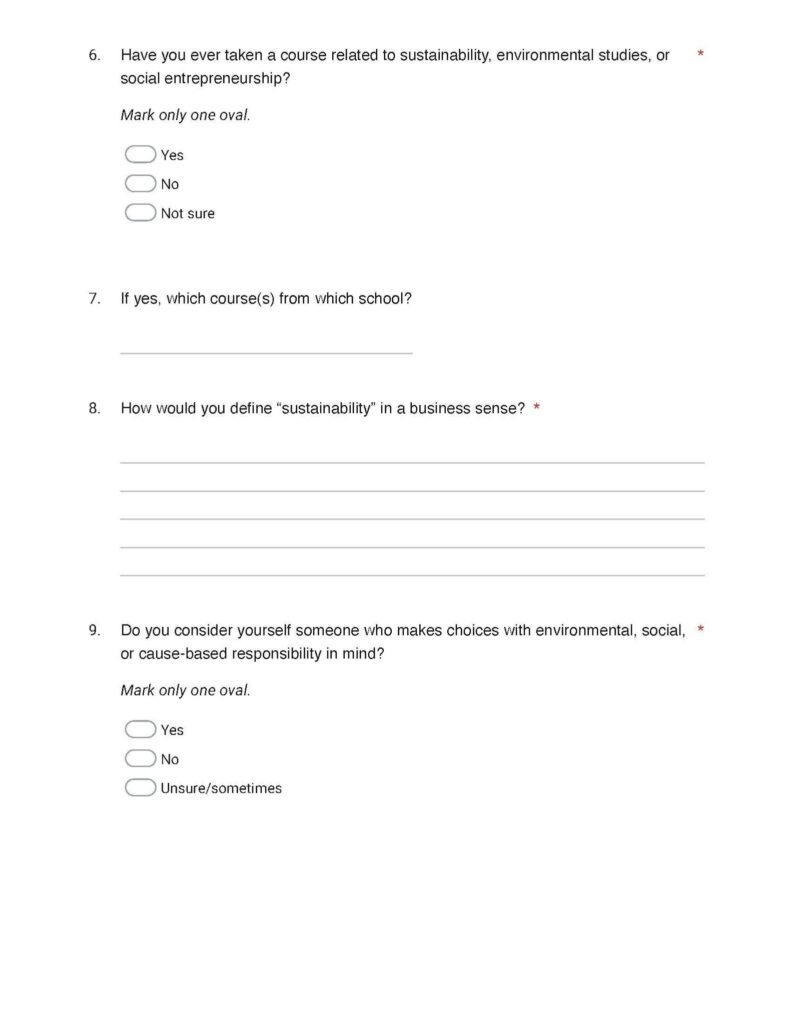
Instruments and Procedure: All participants completed a pre-survey (Survey 1) that captured demographic data and baseline measures of psychosocial orientations (e.g., empathy, responsibility, motivation, collaboration, and engagement). Following their assigned condition, participants completed a post-survey (Survey 2) consisting of the same items, designed to assess changes in psychosocial states. Participants defined sustainability in business from their own perspective in the following ways (fig. 2).
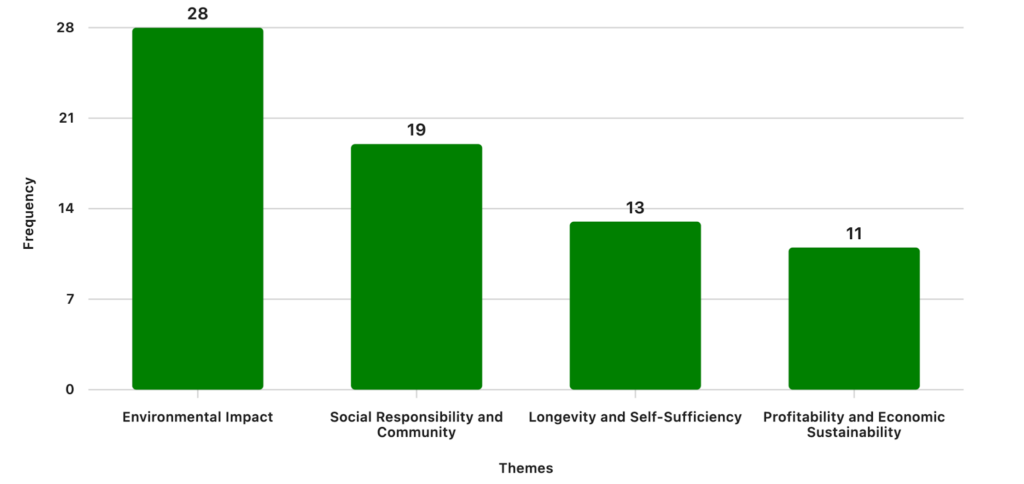
Figure 2. Student’s response to the question: “How would you define “sustainability” in a business sense?”
(Stenn, 2025)
During gameplay, students worked collaboratively in groups of three to five. Each participant was allotted two minutes per turn to address a sustainability challenge; however, discussions sometimes extended beyond the time limit as groups engaged in collaborative problem-solving to generate well-developed collective responses. A turn began with the selection of three random coin cards, each valued between one and three points, and one Sustainable Development Goal (SDG) card valued at ten points. Players also selected a section of the Business Model Canvas (BMC) on which to focus their scenario. To support the process, participants could photograph their selected cards and send the image to Sam, an AI assistant designed to facilitate gameplay. Upon receiving the image, Sam immediately generated two suggestions that the player could choose to incorporate or disregard. The player then had two minutes to construct a sustainability scenario that utilized as many of the coin cards as possible while addressing the chosen SDG. Players could seek Sam’s assistance by reading their ideas aloud or typing them in for real-time feedback. Group members were encouraged to collaborate throughout this process, offering additional input and support. Once a scenario was finalized, the player presented it to both Sam and their teammates, typically incorporating feedback from the group discussion. The completed response was shared with Sam either verbally or in writing. Sam then recorded and summarized the response, tracking each team member’s progress and points earned, over the course of the game.
Observational Notes: Across 15 student groups, gameplay involved the application of sustainability concepts to three different enterprise Business Model Canvases (BMCs). While gameplay was characterized by increasing fluidity, creativity, and group synergy, post-game debrief engagement was relatively limited. Informal observations suggest that much of the reflective processing occurred organically during gameplay itself. This may have led to reduced cognitive bandwidth for further analysis during the formal debrief session, indicating potential cognitive saturation.
Statistical Methods
To strengthen the analysis, inferential statistical tests were conducted to determine whether the observed pre- and post-intervention changes were statistically significant. Given that the dataset comprised paired Likert-scale responses (n = 52), multiple analytical methods were employed to ensure robustness and address potential violations of normality assumptions. Parametric analyses included paired t-tests to examine mean differences under the assumption of normally distributed differences. Complementary nonparametric methods were also applied, including the Wilcoxon Signed-Rank test, which is appropriate for ordinal data and does not assume normality, and the Sign test, which provides a conservative evaluation of directional change without relying on magnitude. In addition, bootstrap confidence intervals were computed to obtain distribution-free estimates of effect sizes, enhancing the reliability of the findings. To control for the increased risk of Type I error associated with multiple comparisons, Holm–Bonferroni corrections were applied to adjust significance levels. Together, these complementary statistical approaches provided a rigorous and multidimensional assessment of whether pre/post changes were statistically and practically significant.
Initial Findings
Initial findings revealed that personal responsibility demonstrated the greatest and most consistent positive change among all measured dimensions. This construct showed statistically significant improvement across multiple tests, including the paired t-test (p = .043) and the sign test (p = .047), with the bootstrap 95% confidence interval ([0.12, 0.60]) excluding zero – indicating a robust and practically meaningful effect. Intent and motivation also showed positive post-intervention shifts, as reflected in bootstrap confidence intervals that excluded zero (Intent [0.06, 0.70]; Motivation [0.06, 0.58]), suggesting genuine though moderate improvements in these areas. However, the Wilcoxon and adjusted t-tests were less conclusive, indicating that while gains were apparent, they may not have been uniformly distributed across participants. In contrast, no statistically significant changes were observed for the remaining dimensions – connection, action, engagement, capacity, and collaboration – which remained largely stable from pre- to post-assessment. This stability is likely attributable to high baseline levels in these areas, suggesting a potential ceiling effect where participants already reported strong initial competencies or attitudes that left limited room for measurable growth.
Explanation of findings
The qualitative analysis of students’ definitions of “sustainability in a business sense” revealed that participants entered the Sustainability Lens Game with a foundational awareness of the concept, though framed in diverse ways. Many emphasized environmental responsibility, highlighting practices such as conserving resources, reducing waste, and avoiding harm to ecosystems. Others associated sustainability with long-term viability and resilience, describing businesses that adapt and renew themselves to ensure continuity over time. A significant portion viewed sustainability as a balance between economic and social responsibility, linking profitability to ethical treatment of people, communities, and the environment. Still others framed it in terms of ethical practices and accountability, noting the importance of fair sourcing, employee well-being, and transparent operations. Finally, some highlighted self-sufficiency and renewal, reflecting ideas of circular systems and resource independence. Together, these perspectives suggest that students came to the game with a multifaceted but primarily conceptual understanding of sustainability. This baseline knowledge positioned them to meaningfully engage with the Sustainability Lens Game, while also leaving room for the game’s experiential, storytelling-based approach to deepen their understanding of how sustainability can be operationalized across business models.
In Sustainability Lens Game gameplays, players did not just talk about climate change or fair trade; they imagined how their enterprise could create new business solutions by embracing these challenges. They negotiated, strategized, and adapted, just like in real life. This immersive experience made sustainability concepts become more real. Creed Ross & Ross find that beyond education, storytelling in games fosters collaboration and empathy. When one steps into a character’s shoes, even for a few rounds of play, they start to see the world from a different perspective. This kind of deep engagement is what drives meaningful change. By integrating storytelling into game mechanics, the Sustainability Lens Game intends to help players think critically and creatively about sustainability, offering a bridge between knowledge and action.
There was a significant emotional response in the pre-game story group that other groups did not experience (Stenn, 2025). Stories can have an impact both before and during gameplay. A positive correlation was found between the game flow and students’ acceptance of tech assistance. It was also found that tech-facilitated problem-solving resulted in more reflection and analysis, and a reduction in cognitive overload. It is expected that the AI assistant, Sustainable Sam, in the Sustainability Lens Game can similarly provide positive support in gameplay by helping with ideas, keeping track of responses, and providing important end-of-game summaries and pitches.
1. Overall Shifts in Psychosocial Orientations
Across the survey responses, the most consistent and statistically significant shift was in personal responsibility (fig. 3). Students increasingly reported feeling that they personally have a role to play in addressing sustainability challenges. This aligns with leadership and behavioral theories that emphasize the importance of internalizing responsibility as a precursor to sustained action. As noted in transformational leadership and moral agency literature, once individuals see sustainability as part of their identity, they are more likely to translate values into consistent decision-making (Creed, Ross, & Ross, 2021).
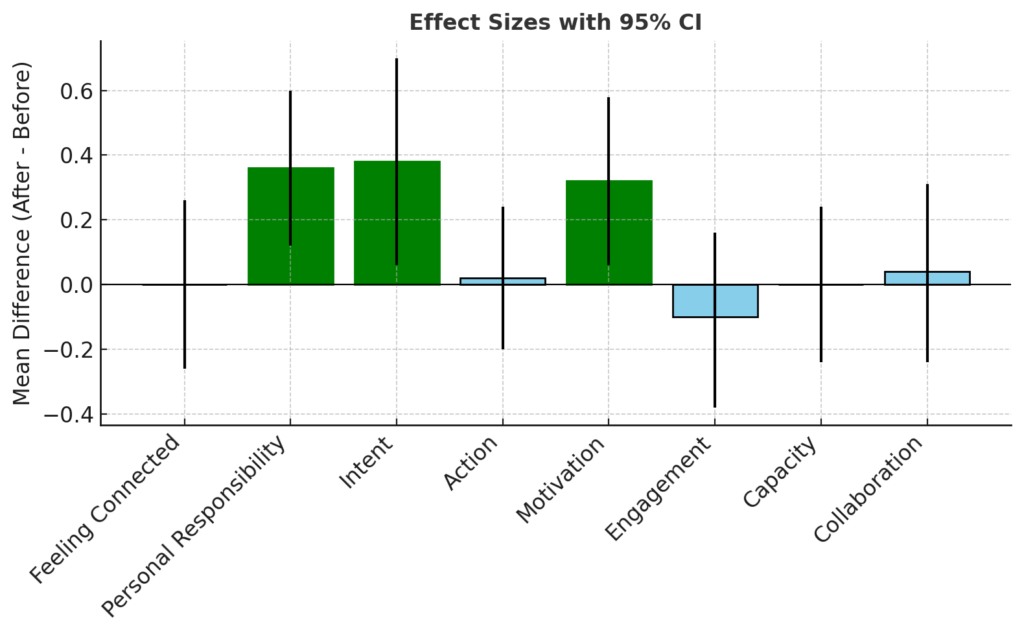
Figure 3. Statistical Significance of Psychosocial Shifts (Stenn, 2025). Adapted from the significance test summary. This figure presents the comparative strength of changes across eight psychosocial orientations. Results show Personal Responsibility as the only consistently significant change (supported by t-tests, sign tests, and bootstrap CIs), while Intent and Motivation showed directional gains significant in bootstrap intervals. Other orientations showed no reliable changes, suggesting ceiling effects.
There was also suggestive evidence of gains in intent (planning to work in or start a sustainability-oriented business) and motivation (exploring sustainability as personally meaningful). While these shifts were not uniformly significant across all tests, they are directionally consistent with the Theory of Planned Behavior, which posits that intention is a critical antecedent to actual behavior (Ajzen, 1991). Other orientations (such as empathy/connection, collaboration, and capacity/self-efficacy) showed more stable results, indicating that a single game intervention may spark responsibility and intent before translating into bigger or broader psychosocial changes.
2. Gender-Based Differences
Gender analysis revealed nuanced patterns (fig. 4). Men (n=32) showed significant gains in both personal responsibility and their intent to work in sustainability, suggesting that gameplay may have particularly influenced how they envision their future roles. Women (n=22), by contrast, already entered with higher baseline levels across nearly all measures and demonstrated a significant increase in motivation (“exploring sustainability because it aligns with personal values”). This supports prior research indicating that women often self-report stronger pro-social and pro-sustainability orientations at the outset. For women, the game may have functioned as an affirming and energizing experience, reinforcing intrinsic motivation, whereas for men it appeared to act as a reframing intervention that heightened responsibility and intention.
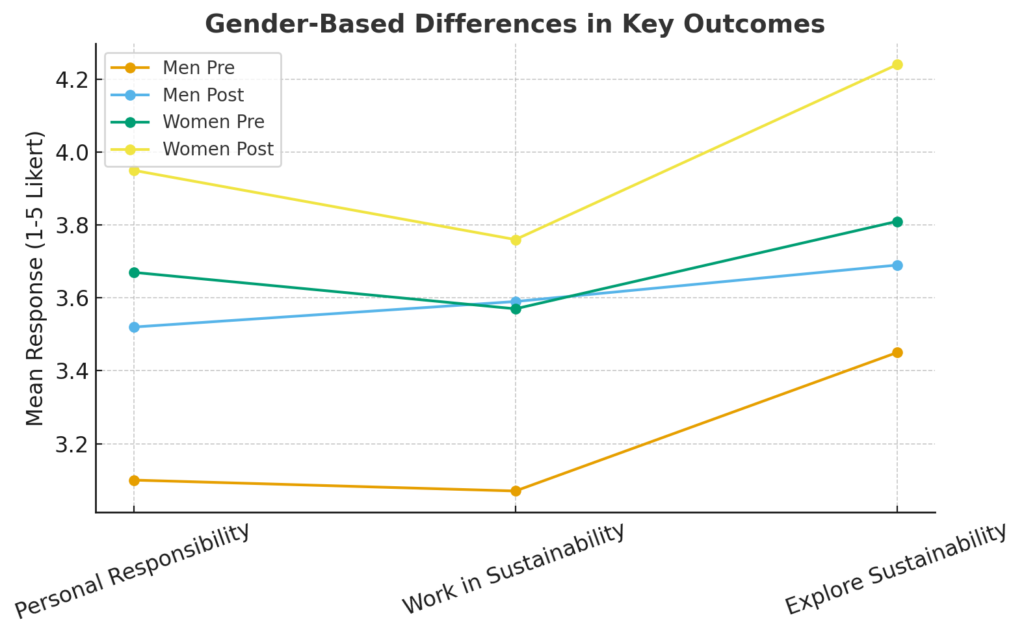
Figure 4. Gender-Based Differences in Key Outcomes (Stenn, 2025). This figure compares pre- and post-game survey means for men and women across three psychosocial orientations: personal responsibility, intent to work in sustainability, and motivation to explore sustainability. Results show that men demonstrated significant gains in responsibility and intent, while women, who entered with higher baseline scores, showed notable increases in motivation. These findings suggest gendered pathways: for men, the game appears to act as a catalyst for identity formation, while for women, it reinforces and deepens existing values.
This finding underscores the differentiated pathways of learning: for some, game-based learning serves as a catalyst for new identity formation, while for others it deepens and consolidates existing commitments. It also resonates with emotional intelligence and sustainability leadership research, which suggests that empathy and motivation are differentially distributed and may require varied pedagogical approaches.
3. Mode of Delivery Differences
The analysis comparing a pre-story with game delivery to game alone or game plus debrief revealed a statistically significant increase in personal responsibility among participants in the story condition (Figure 5). This outcome supports storytelling theory, which posits that narratives can prime empathy, compassion, and moral engagement before action (Creed, Ross, & Ross, 2021). The story, delivered as a first-person testimony of marginalization and sustainability challenge, provided participants with a concrete emotional experience that grounded subsequent gameplay decisions in human connection and moral salience. In this way, storytelling served as an effective primer, heightening moral awareness and internalized responsibility beyond what was achieved through cognitive gameplay alone.
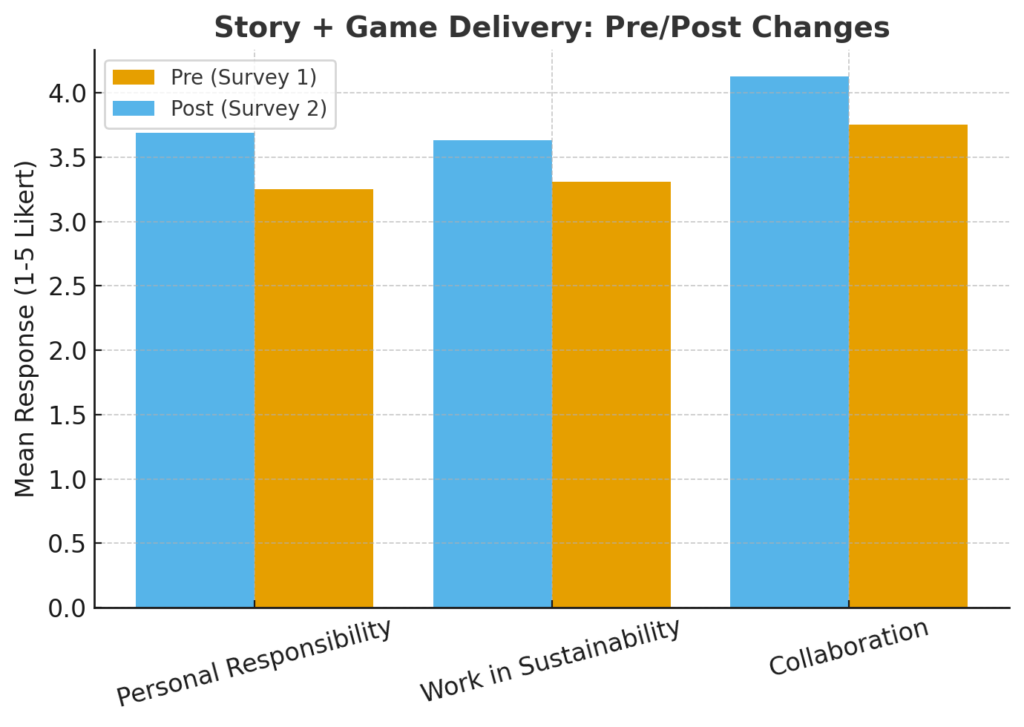
Figure 5. Story + Game Delivery: Pre/Post Changes (Stenn, 2025). This bar chart illustrates pre- and post-survey responses for students who experienced the Sustainability Lens Game with an introductory story. Significant increases are visible in personal responsibility, intent to work in sustainability, and collaboration. The results support the literature on storytelling as a values-carrier, suggesting that narratives enhance the emotional and moral framing of experiential learning, thereby strengthening responsibility and engagement.
This finding aligns with transformational leadership and moral agency frameworks, which emphasize that internalized responsibility represents a key step in translating values into sustained prosocial behavior (Creed et al., 2021; Munira, Rahman, & Akhter, 2022). Once students begin to view sustainability as part of their identity, decisions are more likely to reflect those values across contexts. The observed gains in responsibility within the story condition suggest that narratives can accelerate this identity formation process, moving learners from awareness toward action.
Within Kolb’s (1984) experiential learning cycle, the story provided the “concrete experience” that grounded subsequent reflection and abstraction during gameplay. Students who heard the story engaged the Sustainability Lens Game from an emotionally anchored perspective, resulting in measurable shifts in responsibility and directionally positive gains in intent and collaboration (Stenn, 2025). By contrast, the game-only group demonstrated smaller, more diffuse changes, indicating that while gameplay fosters cognitive engagement, it may lack the emotional framing needed for moral transformation.
Qualitative observations during gameplay also indicated that participants in the storytelling condition made more frequent references to human and community dimensions of sustainability—such as fair labor, inclusion, and access—than those in the other two conditions. This finding supports Creed et al.’s (2021) argument that stories act as “values-carriers,” transmitting humane, relational wisdom that guides ethical organizational practice. Through narrative framing, abstract sustainability challenges became personally meaningful and emotionally resonant, prompting deeper reflection and moral motivation.
Taken together, these results suggest that storytelling amplifies the transformative power of experiential learning by embedding moral values and empathy into the learning process. In the Kolb framework, the story initiates the cycle through lived experience, gameplay enables reflection and conceptualization, and debriefing (when included) facilitates transfer to real-world action. When combined, these stages create a holistic progression of feeling, thinking, and doing, effectively cultivating responsibility and commitment to sustainability leadership.
4. Education, Identity, and Experience Pathways
Cross-variable descriptive analysis revealed additional insights. Students with prior sustainability coursework were more likely to self-identify as sustainability-conscious and engage in clubs or internships. Similarly, those who already held a strong sustainability identity engaged more in volunteerism and diverse experiences (fig. 6). This triangulates with the survey’s finding that the game most significantly influenced responsibility and intent, suggesting that experiential interventions like the Sustainability Lens Game may be especially valuable in bridging the gap for students without prior formal exposure.
These findings echo research on the education–identity–action pathway, where formal learning supports identity formation, which in turn motivates sustained engagement (Bryant, Ayers, & Missimer, 2023). The game appears to accelerate this process by providing a practice ground where students can embody sustainability leadership roles, reinforcing both responsibility and intent.
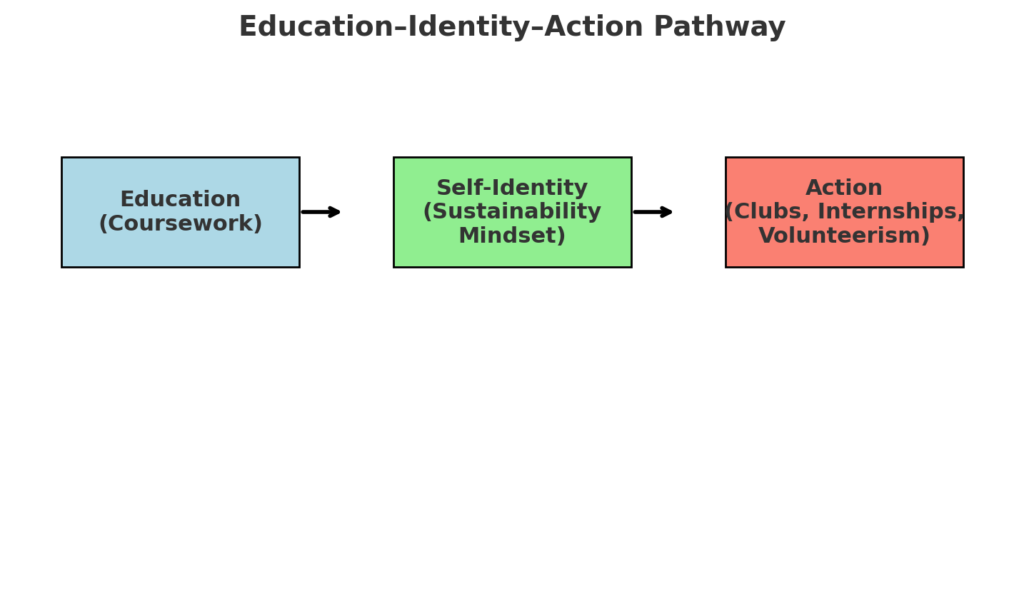
Figure 6. Education–Identity–Action Pathway (Stenn, 2025). This conceptual diagram maps the relationship between sustainability coursework, sustainability self-identity, and engagement through experiential pathways (clubs, internships, volunteerism). The analysis shows that prior education is associated with stronger self-identity, which in turn predicts higher engagement. The Sustainability Lens Game appears to accelerate this pathway by strengthening responsibility and intent, effectively bridging cognitive learning with applied action.
Implications for Theory and Practice
The findings demonstrate that experiential tools such as the Sustainability Lens Game can meaningfully shift key psychosocial orientations, particularly personal responsibility and intent, which theory identifies as foundational to sustained leadership and ethical decision-making (Creed, Ross, & Ross, 2021; Munira, Rahman, & Akhter, 2022). These constructs reflect an internalization of moral agency: once individuals perceive sustainability as part of their self-concept, their actions increasingly align with values of care, equity, and stewardship. In this sense, the game functioned not merely as a pedagogical exercise but as a transformational learning environment that initiated the identity shifts necessary for sustainable leadership (Bryant, Ayers, & Missimer, 2023).
Differences by gender and mode of delivery highlight the importance of tailoring interventions to distinct learning pathways. The storytelling condition, preceded by a narrative of lived experience, was most effective in heightening responsibility, supporting prior research that identifies storytelling as a carrier of values and moral meaning (Creed et al., 2021). Narratives appear to anchor learning in emotional and ethical frameworks, stimulating empathy and engagement before cognitive reflection begins. Conversely, repeated gameplay and collaborative interaction may deepen motivation and collective sense-making, consistent with theories of design thinking as a participatory method that builds shared understanding and vision (Di Leo & Massari, 2024).
From a pedagogical standpoint, these results reinforce the argument that sustainability education must engage both the affective and cognitive domains of learning. Students who experience sustainability through emotion-rich, game-based contexts are more likely to translate conceptual knowledge into personal conviction and applied practice. This integration of cognitive (theory, coursework) and affective (stories, reflection, collaboration) dimensions supports a holistic model of sustainability learning, where knowledge, emotion, and identity reinforce one another.
For practitioners and educators, the study underscores that transformative sustainability learning is not achieved through information alone. Rather, it emerges through structured experiences that combine empathy, reflection, and creative problem-solving, allowing students to envision themselves as capable actors within sustainable systems. These findings align with Kolb’s experiential learning framework, in which concrete experience (storytelling), reflective observation (gameplay), and active experimentation (debrief and application) form a continuous cycle of learning and doing (Kolb, 1984; Hayse, 2018).
In sum, the analysis suggests that carefully designed experiential and narrative-based pedagogies can move students beyond abstract concern toward personal commitment. Such interventions foster the psychosocial foundations, responsibility, intent, motivation, and collaboration that are critical to the development of future leaders capable of integrating sustainability into organizational strategy and practice (Stenn, 2025).
Conclusion
Taken together, the findings converge on a consistent picture: carefully designed and facilitated game-based learning, particularly when intertwined with storytelling, serves as a powerful catalyst for cognitive, emotional, and behavioral engagement in sustainability education. Across the literature and this study, several interlocking mechanisms emerge.
First, storytelling serves as a values carrier, cultivating humane connection and moral sensitivity that prepare learners for ethical reflection and responsibility (Creed, Ross, & Ross, 2021). Second, games such as the Sustainability Lens Game increase engagement by situating students in consequential, realistic scenarios that bridge theory and practice and align with experiential and design thinking frameworks (Kolb, 1984; Di Leo & Massari, 2024). Third, the tactile, collaborative, and social nature of analog gameplay strengthens conceptual learning by allowing students to manipulate ideas through shared, multisensory experiences (Rye, 2023).
The results also indicate that game-based learning can enhance creative potential and design thinking skills, even if evidence for changes in emotional creativity remains mixed (Dyson et al., 2016). Technology, when integrated thoughtfully, such as through AI assistance or augmented interfaces, further supports flow, ease of use, and collaborative learning, echoing findings by Hou and Keng (2021). In addition, gameplay fosters collective sense-making, encouraging participants to co-construct meaning and sustainability visions through iterative, participatory processes (Di Leo & Massari, 2024). Finally, structured debriefing sessions play a critical role in consolidating learning by helping students process emotion, extract key insights, and translate experiences into transferable lessons (Hayse, 2018).
In sum, this convergence of evidence underscores that experiential learning environments – anchored in story, collaboration, and reflection – are uniquely capable of developing sustainable leadership competencies. By integrating affective and cognitive dimensions, such pedagogies foster not only understanding but also the personal responsibility, motivation, and intent required for lasting change.
Acknowledgments
I gratefully acknowledge Marvelous Mutatarara, Royal Nyakabawu, and Anisa Spaho for their contributions to data analysis and statistical support. I also thank Franziska Greiner for her assistance with the gameplays and Dion Froese for his compelling and heartfelt storytelling, which enriched this research. Special appreciation goes to Dr. Jane Ross for her insightful guidance on the use of storytelling to foster empathy. Finally, this work was supported by the Sawyer Business School Summer Research Grant from Suffolk University, whose funding made this research possible.
Works Cited
Ahmed, S. (2025). Entrepreneurship and sustainable leadership practices: Examine how entrepreneurial leaders incorporate sustainability into their business models and the leadership traits facilitating this integration. Journal of Entrepreneurship and Business Venturing, 5(1). https://doi.org/10.56536/jebv.v5i1.182
Ajzen, I. (1991). The theory of planned behavior. Organizational behavior and human decision processes, 50(2), 179-211.
Avery, G. (2005). Leadership for sustainable futures: Achieving success in a competitive world. Cheltenham: Edward Elgar Publishing.
Avery, G. C., and Bergsteiner, H. (2011b). Sustainable leadership practices for enhancing business resilience and performance. Strategy & Leadership, 39, 5–15.
Ballarotto, G., Abate, R., Baiocco, R., & Velotti, P. (2024). The relationship between emotion regulation and sustainable leadership: The mediating role of social safeness. Journal of Human Behavior in the Social Environment, 35(3), 377–390. https://doi.org/10.1080/10911359.2024.2302512
Bryant, J. (2023). Transformative learning in a sustainability leadership master’s. International Journal of Sustainability in Higher Education, 24(6), 1189–1206. https://doi.org/10.1108/IJSHE-03-2022-0086
Bryant, J., Ayers, J., & Missimer, M. (2023). What transforms? – Transformative learning in a sustainability leadership master’s program. International Journal of Sustainability in Higher Education, 24(9), 231–251. https://doi.org/10.1108/IJSHE-03-2022-0086
Cesário, F. J. S., Sabino, A., Moreira, A., and Azevedo, T. (2022). Green human resources practices and person-organization fit: The moderating role of the personal environmental commitment. Emerging Science Journal, 6, 938–951.
Conway E, & Smith R. (2026). Analogue Play in the Age of AI: A Scoping Review of Non-Digital Games as Active Learning Strategies in Higher Education. Behavioral Science (Basel). 16;16(1):133
Coronado-Maldonado, I., Salazar, I., & Chiva, R. (2023). Emotional intelligence, leadership, and work teams: A systematic review. Frontiers in Psychology, 14, 10543214. https://pmc.ncbi.nlm.nih.gov/articles/PMC10543214/
Creed, A., Ross, J., & Ross, J. (2021). Storytelling for human sensitivity, compassion and connection in corporate sustainability. In S. H. Park, et al. (Eds.), The Palgrave handbook of corporate sustainability in the digital era (pp. xx–xx). Palgrave Macmillan.
Di Leo, A., & Massari, S. (2024). Fostering empathy and co-learning skills to drive companies towards sustainability 2030: Design thinking as a metabolic approach. In Experiencing and envisioning food: Designing for change (pp. 229–236). Taylor & Francis.
Dyson, S. B., Chang, Y.-L., Chen, H.-C., Hsiung, H.-Y., Tseng, C.-C., & Chang, J.-H. (2016). The effect of tabletop role-playing games on the creative potential and emotional creativity of Taiwanese college students. Thinking Skills and Creativity, 19, 88–96. https://doi.org/10.1016/j.tsc.2015.10.004
Eustachio, J., Caldana, A, & Filho, W. (2023). Sustainability leadership: Conceptual foundations and research landscape. Journal of Cleaner Production. Elsevier. V 415.
Gibb, A. (2002). In pursuit of a new enterprise and entrepreneurship paradigm for learning: creative destruction, new values, new ways of doing things and new combinations of knowledge. International Journal of Management Reviews. Vol. 4 No. 3, pp. 213-231.
Gillespie, B. (2022). Using digital storytelling and game-based learning to increase student engagement and connect theory with practice. Teaching & Learning Inquiry, 10(1). https://doi.org/10.20343/teachlearninqu.10.14
Hargreaves, A., and Fink, D. (2004). The seven principles of sustainable leadership. Educational Leadership, 61, 8–13.
Hayse, M. (2018). Tabletop games and 21st-century skill practice in the undergraduate classroom. MidAmerica Nazarene University. [Unpublished manuscript].
Heinrich, A. (2025, September 18). What is coopetition & what are its benefits? Harvard Business School Online Business Insights Blog. https://online.hbs.edu/blog/post/coopetition
Hou, H.-T., & Keng, S.-H. (2021). A dual-scaffolding framework integrating peer-scaffolding and cognitive-scaffolding for an augmented reality-based educational board game: An analysis of learners’ collective flow state and collaborative learning behavioral patterns. Journal of Educational Computing Research, 59(3), 547–573. https://doi.org/10.1177/0735633120969409
House et. al. (2004). Culture, Leadership, and Organizations. The Globe Study of 62 Societies, United Kingdom: Sage Publications.
Kolb, D. A. (1984). Experiential Learning: Experience as the Source of Learning and Development. Englewood Cliffs, NJ: Prentice Hall.
Kumar, A., and Kiran, P. (2017). Green entrepreneurship: A bibliometric study. International Journal of Applied Business and Economic Research. 15, 153–166.
Lazarte-Aguirre, A. (2024). Pathways to sustainable entrepreneurship: Analysing drivers of sustainable entrepreneurial orientation, Sustainable Technology and Entrepreneurship, 3(3).
Liao, Y. (2022). Sustainable leadership: A literature review and prospects for future research. Frontiers in Psychology, 13, 1045570. https://doi.org/10.3389/fpsyg.2022.1045570
Moizer, J., Lean, J., Smith, G. & Towler, M. (2004). Experiences of using a business strategy
simulation: lessons for promoting effective learning. International Journal of Management Education. Vol. 4 No. 1, pp. 19-28
Munira, K., Rahman, M., & Akhter, S. (2022). Impact of emotional intelligence on sustainable leadership: A PLS-based study. Business Perspective Review, 4(2), 45–58.
Osterwalder, A., & Pigneur, Y. (2010). Business model generation: A handbook for visionaries, game changers, and challengers. John Wiley & Sons.
Panoutsopoulos, H. & Sampson, D. (2014). Digital game-based learning in the context of school entrepreneurship education: proposing a framework for evaluating the effectiveness of
digital games. In Sampson, D., Ifenthaler, D., Isaías, P. & Spector, J.M. (Eds), Digital
Systems for Open Access to Formal and Informal Learning. Springer. New York, NY.
Piwowar-Sulej, K., Krzywonos, M., and Kwil, I. (2021). Environmental entrepreneurship-bibliometric and content analysis of the subject literature based on H-Core Journal of Cleaner Production, 295:126277.
Razzouk, Rim & Shute, Valerie. (2012). What Is Design Thinking and Why Is It Important? Review of Educational Research. 82. 330-348.
Rye, S. (2023). Hands-on minds: Fostering conceptual learning through tangible analogue games in higher education. Bradford Scholars.
Sai, R. D. (2024). Social enterprises in India: Progress, challenges, and opportunities. Sustainability, 16(15), 6499. https://doi.org/10.3390/su16156499
Stenn, T. (2026). The Profitable Good, a bold playbook for sustainable business growth. Vibrant Publishing.
Stenn, T. (Sept. 2025). Sustainability Lens Game study. Suffolk University, Sawyer Business School. Boston, MA.
Taylor, I., & Ball, N. (2023). The collaboration playbook: A leader’s guide to cross-sector collaboration. The Whitehall & Industry Group (WIG) & Government Outcomes Lab, University of Oxford.
The Sustainability Lens Game. (n.d.). Blog. Retrieved February 15, 2026, from https://www.sustainabilitylensgame.com/blog
Usart, M. & Romero, M. (2014). Entrepreneurship competence assessment through a game
based learning MOOC. Games and Learning Alliance Lecture Notes in Computer Science. pp. 252-264.
Wang, C.S., Li, Y.C. & Tzeng, Y.R. (2015). How to replicate the cognitive process in computer
game-based learning units. Information Technology & People. Vol. 28 No. 2, pp. 327-343.
Zanardo, S., El-Deeb, H., El Abed, E. M., & Al-Awamleh, I. (2024). Navigating the green banking landscape: A bibliometric and visualization analysis. Finance Research Letters, 65, 105514. https://doi.org/10.1016/j.frl.2024.105514
Appendix 1
The debrief group, after 30 minutes of game play, received the following questions, based on the Kolb Learning Cycle. The debriefing lasted for 15 minutes:
- (Concrete Experience) Pair up and share one decision you made during the game and why you made it.
- (Reflective Observation) As pairs, talk about what surprised you about the outcomes of your decisions—what worked out differently than expected.
- (Abstract Conceptualization) What patterns are emerging about sustainability trade-offs like cost vs long-term value, stakeholder inclusion, or innovation under constraints? How do these compare to sustainability challenges in real businesses?
- (Active Experimentation) Think of one concrete change you could propose in a business (real or hypothetical) that draws on what you learned. Maybe you’ll change how you choose suppliers or how you measure success beyond financial profit.
(Stenn, 2025)
Appendix 2 – The Survey
Appendix 3 – The Infographic Literature Review and Academic References
| Explored State | How It Supports Leadership / Action | Supporting Evidence or Gaps |
|---|---|---|
| 1. Feeling Connected (empathy / relational awareness of vulnerable populations/communities) | Empathy and perspective-taking are widely recognized as pathways into ethical consciousness and social responsibility. Feeling connected can help leaders bridge “us vs. them” divides and ground sustainability in lived human contexts (not just abstract). It can prime moral motivation and help align profit/ social/ environment tradeoffs. | Emotional intelligence research includes “empathy” as a component; those with higher EI tend to adopt more sustainable leadership practices (Munira et al., 2022). Sustainability education research notes that positive emotions like gratitude and awe in social contexts promote willingness to act (Grund et al. 2024) |
| 2. Personal Responsibility | Internalization of personal responsibility is a key lever in translating concern into intentional commitment. This aligns with “moral agency” or “prosocial motivation” constructs in leadership theory. Once a leader sees sustainability as part of their identity, decisions tend to reflect that. | Some entrepreneurial research touches on values and orientation as drivers of sustainable entrepreneurial orientation (i.e., entrepreneurs who adopt sustainability tend to hold stronger values) (Lazarte-Arguirre, 2024). But there appears to be less direct empirical research linking “personal responsibility” as a discrete emotional state to sustained leadership action. |
| 3. Intent | In the social psychology tradition (e.g., Theory of Planned Behavior), forming an intention is a critical antecedent to behavior. In sustainability domains, intention to pursue sustainable entrepreneurship is often studied as a predictor of behavior. | A recent conceptual framework connects climate awareness, values, and sustainable entrepreneurial intention as bridging awareness to action. (Zanardo et al., 2024). “Intention to found a green venture” is a key dependent variable in some entrepreneurship-sustainability studies. |
| 4. Action Intention / Behavioral Commitment | Intending to act is a stronger precursor than mere thinking. In leadership transitions, the move from intent to planning to execution is key. If one intends to work or start a sustainable business, that is a critical pivot toward system change. | Work on sustainable entrepreneurship often operationalizes behavioral intention or a reported commitment to sustainable practices. Transformational leaders in environmental leadership studies have induced pro-environmental behaviors (i.e. action) in followers via visioning and motivation (Sai (2024). |
| 5. Motivation | A key motif: sustainable action is rarely driven by external pressure alone, but by internal alignment (values, meaning). Motivation grounded in values is more enduring and resilient than compliance. Leaders who feel intrinsically motivated are more likely to persist, innovate, and sustain efforts under adversity. | An emotional intelligence → sustainable leadership study found that motivation (one EI component) had a significant positive effect on sustainable leadership outcomes. Additionally, dynamic leadership frameworks highlight that intrinsic motivation is needed to sustain change over time (Munira, Rahman & Akhter, 2022). |
| 6. Engagement (Reflective / Cognitive–emotional engagement) | Deep engagement means that sustainability is not shallow. One thinks, senses, dialogues, and experiments with new concepts. Effective leaders often have a willingness to grapple with complexity, learn iteratively, and connect with others. Engagement helps move from abstraction to grounded strategy. | In sustainability education and leadership programs, transformational learning scholars find that sustained engagement (reflection, dialogue, action) is key to want to shift meaning and behavior. (Bryant, et al, 2023) Organizational leadership literature find that engaged leaders foster higher employee engagement and initiative. |
| 7. Capacity (Self-efficacy / believing I can contribute) | Belief in one’s ability is crucial. Without confidence or perceived capacity, people often stall or drop out. Leaders who believe they can effect change are more likely to mobilize resources, take risks, and persist despite challenges. | Self-efficacy is a well-established predictor of entrepreneurial action in general. Some studies on emotional regulation and sustainable leadership emphasize that leaders who can manage their emotions feel more capable of sustaining sustainability work (e.g., leader emotion regulation correlates with sustainable leadership) (Ballarotto, et al, 2024) |
| 8. Collaboration | Sustainability is deeply relational and cross-sectoral. Working with others helps scale ideas, pool resources, provide feedback, and maintain accountability. Collaboration also helps fill capacity gaps and distribute risk. For a leader, being open to co-creation and networks is a hallmark of adaptive, resilient leadership. | In the sustainable leadership literature, collaborative engagement is often cited as a key trait: entrepreneurs tend to mobilize stakeholder networks, partnerships, and co-creation processes – leveraging collaboration to innovate. (Liao, 2022, Doornich et al, 2025) |
Table 1. Explored States of Sustainability Leadership, Their Role in Action, and Supporting Evidence (Stenn, 2025).

Tamara Stenn
Assistant Professor
Suffolk University, Sawyer Business School
I’m an Associate Professor of Entrepreneurship at Suffolk University’s Sawyer Business School in Boston. As an author, I focus on sustainable business, change, and development economics. In my book Social Entrepreneurship as Sustainability, I introduce the “”Sustainability Lens,”” a framework for building sustainable businesses. Another book, The Cultural and Political Intersection of Fair Trade and Justice, dives into Fair Trade practices and how economics and justice intersect. Outside the classroom I’ve launched initiatives like the Sustainability Lens Game, a creative tool that helps organizations build resilience and spark innovation, Inti Wasi an artsy surf resort in Nicaragua, and A Perfect Seed, Inc., a farmer-run cooperative that supports Royal Quinoa growers in Bolivia – inspired by Fulbright research (2015–2018) on the well-being of indigenous women quinoa producers. Earlier in my career, I founded KUSIKUY, a fashion brand that supported sustainable livelihoods for Bolivian women through alpaca knitwear production.
https://www.linkedin.com/in/tamarastenn/ https://www.sustainabilitylensgame.com/